
CHE Policy Forum 2026: Behind the NICE curtain
Posted on Wednesday 16 September 2026
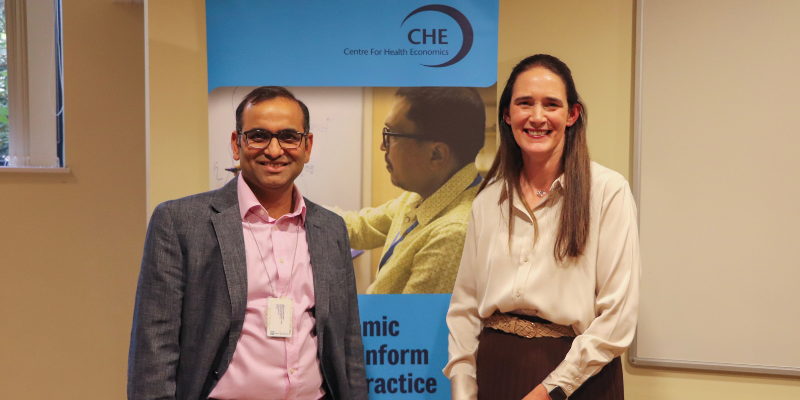
The Centre for Health Economics (CHE) at the University of York hosted a Policy Forum on 10 September 2026, examining the evolving role of External Assessment Groups (EAGs) in shaping the evidence, scrutiny and transparency underpinning NICE decisions.
The event featured a presentation by Professor Claire Rothery from CHE and was chaired by Professor Mark Sculpher, Head of Department. Raju Reddy FRCA MBA, Consultant Paediatric Anaesthetist at Birmingham Children’s Hospital, led the discussion.
The evolving role of External Assessment Groups
Professor Rothery outlined the critical contribution EAGs make to NICE’s technology appraisal process through independent evidence scrutiny, methodological innovation and transparent decision-making.
Established to support the efficient use of NHS resources, NICE works with independent academic groups, including the York Technology Assessment Group, to critically assess evidence submissions and economic models provided by companies.
The role of EAGs has evolved considerably. Their remit has expanded from developing de novo economic models for Multiple Technology Appraisals to conducting reviews for increasingly complex Single Technology Appraisals. This requires EAGs to balance rapid and proportionate assessment with detailed methodological critique.
EAG analyses can have a substantial influence on NICE committee deliberations. An estimated 70% of the incremental cost-effectiveness ratios (ICERs) considered by NICE committees align more closely with EAG-preferred assumptions than with the estimates originally submitted by companies.
The presentation also considered continuing challenges and debates, including the UK cost-effectiveness threshold, severity modifiers and alternative approaches to managing uncertainty. Emerging developments, including generative artificial intelligence and a whole-lifecycle approach to guidance development, were also explored.
Understanding and communicating uncertainty
A central theme was that NICE decision-making involves much more than reviewing clinical evidence. Committees must understand uncertainty, opportunity costs and consequences for different patient populations while balancing competing priorities around access, affordability and innovation.
The discussion raised an important question: does NICE have the appropriate frameworks for deciding when uncertainty is acceptable?
EAGs increasingly shape committees’ understanding by characterising uncertainty, examining how much confidence can be placed in the available evidence, and identifying the implications of alternative assumptions. As the challenges facing health technology assessment expand, the importance of independent academic scrutiny is likely to grow.
A robust challenge for sustainable healthcare
In his response, Raju Reddy emphasised the essential role of EAGs and health economics in challenging assumptions and helping to ensure that healthcare systems remain financially sustainable.
He argued that universal healthcare that is not dependent on individual income would be difficult to sustain without health technology assessment bodies such as NICE. He also encouraged EAGs and health economists to continue pushing methodological boundaries and demonstrating the value of health interventions.
Reflecting on the difficult choices involved in allocating finite healthcare resources, he suggested that the public may sometimes be prepared to go further in making tough decisions than clinicians and health economists assume.
The event concluded with questions and discussion involving members of the audience.
A recording of the Policy Forum will soon be available on CHE's YouTube channel. The presentation slides used during the session are also available to view online.
Sign up for our mailing list to hear about future CHE events.