
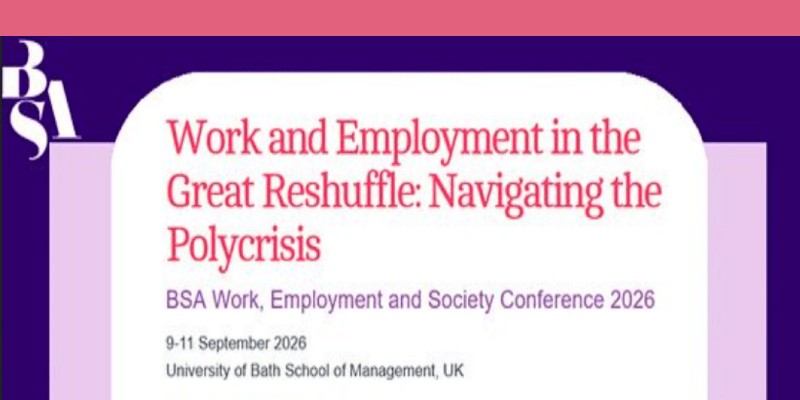
Work, Society and Employment Conference
This event has now finished.
Event details
Work pacakge 2 project member Levana Magnus will be presenting their work titled: Support2Work: Emerging qualitative evidence on the impact of Employment Advisers in NHS Talking Therapies
Abstract
In the UK, concerns about economic inactivity fuelled by mental health challenges have seen the Labour government set out plans to both ‘Keep Britain Working’ (retention) and ‘Get Britain Working’ (entry). Integrated services and partnership working sit at the centre of these proposals, which have been a growing feature of OECD countries in recent years (Arends et al. 2014). The evidence base on integrated services suggests positive employment and wellbeing outcomes. However, further research on the mechanisms of service delivery and the experiences of staff and service users is needed to
explore how services work, what works well, for whom, and why.
Building on pilots in 2009 and 2018, over the past 8 years the UK government has invested in the roll out of employment advice embedded in NHS Talking Therapies services, with every area in England now benefitting from this provision (Loveless 2019). Employment Advisers in Talking Therapies work collaboratively with psychological therapists to support patients to remain in, return to, or regain employment.
This paper will present early qualitative findings from a 3-year mixed-methods evaluation of the impact of Employment Advisers (EAs) in NHS Talking Therapies. Funded by NIHR, the Support2Work project is the first major independent evaluation of the EAs service. In-depth interviews are taking place
throughout 2026, with service users, Employment Advisers, and therapists across 12 sites in England. Our qualitative inquiry is uncovering the mechanisms through which Employment Advisers influence service users’ trajectories of absenteeism, presenteeism, and entry/maintaining/return to work. Emerging themes highlight the importance of integrated and collaborative practices, and demonstrate the challenges of tailoring support to meet the needs of service users. As well as making a direct empirical contribution to policy evidence, our findings contribute to wider sociological debates on the role of work in mental wellbeing and vice versa (World Health Organization, 2022), workplace relationships in the context of mental ill health (Kelloway et al., 2023), and the lived experiences of frontline workers who span practical and emotional support for vulnerable individuals (Bakkeli, 2022; Irvine et al. 2024).