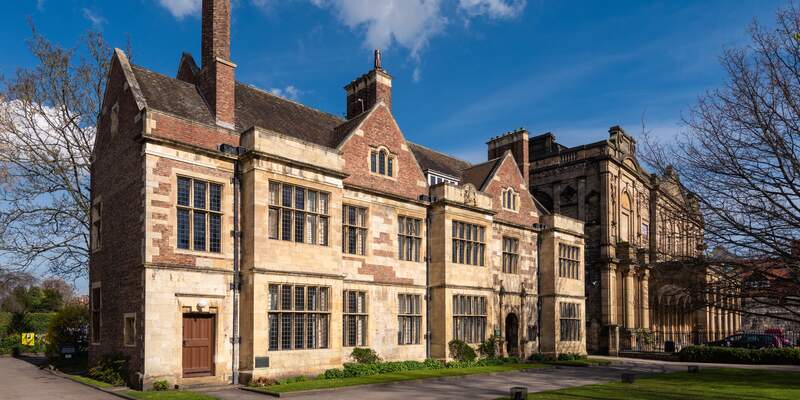
We are moving out from King’s Manor and working to conserve and protect this beautiful, historic space.
Project overview
In June 2024, we confirmed plans to move out of our much-loved King’s Manor in the centre of York. We will bring Archaeology, Centre for Medieval Studies and Centre for Eighteenth Century Studies to our main University campus.
Where
We have explored different options on Campus West - in particular, Berrick Saul and Heslington Hall - to understand how we best manage space for all the different requirements for Arts and Humanities.
This included how we support teaching space, labs, academic workspace, community events, a strong research environment, professional services and provide a welcoming and inspiring place for staff, students and visitors.
In November 2024, we released further details of the relocation plans with impacted staff and students.
A new home
We understand how sad it is to move from King’s Manor and we recognise there are concerns about how we best share space on campus.
We have taken time to listen and talk to staff, PGRs and students about how we can draw out the benefits of co-location and evolve our exceptionally strong interdisciplinary home for Arts and Humanities on campus.
The Library at King's Manor will also be affected by this change, with a planned move by September 2025. Whilst the Library will be moving out of King’s Manor, the space will be utilised as additional study space, which will remain available for the remainder of our time at King’s Manor as residents relocate in the agreed phases.
When
There are a number of complex inter-connected changes.
High level timescales
By September 2025: Our Humanities Research Centre, Centre for Eighteenth Century Studies, Centre for Medieval Studies, Centre for Renaissance and Early Modern Studies will move into Heslington Hall - to create a new hub for arts and humanities.
By September 2025: The Library at King’s Manor will be moved, creating additional study space in King’s Manor.
Over Summer 2026: Archaeology will move to the Berrick Saul Building, which was judged to be the best place for its large teaching commitments and laboratory space.
We are grateful to Professional Services colleagues who will be moving out of Heslington Hall in 2025 into PS Hubs being set up in Market Square and Innovation Close.
Specific dates and comprehensive move details will be shared as the project progresses with those directly impacted by the changes.
Why
It has become increasingly clear that substantial running costs, conservation costs and accessibility concerns makes it very difficult for us to continue using King’s Manor in the way that we have in the past. It is a space that does not meet the future needs of our entire community and we must address these challenges responsibly.
This is also part of a wider plan for our campus, as we look to share our quality buildings more with each other, whilst also repurposing unsuitable ones. This move opens up exciting new opportunities, including philanthropic bids to invest in facilities on campus, such as the new Wolfson Digital Archaeology and Heritage Laboratory. This world-leading facility, which integrates archaeology and heritage with digital technologies, will be located in the Berrick Saul Building. This building provides the necessary infrastructure and space that King’s Manor could not accommodate.
Costs associated with King’s Manor
We know staff and students have asked for more information about the costs to run King’s Manor, which have underpinned the University’s decisions to move teaching and activity out of the building.
The costs below are from 2022/23, with updated figures available soon.
c.£500,000 annual running costs for King’s Manor (excluding provision of library services)
More than £1 million backlog of the most urgent maintenance, based on a Purcell Condition Survey Report from 2022. This cost does not include upgrades to take account of legislation re: energy efficiency, improvements to accessibility and modernisation, e.g. WCs.
At least £15 million longer term costs. This is bare minimum to keep the building watertight, so fuller conservation costs will be much more.
Estates also notes that the net usable space of King’s Manor is 36%, compared to over 80% for our on-campus spaces of Church Lane Building and Berrick Saul.
What next for King’s Manor
In June 2025, we were able to share the news that York St. John’s (YSJ) will be taking over the lease, which will ensure King’s Manor will continue to serve as a valuable home for education, teaching and learning.
As we hand over the reins, we are working closely with our City partners about how we best conserve the building and surrounding precinct, ensuring our well-connected academics remain part of this important conversation. We are confident that YSJ shares this commitment, all while bringing new energy and vision to its future.
We understand that King’s Manor is really significant to our local and national heritage. The transition to York St. John will add to its rich and diverse history - firstly, as the residence of the Abbots of St. Mary’s Abbey, then as the meeting place of the King’s Council in the North, as the original Manor school, the Wilberforce School for the Blind, and recently as a home for Archaeology, Medieval Studies and Eighteenth Century Studies at the University of York.
How we are managing the move
During the Summer of 2024, we set up a Project Board with representatives from key groups across the Faculty. We have collectively explored the opportunities and challenges of the different space requirements, as well as building on our vision for Arts and Humanities in the future. The Board has been reviewing architects' plans, taking part in a series of tours and we’ve had detailed discussions with representatives on how best we configure and shape new homes for our community.
Who represents you at the project board
Core Arts and Humanities Faculty project team
Professor Duncan Petrie (Project Sponsor), Dean of the Faculty of Arts and Humanities
Sarah Finch, Head of Faculty Operations (HFO), History, History of Art, Archaeology and Centre for Medieval Studies
Jane Harrison, PA to the Dean of the Faculty of Arts and Humanities
Becky Johnson (Project Manager), Strategic Project Manager
Ros Roberts, Director of Faculty Operations, Faculty of Arts and Humanities
Departmental representation
Professor Jennie Batchelor, Department of English and Related Literature
Dr Jessica Bates, Department of Archaeology
Professor Oleg Benesch, Department of History
Professor Rachel Cowgill, Director, Humanities Research Centre
Professor Kenneth Clarke, Director, the Centre for Medieval Studies
Richard Hagan, Senior Technical Team Manager, Department of Archaeology
Dr Richard Johns, Department of History of Art
Dr Nicola McDonald, Department of English and Related Literature
Professor Nicky Milner, Head of Department, Department of Archaeology
Megan Russell, Support Officer, Humanities Research Centre
Dr Jim Watt, Director, Centre for Eighteenth Century Studies
Professor Chloe Wigston Smith, Incoming Director, Centre for Eighteenth Century Studies
Student representation
Sam Elphick, Centre for Medieval Studies
Rachel Feldberg, Centre for Eighteenth Century Studies
Constance Halstead, Centre for Eighteenth Century Studies
Maisie James, undergraduate and postgraduate-taught student rep, Department of Archaeology
Francis Mahon, postgraduate research student rep, Department of Archaeology
Gabby Morgan, Student Voice and Insight Manager, University of York Students’ Union
Megan Woodward, postgraduate student rep, Humanities Research Centre
Directorates: IT Services, Estates, Facilities Management and Campus Services
Robin Beattie, Assistant Director: Capital Development
Sarah Frankland, Strategic Programme and Projects Manager, Estates
Richard Fuller, Assistant Director of IT: Technology and Cyber
Tom Moorcroft, Project Manager, Capital Development