
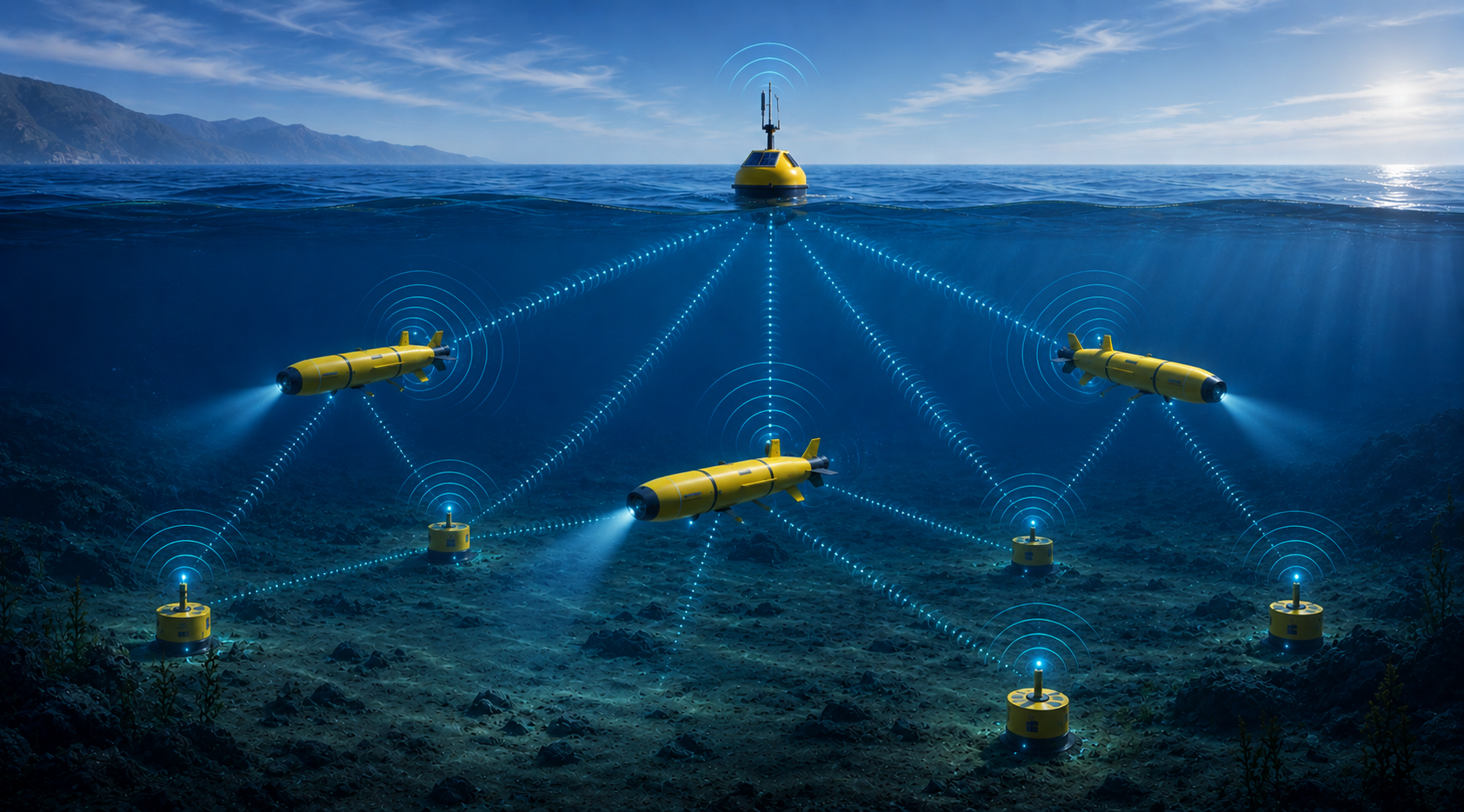
Underwater Acoustic Communication and Networking
Course booking
Programme schedule
The exact programme is yet to be finalised. The outline of the sessions and topics covered is below:
Day 1
- Applications and challenges of underwater acoustic communication and networks (UACN)
- Overview of the state-of-the-art in UACN for data telemetry and positioning
- The underwater acoustic environment
- UACN live demo
- How underwater communication systems are developed and tested in trials at York
A social dinner will take place on the evening of Day 1. This is a good chance to network with others on the course and see some of the city of York. The dinner is optional to attend. Your course booking fee covers the cost of your meal.
Day 2
- Underwater acoustic channel modelling and simulation
- Signal processing and underwater acoustic modem design
- Underwater acoustic signal processing lab
Day 3
- Underwater acoustic network protocols: overview of the protocol stack
- Medium access control and routing in underwater networks
- Node discovery and positioning in underwater acoustic networks
- Underwater network live demo
- Underwater acoustic networking lab
Objectives
By the end of Day 1 of the course, the participants will:
- Understand the key applications of underwater acoustic communication and networking (UACN) and the operational challenges associated with underwater environments
- Have knowledge of the current state-of-the-art in UACN for data telemetry and positioning in subsea technologies.
- Understand the physical characteristics of the underwater acoustic environment and their impact on communication system performance.
- Understand the processes used to develop, test, and validate underwater communication systems through laboratory and field trials.
By the end of Day 3 of the course, the participants will be able to:
- Understand the key signal processing techniques used in underwater acoustic communication, including, modulation, packet detection, synchronisation, demodulation and decoding.
- Understand the design considerations and functional components of underwater acoustic modems.
- Use underwater acoustic channel modelling tools, and real recorded signals, for the evaluation and testing of acoustic modems and signal processing techniques
- Produce prototype implementations and test underwater acoustic modems, based on the example provided in the lab session on Day 2
- Explain the structure and operation of the underwater network protocol stack and the interactions between protocol layers
- Explain how medium access control, routing, node discovery and positioning protocols work in underwater networks
- Produce prototype implementations and test network protocols on real-time underwater hardware, based on the example provided in the lab on Day 3.
Course facilitators
| Name | Bio |
|---|---|
|
Dr Nils Morozs (MEng, PhD, MIEEE, FHEA)
|
Dr Nils Morozs is a Senior Research Fellow in the School of Physics, Engineering and Technology and the Institute for Safe Autonomy at the University of York. He has 13+ years research experience in wireless and underwater communication, including the development, hardware implementation and sea trials of multiple underwater acoustic systems. He received the M.Eng. and Ph.D. degrees in electronic engineering from the University of York, in 2012 and 2015, respectively. In his PhD research he developed AI-based protocols for 4G/5G wireless networks. Afterwards, he worked as a Researcher in Wi-Fi & wireless convergence at BT. He rejoined the University of York as a Research Associate in 2016, became Research Fellow in Sep 2020, and Senior Research Fellow from Sep 2026. His current work is in the field of underwater communication and sensing technologies. Since 2017, he wrote and co-authored 17 journal articles and 15 conference papers in this field, and received a best paper award at ACM WUWNet 2024. In addition to his academic research, he has led and participated in multiple industry projects in the aquaculture and defence sectors, and is chairing a work package on acoustic waveform evaluation and modelling in the NATO IST-216 Research Task Group. |
|
Prof Paul Daniel Mitchell (MEng, PhD, PGCAP, SMIEEE, MIET, FHEA)
|
Prof Paul Daniel Mitchell is a Professor in the School of Physics, Engineering and Technology and the Institute for Safe Autonomy at the University of York. He is head of the Communication Technologies and Underwater Information Systems Research Groups with over 26 years research experience in wireless and underwater acoustic communication systems, specialising in networking. He has been a member of academic staff at the University of York since 2005, and a full Professor since 2020, with industrial experience from BT and DERA Malvern. He is author of more than 170 refereed journal and conference papers and has experience developing and managing large collaborative research projects. Undergraduate and postgraduate teaching experience over the past 20+ years includes Continuing Professional Development provision nationally and overseas. Prof Mitchell has supervised 122 undergraduate project students (65 as lead supervisor) and 120 postgraduate project students (43 as lead supervisor). Teaching related leadership experience includes chairing the Board of Studies and Staff Student Liaison Committees, as well as serving as the undergraduate Communications Stream Leader, MSc in Communications Engineering Programme Leader, Department Feedback Coordinator and MSc Project Coordinator. External examining experience includes 22 PhD/DSc/MRes candidates, serving as an undergraduate examiner for the University of Edinburgh and postgraduate examiner at the University of Leeds, University of Surrey, University of Bradford and Nottingham Trent University. |
|
Dr Yuriy Zakharov (MSc, PhD, SMIEEE)
|
Dr Yuriy Zakharov received the M.Sc. and Ph.D. degrees in Electrical Engineering from the Moscow Power Engineering Institute, Moscow, Russia, in 1977 and 1983, respectively. From 1977 to 1983, he was with the Special Design Agency, Moscow Power Engineering Institute. From 1983 to 1999, he was with the N. N. Andreev Acoustics Institute, Moscow. From 1994 to 1999, he was with Nortel as a DSP Group Leader. Since 1999, he has been with the Communications Research Group, University of York, U.K., where he is currently a Reader with the School of Physics, Engineering and Technology. His research interests include signal processing, communications, and underwater acoustics. |
|
Dr Lu Shen (BSc, MSc, PhD, MIEEE)
|
Dr Lu Shen received her PhD degree in Electronic Engineering from the University of York in 2021, where her doctoral research was recognised with the KM Stott Memorial Prize for Excellence in Research. She is currently a Research Fellow in the School of Physics, Engineering and Technology at the University of York. Her research spans underwater acoustic communication, adaptive signal processing, and integrated sensing and communication systems. She is the co-author of over 30 peer-reviewed publications and the recipient of the 2025 Prof. John Papadakis Award for Best Paper Presented by a Young Acoustician. In March 2026, she delivered a six-part guest lecture series on underwater acoustic communication at the Gdańsk University of Technology, open to members of the IEEE Computer Society Gdańsk Chapter and the Polish Acoustical Society. |
|
Dr Benjamin Henson (MEng, MSc, PhD)
|
Dr Benjamin Henson received his M.Eng. degree in Electronic Engineering in 2001 from University of York, U.K.. From 2002 to 2008, he worked as an engineer for Snell & Wilcox Ltd. designing broadcast equipment. From 2008 to 2009, he worked for SRD Ltd. on imaging sonar designs. He received an M.Sc degree in Natural Computation in 2011 from University of York, U.K.. Then, from 2011 to 2013, he worked on laser measurement equipment for Renishaw plc. He received his PhD. degree in Electronic Engineering in 2018 from the Communication Technologies Research Group, University of York U.K., where he continues to work, now as a Research Fellow in the School of Physics, Engineering and Technology. His interests include signal and image processing, and underwater acoustics. |
-235x234.jpg)
-235x235.jpg)
-235x235.jpg)
-235x235.jpg)
-235x235.jpg)
Fees
Fees
| 2026 | 3 day course | 1 day course |
|---|---|---|
| Standard Price | £2500 | £1250 |
| Academic Standard Price | £2000 | -------- |
| Group discount (if booking 4 or more people) | Please contact pes@york.ac.uk | Please contact pes@york.ac.uk |
VAT is not payable. Registration fees are fully inclusive of:
- Tuition
- Lunch
- Course Dinner
- Course materials
Registration is done online by Credit/Debit Card for instant payment and a guaranteed secured place on the course (please note the University of York does not accept American Express cards).
Accommodation
Delegates are responsible for booking their own accommodation and arranging payment directly with the hotel of their choice.
A list of some hotel options in the city will be circulated to all delegates.
For further information about York, please visit the 'Visit York' website.