
"A true collaborative partnership..."
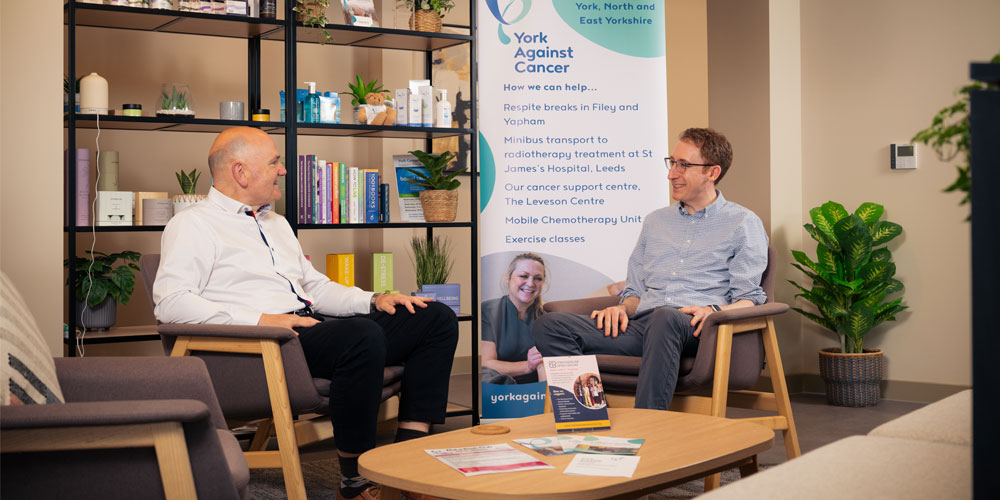
In summer of 2026, York Against Cancer Chief Executive Andy Knowles met with the Jack Birch Unit’s Director, Professor Will Brackenbury, to talk about the unique advantages of their enduring relationship.
In 1987 Professor Steve Leveson, a senior lecturer and consultant surgeon at St James’ Hospital in Leeds, was determined to improve the lives of those living with cancer, and along with fellow surgeon John Craven and Dr Colin Garner, founded York Against Cancer.
Within a year the charity had a patron, Dame Judi Dench, and in 1988 it embarked on its first research project.
A shift in emphasis
Five years after the charity was founded, the Jack Birch Unit was established at the University of York with funding from YAC. Colin Garner, by now a Professor, took up the Unit’s first directorship, with a focus on molecular epidemiology. Soon afterwards Professor Jenny Southgate took over as director, a post she held until her retirement in 2025, and the Unit shifted its emphasis to molecular carcinogenesis, where it remains.
And today, 34 years later, the relationship between the cancer research unit and the cancer-fighting charity continues to flourish.
The charity’s current CEO Andy Knowles joined earlier this year, while JBU director Professor Will Brackenbury, took over in 2025, following Jenny’s retirement. They met to talk about the past, present and future of a partnership which has enabled vital, long-term globally impactive cancer research to take place in the heart of the white rose county.
Both Andy and Will began by describing what it is about the partnership that was most important to each organisation
Andy says: “To me it’s the phrase ‘partnership with the JBU’, it’s not a transactional relationship and it’s not simply a case of York Against Cancer handing funds over then hoping for the best. It’s a true collaborative partnership, and collaboration is one of my favorite ways of working; when you do it properly, it’s powerful, we have an opportunity for our partnership to do just this”
A collaboration to inspire confidence
He adds that to have senior researchers so willing to meet with business leaders, other funders, and supporters from across the region has a strong galvanising effect on his charity’s ability to raise money.
“They can see that the money they’re donating, or fundraising, is going straight to world-class scientific research and it’s happening right here on their doorstep.
“For me to be able to tell them their money will be invested in the Jack Birch Unit, within one of our fantastic local universities, is a very powerful thing; people understand it and feel confident about donating their money because of that.
“Recently, myself and a guest from one of YAC’s business partners spent a full day in the JBU labs, as part of one of several schoolteaching sessions. We were able to experience first hand some of the experiments carried out as part of their research.”
Will says that for him and his team, that close working relationship gives their work an extra dimension. “I think one of the really nice things about this partnership is that over a long time the researchers here have become very aware of the significant support that comes from the charity, and they want to support it and give something back.
“For us as researchers, that means our work isn’t just about looking at cells in a microscope, but it’s also about supporting the charity’s networking and fundraising efforts.”
A partnership rooted in Yorkshire
Andy believes that York Against Cancer’s Yorkshire roots play a crucial part in the charity’s success, enabling it to maintain an agile low-cost, high-impact presence in the region, and having the Jack Birch Unit, gives him an ace in the hand when talking to local people about support for the charity. He says they’re often surprised to hear that YAC has committed to £1.5m funding over the next five years.
Both Will and Andy agree that the general public would be surprised to discover the sort of scientific research going on at the JBU.
“I think a lot of people would think this sort of work happens in America and China,” says Andy. “They’d be amazed to find such wonderful research work happening in the UK - let alone here in York.”
Will sees this as a potential opportunity though, and one where the YAC-JBU partnership comes into its own.
“That’s one of the really exciting things about working with the charity. It can make the case to the local population and make people aware of the work we’re doing here,” says Will.
“They can also help with educating the next generation about cancer, from what it is, to what we’re doing to address it and how you can protect yourself against it, that's something we take really seriously.”
Reaching out to the next generation
Will’s colleague, Dr Simon Baker, is part-funded by York Against Cancer and he organises a programme of outreach events to educate schoolchildren about the research that goes on at the JBU, while several York Against Cancer-funded students have completed their PhDs at the JBU.
“So again, that’s another example of how York Against Cancer is funding the next generation of cancer researchers,” says Will.
And both Andy and Will now have their sights set on the partnership’s future, and have ideas about how the relationship should develop over the next 30 years. Andy says: “For me the partnership embodies our purpose. We often talk about ‘changing lives’ and supporting people affected by cancer, but a cancer diagnosis has a ripple effect that travels much further than the person with the diagnosis, this is an area where creating wider awareness of our research partnership can provide hope for the future.
“We can affect the life of the person with the diagnosis, through complementary therapies, peer support, and wellbeing” says Andy. “But we can also improve the lives of people around them; their friends, their families, I am not sure that aspect is well known enough yet, and I’m excited to get that message out there.”
And Will says that for his team and the work they do, the longevity of the partnership is vital.
“At the Jack Birch Unit, we’re very proud of the long-serving support of the charity and we’re always looking to give something back in return, and the best way to acknowledge that is by delivering tangible benefits to patients.
“Obviously, getting new treatments to the clinic takes time, but along the way, it’s our job to deliver excellent research and publish it as we go. Those are tangible milestones on the route to achieving that goal.”