
New excavations shed light on early farmers in Saudi Arabia
Posted on Tuesday 24 March 2026
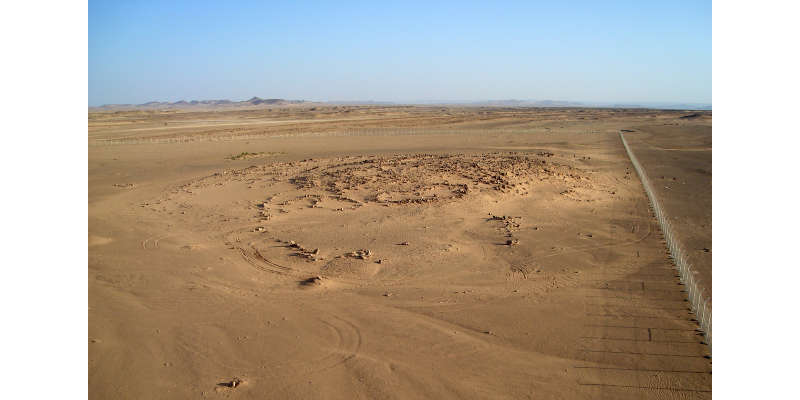
Al Uyaynah has long been known from surface remains of stone-built structures, but Khalid was the first to excavate the site, in 2012, for his Saudi MA. A more detailed excavation in 2016 of one of the largest rectangular structures is the subject of his PhD in York under the supervision of Profs Geoff Bailey and Penny Bickle.
The results have recently been published in the journal Arabian Archaeology and Epigraphy. A NEIF radiocarbon grant awarded to Penny and Khalid, modelled with the aid of Prof. Derek Hamilton (SUERC, University of Glasgow), demonstrates a relatively short duration between 7190 and 6900 cal BC (late PPNB).
Other York people involved are Dr Delphine Joly, who identified the charcoal remains, Dr Stephanie Piper (now at the British Museum) who analysed the lithics, and former MSc zooarchaeology student Kirsten Grothe, who examined the faunal remains, finding evidence for the presence of domestic goats, along with small amounts of cattle, hare and gazelle.
An unusual feature is the large number (> 200) of small (2–5 cm) roughly formed clay objects at the base of the sequence, many with what appear to be deliberately made grooves, holes, or inserts of flint artefacts or charcoal, indicating a decorative or symbolic function. They have no clear parallel with unfired clay objects elsewhere, which in any case are unusual in PPNB contexts before the widespread introduction of pottery.
Overall, the site shows similarities with the late PPNB sites in the southern Levant but with some distinctive features and provides new information about the spread of agriculture into arid regions during a short-lived interval of wetter climate.
Here you can read the open access paper.