
(Super)naturecultures symposium at University College Dublin
Posted on Wednesday 25 March 2026
.jpg)
The symposium brought together folklorists and ethnologists from across the North Atlantic region to explore vernacular conceptions of the natural world and humans’ relationship to it as expressed in folk tradition. Critique of the ontological nature/culture divide has been a cornerstone of much ecocritical scholarship in recent years; folkloristics as a discipline is particularly well-placed to appreciate the relevance of an additional dimension to this critical approach: that of the supernatural.
Dr Màiri McFadyen and Raghnaid Sandilands discussed the Gaelic fairy belief complex in Scotland, which they proposed functions as a ‘moral ecological ontology’ encoding an ethic of care which guides traditional communities’ engagement with the natural world. Dr. Kyrre Kverndokk also discussed the ecological ethics of the fairy faith complex but with a special focus on Norway and the relation of fairy belief to the practice of transhumance. He gave an invigorating critique of varying conceptions of nature across time, carefully distinguishing between emic and etic conceptions of nature as evidenced in literature and folk tradition. Dr. Tiber Falzett of University College Dublin explored comharthaí or ‘signs’ in vernacular tradition, where the behaviour of birds and other creatures or natural phenomena are interpreted by humans to foretell future events, thus offering an insightful interrogation into super/natural/cultural entanglements.
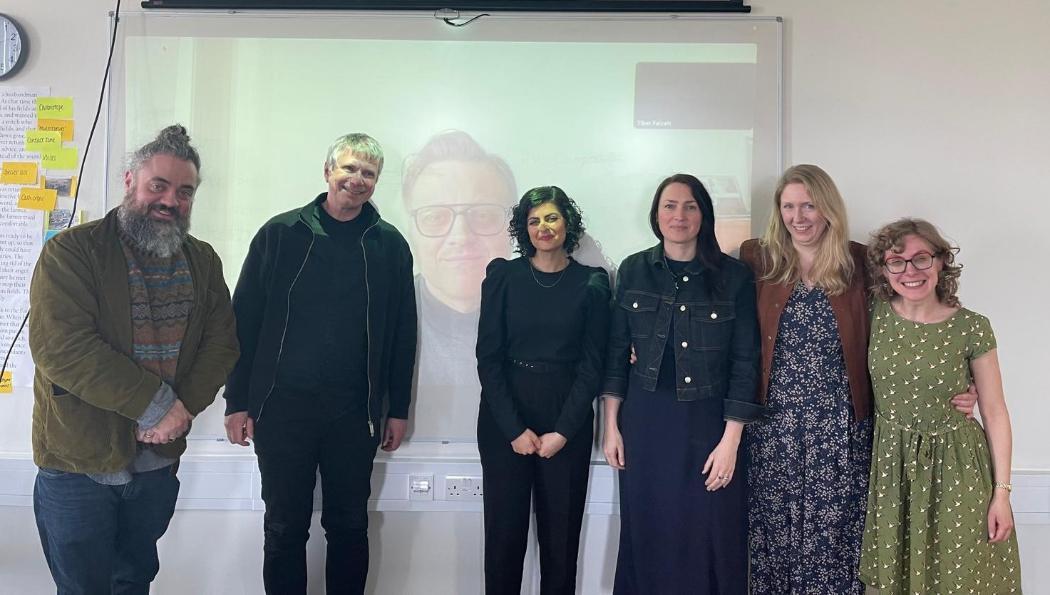 Speakers at the Symposium (from left to right): Dr. Tiber Falzett, Professor Kyrre Kverndokk, Dr Kristinn Schram (online), Dr Tina Paphitis, Raghnaid Sandilands, Dr Màiri McFadyen and Tracey Hayes.
Dr. Tina Paphitis of the University of Bergen outlined her innovative methodological approach to investigating (super)naturecultures in folk tradition which draws on a combination of ecocriticism, phenomenology and ostension, and she treated the audience to a live demonstration of her methodology in practice. Dr. Kristinn Schram from the University of Iceland discussed folk traditions of the ‘right whale’, giving consideration to their personhood, materiality and the afterlife of their remains, and more-than-human entanglements. PhD student Tracey Hayes concluded the presentations for the day with a discussion of her research into the folklore of eagles as represented in Ireland’s National Folklore Collection. She presented an analysis of multispecies’ relations as evidenced in selected extracts from the collection.
The symposium offered an invigorating mixture of theoretical and methodological approaches to investigating (super)naturecultures in folk tradition. From the fruitful discussion which emerged it became evident that etic concepts of ‘disenchantment’ and the ontological division of nature/culture and the natural/supernatural are challenged by vernacular tradition where such worldviews are not necessarily evidenced. Many of the speakers pointed to the ecological ethic evidenced within the fairy faith tradition, where human/nature affairs are understood in a relational sense as opposed to one of isolation.
The (Super)naturecultures symposium was a timely gathering of folklorists and ethnologists to share findings on research into multispecies’ relations, more-than-human entanglements, and posthumanist approaches to folklore. The discussion demonstrated the importance of investigating vernacular conceptions of nature as expressed in folk tradition, which can often challenge certain theoretical assumptions. It also became apparent that any understanding of the ‘supernatural’ (as defined in opposition to the ‘natural’) is relative, and that in various aspects of folk tradition the supernatural is an accepted part of the natural word.