
Three months in the Rainforest - in Devon?!
Posted on Tuesday 10 March 2026
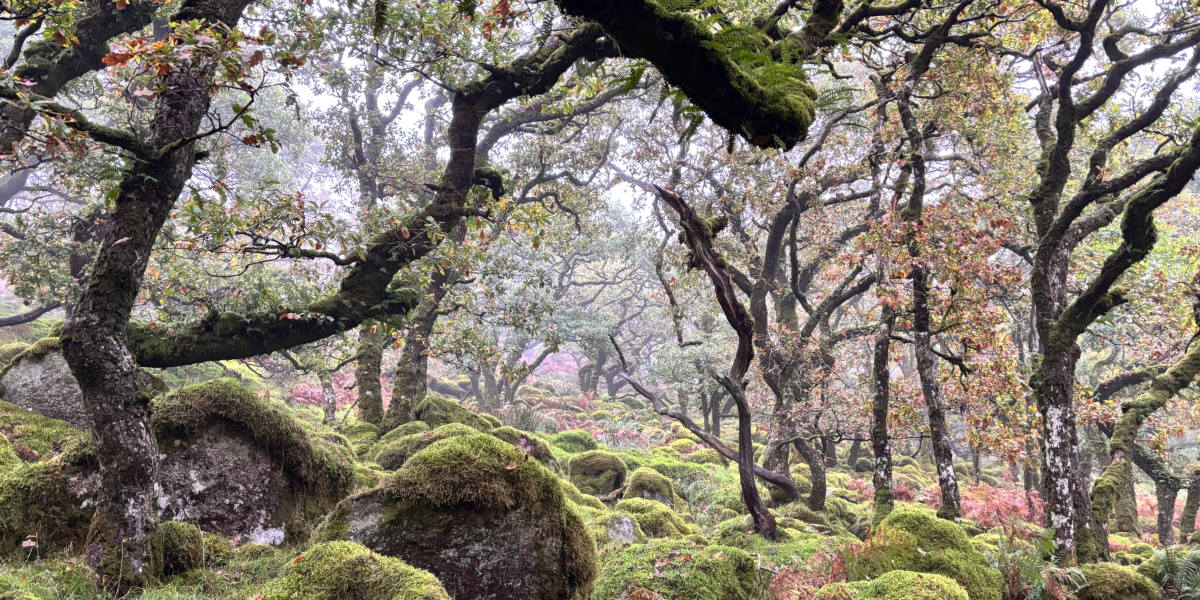
Really it should come as no surprise that our rainy, mild island surrounded by water supports these wonderfully diverse habitats, but often when people find this out for the first time they are awestruck, I certainly was. Having grown up sandwiched between the Atlantic Woodlands around Hartland and the National Parks of Exmoor and Dartmoor, I knew these landscapes well, but with “rainforest goggles” I now see them in a whole new light. When you really look, one thing you notice about these woodlands is how green they are. Not just the leaves in the canopy like other woodlands, but everything is green. The ground is green, the boulders are green, the trunks of trees are even green and what's more, this green is all year-round. After delving a little deeper I began to understand what this green is made from, a rich tapestry of lichens, mosses, liverwort and vascular plants, growing on every available surface. Perhaps echoing the legends and folklore that spring from these wild woods, many of these species here have fantastical names. Scaleworts, Fairy Beads and Green Dragonskin coat the trees, whilst Old Man’s Beards, Elf Ears and Scripts and Scribbles cling to twigs whilst Cudbears creep across rocks and up trunks - these habitats are filled with amazing species found in few other places on Earth. It is because of these rare species that these woodlands have become so prized. Since the publication of Guy Shrubsole's “The Lost Rainforests of Britain” (1), media attention surrounding temperate rainforests has exploded and the scientific and conservation community have jointly recognised that protecting and restoring these habitats is essential.
The UK’s rainforests have suffered heavily in the past. Millenia of land clearance and logging has reduced their cover dramatically, leaving small pockets in a fragmented landscape. Air pollution beginning during the industrial revolution, further affected lichen and bryophyte populations by eliminating pollution sensitive species across much of middle and southern England. This has left our rainforests in a generally poor condition and many of our rarest rainforest species vulnerable(2). Although efforts are being made to expand rainforests there is concern that in the existing pockets, declines in these important species may continue due to a suite of modern pressures. These threats include the rapid rise in pests and diseases, such as Ash Dieback and Dutch Elm Disease (3), which have caused the widespread loss of suitable host trees and climate change(4) which is altering rainfall patterns and increasing storm damage. To help understand these threats and to identify ways of minimising them, we chose to investigate the resilience of epiphyte communities and identify the types of woodland that are associated with their resilience. Resilience quantifies how an ecosystem can absorb and recover from stress whilst maintaining its existing state.
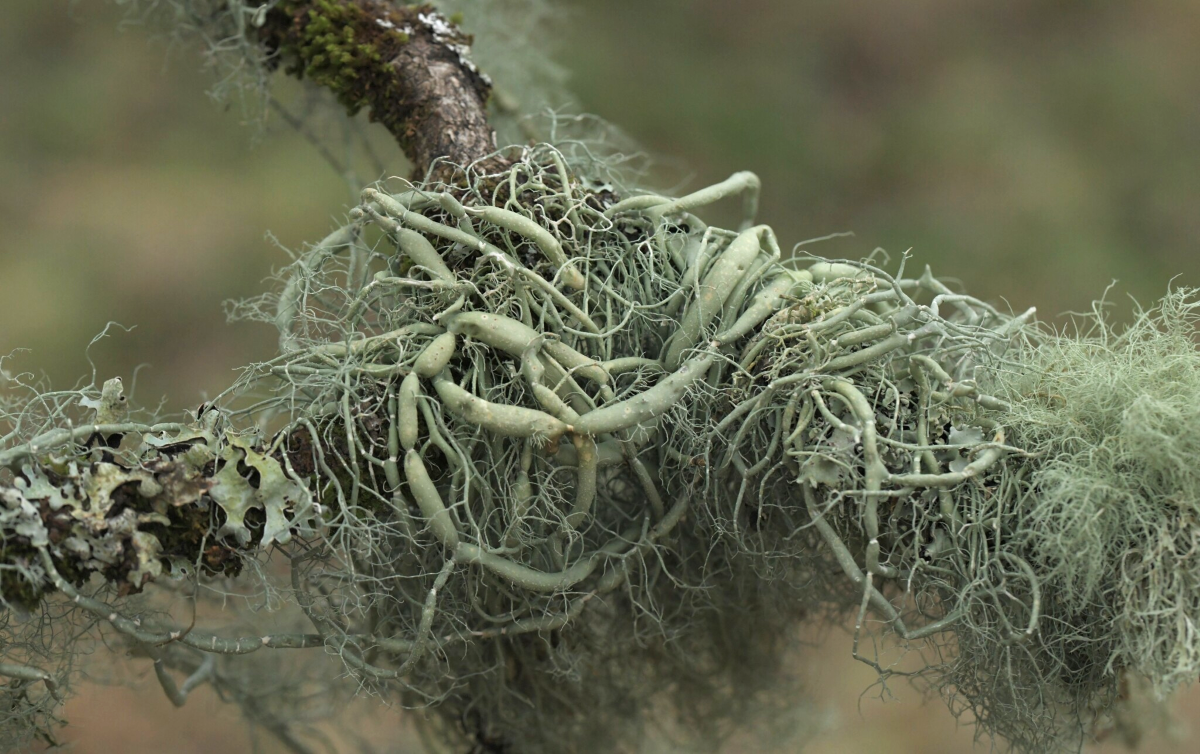 String-of-Sausages (Usnea articulata) swarms the branches of a tree at Arlington Court, Devon
To understand what makes a resilient rainforest we first need a way of measuring resilience. The easiest method would be to subject the woodlands to different stresses and measure how much biodiversity is lost. This method is generally unpopular; there is not much point finding how to save the rainforest by destroying the last remaining patches. Instead we can use species interaction networks to quantify resilience. Because species are sustained by their interactions with other species (e.g. a lichen growing on an Ash tree), we can quantify a whole ecosystem by expressing it as an interconnected web of species. Although it may seem bizarre that we can take an ecosystem and simply convert it into a tangled web of lines (interactions) and dots (species), network ecology has many real world applications. From this web we can measure the web’s structure and anticipate how parts of the web might respond to species disappearing (e.g. what happens if we remove all the Ash trees). Hence I found myself waist-deep in Bracken and Brambles, swarmed by ticks and midges and crawling through Holly bushes, deep in the wilds of Devon and Cornwall. Of course the goal wasn’t to be attacked by the forest, we needed data and lots of it. Network ecology relies on large datasets of species interactions that are incredibly labour intensive to collect. So each day we got up, drove down the winding lanes of the South West, hiked up to the day's plot and spent the whole day collecting data. To quantify our networks we collected data on how epiphytic lichens and bryophytes were distributed across 32 trees in each of our 40 chosen woodland stands, to a total of almost 13,500 interactions. We also collected data on the tree bark and light levels, ground vegetation, tree heights and diameters, herbivore damage and forest structure amongst many others. Together we hope the data can help to answer whether the UK’s rainforest epiphytes are resilient and help improve our understanding of what types of woodland are the most resilient and why. But for now there is a mountain of data to trawl though, within which the secrets to a resilient rainforest lie.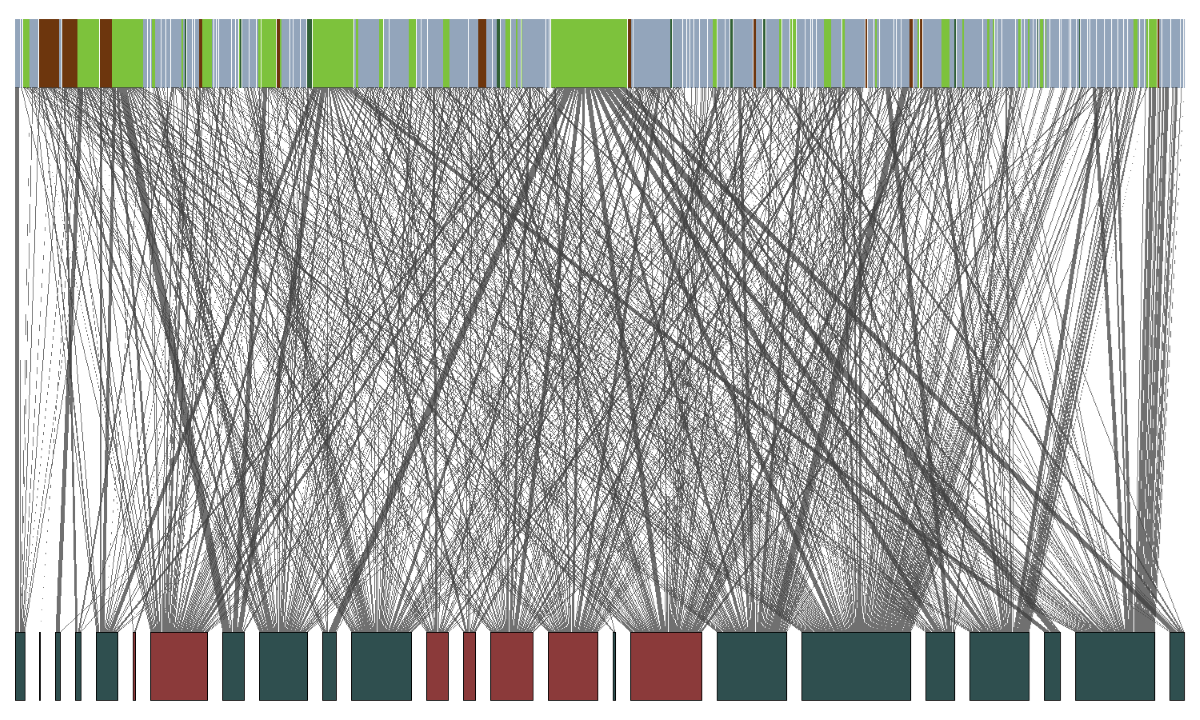 Our final web of all 13,500 interactions, with trees species along the bottom (red - non-native, teal - native) and epiphytes across the top (light green - mosses, burgundy - liverworts, blue - lichens and dark green - vascular plants) weighted by percentage of tree bark covered. Grey lines indicate which epiphyte species were on which tree species.
References
- Shrubsole G. The Lost Rainforests of Britain. London: William Collins; 2022. 326 p.
- Murphy T, Chernyuk K, Roszkowski M, Lewin S, Lunt P, Buckley J. The State of Temperate Rainforest in South West England [Internet]. 2025 [cited 2026 Mar 6]. Available from: https://pearl.plymouth.ac.uk/gees-research/1468/
- Ellis CJ, Coppins BJ, Eaton S, Simkin J. Implications of Ash Dieback for Associated Epiphytes. Conserv Biol. 2013;27(5):899–901.
- Ellis CJ, Eaton S, Theodoropoulos M, Coppins BJ, Seaward MRD, Simkin J. Response of epiphytic lichens to 21st Century climate change and tree disease scenarios. Biol Conserv. 2014 Dec 1;180:153–64. doi:10.1016/j.biocon.2014.09.046