
Ancient baobabs hold the secret to rainfall
Posted on Thursday 12 March 2026
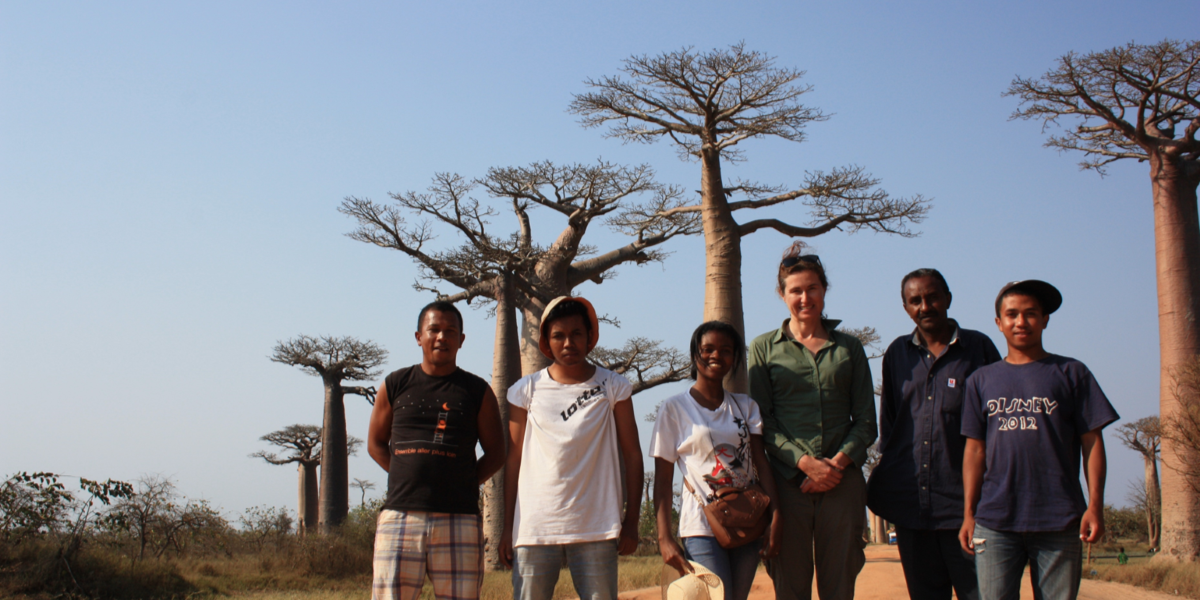
Understanding long-term patterns in rainfall variability helps us to untangle the role of climate and people in driving vegetation change. This is especially useful in Madagascar, where the landscape history, cover and influence of humans is a highly debated and controversial topic. The paper helps us to refine the interpretation of nearby fossil pollen records, and contributes to debates over what drives variability in tree cover on the island.
The technique was pioneered by our collaborators Stephan Woodborne and Grant Hall, who have previously used it to reconstruct rainfall elsewhere in southern Africa (e.g. Botswana and South Africa). During dry periods, photosynthetic products show higher concentration of 13C, the heavier carbon isotope while during wet periods lower value 13C is recorded in tree rings. Studying changes in the concentration of 13C in fallen baobabs, or tree rings cores, enables changes in rainfall to be estimated over time. Combined with radiocarbon dating, it is possible to develop high resolution rainfall records stretching back several hundred years.
The work was led by Estelle Razanatsoa as part of her PhD and postdoctoral research in Lindsey Gillson's lab at the University of Cape Town. Estelle's field work, guided by Grant Hall, involved coring of baobab trees in Madagascar to reveal the history of recurrent droughts across the region.
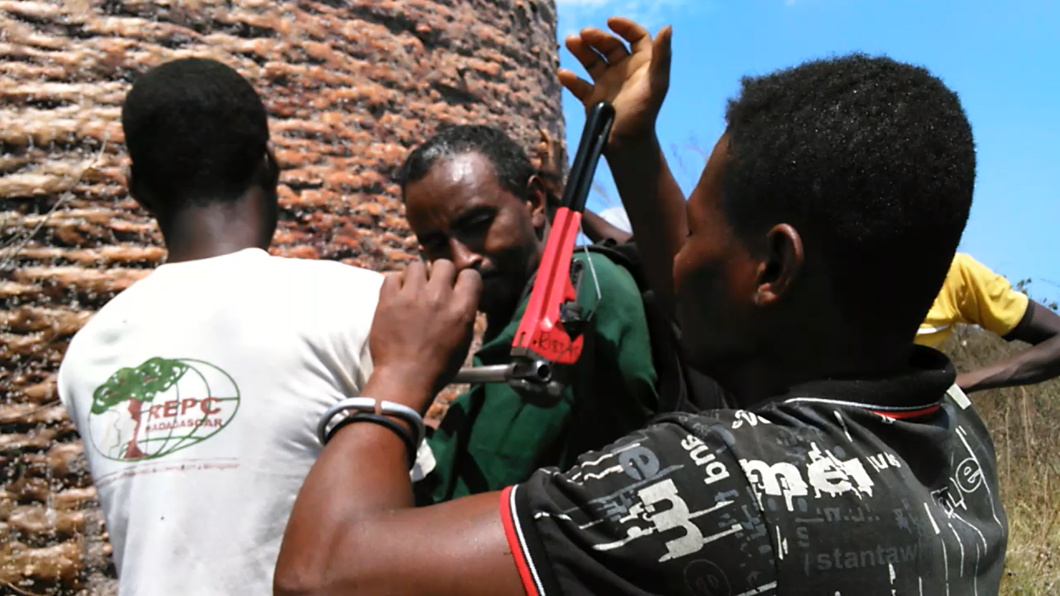
Our results show that for the last 700 years, the region has been experiencing a decrease in rainfall over time with the wettest periods occurring around 1350- 1450 Common Era (CE) while the driest period was recorded around 1600-1750 CE.
We also collected sediment cores from nearby wetlands, which were used to reconstruct changes in vegetation and fire over time. While the pollen and charcoal records are useful in understanding changes in vegetation cover, it is not always clear whether humans, climate or both are the major drivers of change. By having an independent climate proxy from baobabs, the project helped to identify synergies between climate change and people over time.
The project as a whole showed that people changed their livelihood strategies in response to periods of drought, while plant composition also shifted in favour of drought adapted taxa. The research explored the important interdependencies of social-ecological systems and the environmental change, and also highlighted some opportunities and challenges for drought adaptation in the future.