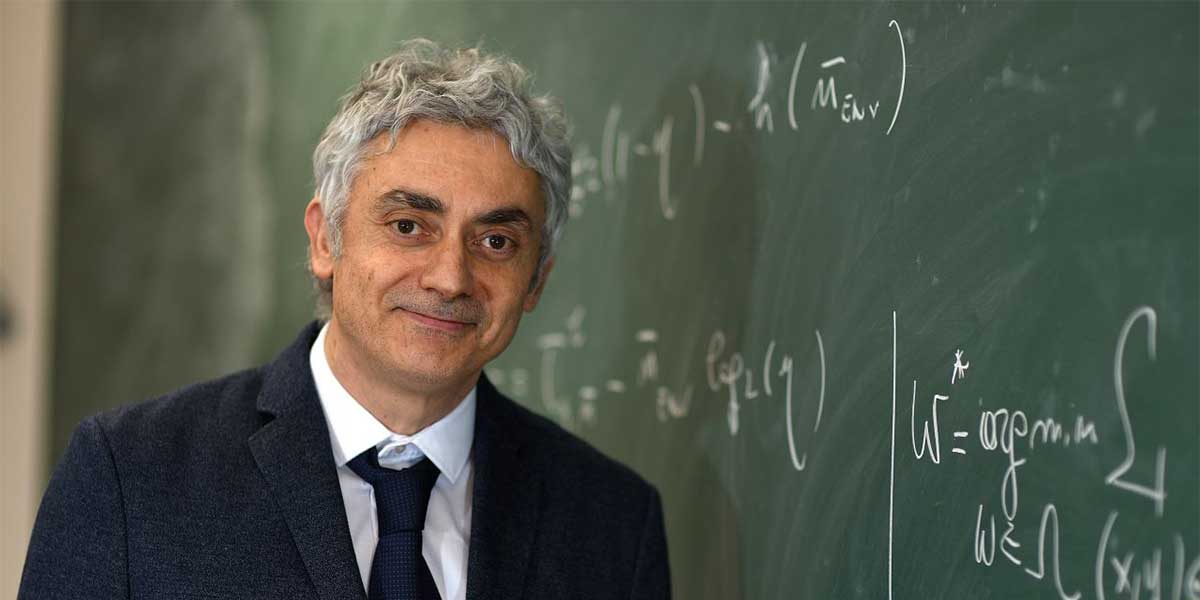
“You need to know the limits that nature imposes on the machine.”
For Professor Stefano Pirandola, these limits aren't obstacles. They are the blueprint for our defence.
Quantum technology will change the world, but it will also challenge our security. As quantum computers evolve they threaten to bypass the encryption that currently protects our global economy. It is a risk known as “harvest now, decrypt later” – where data stored safely today could be unlocked by the machines of tomorrow.
This week’s Human of York is the man working to close that loophole.
Stefano was recently awarded the IET Achievement Medal – one of the top international awards in engineering – for his work defining the "theoretical limits" of quantum technology.
He determines the fundamental limits set by physics on quantum computing and quantum communications, clarifying what is and isn’t possible and guiding the design of protocols impossible to crack.
But for Stefano this isn't just about security. It is about the thrill of the unknown.
"There is a beauty in scientific discovery," he says. "It is finding something that nobody else knows. It is about leaving a signature in the world."
That signature is already visible at York. Under his guidance, students recently conducted one of the world's first experiments in post-quantum encrypted communication. It is a practical mindset that ensures our graduates understand the technology, not just the theory.
While the industry races to build quantum computers, Stefano is doing the vital work of ensuring they are safe to use.
Professor Stefano Pirandola, Department of Computer Science, Humans of York, January 2026