


"The LLM is like a year-long internship – it’s really helping me develop the skills and knowledge that I need to hit the ground running when I start work. The lectures are engaging and contextualise the big debates on human rights through case studies. The assessments have taught me to apply my skills in practice and are a good learning experience. Perhaps the best part of the Centre for Applied Human Rights is its diversity. This provides an incredible opportunity to learn from practitioners of human rights from all over the world and has definitely enriched my experience here. "
Primrose Lovett, LLM Student 2010/11


Goma mural (Democratic Republic of Congo)
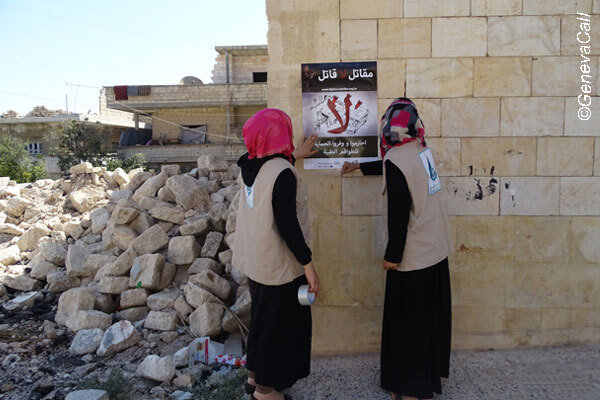
Gacaca poster (Rwanda)
Students must take at least one of the following optional modules (and may take two). The more law-based optional modules are Asylum, Migration and Human Trafficking; and Truth, Justice and Reparations after Violence.
Martin Jones
Spring Term (20 Credits)
The module explores the general category of “migrant” and its various sub-categories (as defined by location of movement and by degree of volition), including the internally displaced, labour migrants, refugees and victims of human trafficking. The module examines the legal tools available to human rights defenders seeking to assist these groups. It also looks at the extent to which human rights law and policy have managed to challenge two of the remaining bastions of state sovereignty: the related powers of a state to control movement and membership. Although the obligations of states to migrants is the primary focus of the course, the policies and practices of international organizations and supranational bodies with respect to migration are also discussed.
The module begins by examining conceptions of citizenship (and their impact upon rights discourse) and the phenomenon of migration (including both its causes and effects). The module then looks at the ability of migrants to enjoy even putatively universal rights, such as the right to equal protection of the law. The module then explores distinctions made in law and policy between forced and voluntary migration and between intra- and inter- national displacement. Smuggling and human trafficking are also discussed. Refugee protection, in the UK and states in the Global South, is reviewed, including the criteria for qualification and the processes of determination of status. The ability of human rights defenders at risk to gain asylum is considered. With respect to more voluntary forms of migration, the rights of migrant workers and long-term residents are also discussed.
Zoe Norridge & Paul Gready
Spring Term (20 credits)
In recent years the intersections between culture and human rights have become more numerous and complex. For example, many members of the public first become aware of human rights concerns through literature, film or theatre. In addition, human rights organisations routinely use diverse media, including video and radio, in their research, advocacy and outreach. Intersections between the two fields are increasingly the subject of interdisciplinary academic study.
This module explores the implications of these developments under the rubric of “cultures of human rights practice” by:
Paul Gready
Spring Term (20 Credits)
Can human rights help tackle poverty and inequality? What lessons can development teach human rights? This module provides insights into contemporary development discourse, intersections between development and human rights, and the tools and strategies that help advance related outcomes. Introductory sessions examine how and why development and human rights have converged in recent years; detail some of the resulting formulations (economic and social rights, human development, the Right to Development, rights-based approaches to development); and link human rights to macro-economic issues such as aid, debt and trade. Human rights are then discussed in the context of key contemporary development challenges (failed states, corruption, and land reform). Recent paradigm shifts and policy innovations have propelled rights into new terrain. In the remainder of the module, specific tools designed to close the gap between the theory and reality of human rights will be explored (voice and accountability work, rights-based programming).
Jonathan Ensor
Spring Term (20 credits)
There are critical issues facing humanity at the start of the 21st century. Climate change is upon us, already destroying the lives and livelihoods of millions of the world’s poorest people. The global population is expanding, and set to reach 9 billion people by 2050. This year, a third of all food will be wasted, a billion people will go hungry, and a similar number will suffer from diseases linked to excessive food consumption. And the world’s natural resources – on which we all depend for survival – will be increasingly controlled by private, multinational actors while being further depleted, reducing the planet’s biodiversity, turning fertile soils into deserts, and posing new risks to human, plant and animal health.
These are global challenges, to which global solutions are currently being proposed. Human rights, and human rights practitioners, cannot avoid these issues and have an important role to play in ensuring that the solutions are equitable and just. This module will introduce these important topics and assess them from a human rights perspective. With a particular focus on the developing world, it will examine the links between poverty and decision-making in environmental, food and agriculture issues, questioning the assumption that technology and the market hold the answers to scarcity and marginalisation. Most importantly, this module will highlight links between these elements of global environmental crises, equipping students to critique the positions of different actors as the world searches for a future that is environmentally sustainable - and fair.
Lars Waldorf
Spring Term (20 Credits)
After violence and repression, states and communities have created “transitional justice” mechanisms to deal with the legacy of gross human rights abuses. The best known mechanisms are international criminal tribunals and national truth commissions. Transitional justice is simultaneously backward- and forward-looking: addressing past abuses with the aim of preventing future ones. As such, it often involves difficult choices between punishment and forgiveness, accountability and reconciliation, remembrance and forgetting. In recent years, transitional justice has become a globalized paradigm as international donors, non-governmental organizations (NGOs), and human rights defenders export, import, and adapt a growing assortment of transitional justice “tools” to diverse settings.
This module begins by locating victims’ rights to truth, justice, and reparations in treaty law and “soft law.” It then critically examines the workings and impact of various transitional justice mechanisms – truth commissions, international and hybrid tribunals, local justice processes, and monetary reparations – in specific international, national and local contexts. Next, the module explores key tensions within transitional justice, such as truth versus justice and peace versus justice. Finally, the module asks a question that is all too often overlooked in policy decisions around transitional justice: what do the victims actually want and need?
Students may take one of the following optional modules:
During the Spring term, instead of choosing an optional module from the Inner Ring above, students may take one from any other department at the University of York if they can demonstrate its relevance to their studies (e.g. their dissertation) or their career plans. Available modules may include the following:
Social and political issues in development
Women, citizenship and conflict
Contemporary philosophy of law
Contemporary issues in toleration