
Slipping away
-
Case study
- Environmental Sustainability and Resilience
Posted on 31 October 2021
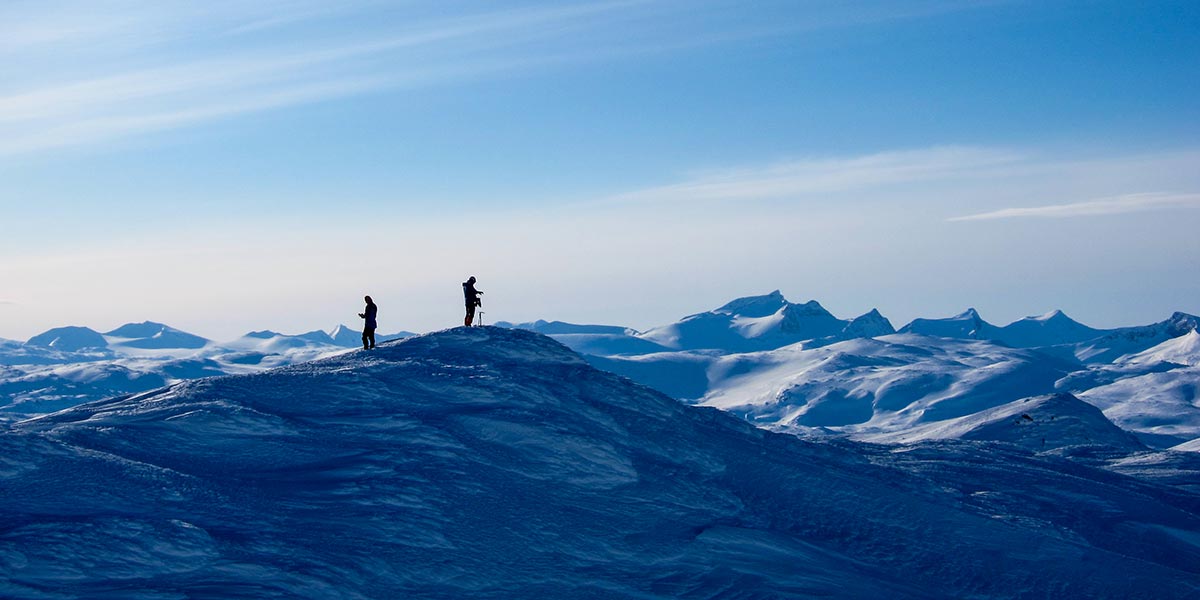
As ice sheets and glaciers melt across the globe, our researchers visited Arctic Sweden to explore the future of a glacier called Kårsaglaciären.
The issue
Small Arctic glaciers have contributed substantially to sea level rise because they are widespread and they respond quickly to a warming climate. Their sensitivity to climate warming is of importance because further climate change is forecast to proceed rapidly in the Arctic. Shrinkage of small glaciers has major implications for the volume of water in the streams they feed, impacting on stream ecology and water supplies.
The research
Kårsaglaciären is a small Arctic glacier in northern Sweden. Our team investigated and studied this glacier over a number of years, exploring it in great depth. Work carried out by Dr David Rippin in our Department of Environment and Geography focused primarily on the glacier’s ‘thermal structure’. Ice within glaciers can exist at a range of temperatures and we wanted to investigate how this ice temperature varied throughout the glacier. This is important because ice that is only just about frozen is softer and moves more easily than ice that is very cold. Water can also exist within ‘warmer’ ice, but not within ‘colder’ ice. We carried out this study using a technique called ‘radio echo-sounding’ which enables us to explore the glacier interior using radar.
The outcome
We determined that this glacier has a complex thermal structure, with parts of it being very cold, but parts of it being warmer. Such a structure is more in keeping with a much larger glacier. This led us to believe that in the past, this glacier was once much bigger and also much more dynamic, because a larger part of it was made of warmer ice. As the climate has warmed it has thinned and shrunk. The glacier’s thermal structure has also evolved but this has lagged behind other changes. Identifying that the thermal structure of such glaciers changes alongside their size is an important insight, with fascinating implications for the way glaciers move across the landscape.

David Rippin
Dr Rippin is a glaciologist interested in the controls on the dynamics of glaciers and ice-sheets, and the use of ground-based and airborne radio-echo sounding (RES) techniques in exploring englacial and subglacial environments.