
Don’t stick your head in the sand
-
Case study
- Environmental Sustainability and Resilience
Posted on 31 October 2021
Our researchers are working with communities in East Africa to balance the needs of nature and economic development.
The issue
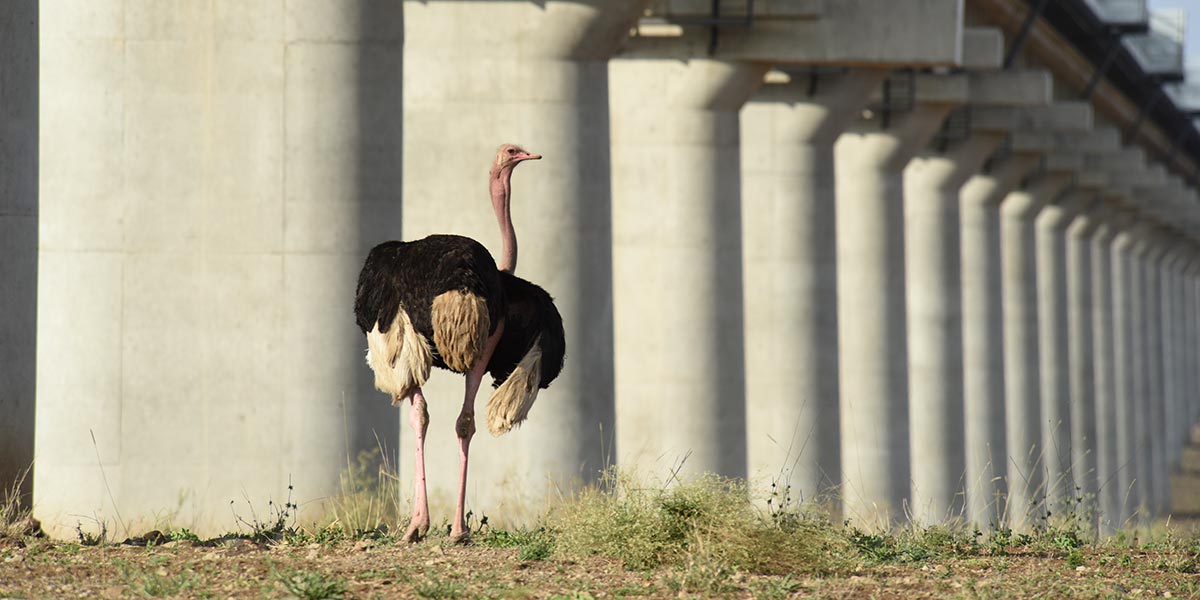
The Development Corridor Partnership has been looking at the wider social and environmental impacts of new transport (roads, railways, pipelines, ports) in Kenya and Tanzania. While there are many positives from new roads, such developments can be damaging for nature and people, including loss of land, wildlife and habitats. For example, by creating new barriers to the movement and migration of mammals, such as elephants, new transportation infrastructure can undermine the ability to adapt to future climatic and land use impacts.
One of the critical challenges for new transportation infrastructure is to safeguard spaces for the wildlife and associated local livelihoods so that better planning and management can sustainably mitigate any adverse effects. This requires relevant historical and current up-to-date social and ecological information that can be used to explore future impacts. Such information is presently lacking in many regions earmarked for rapidly expanding road and rail networks. Given the government's enthusiasm for large infrastructure projects and the speed of infrastructure development that often outpaces social and ecological ability to adjust, we have to get ahead of the construction process to chart competing interests.
The research
Work at the University of York is combining historical and environmental data with a participatory modelling approach (KESHO) to investigate interactions between changing human population, environments, infrastructure and development at a landscape scale in the recent past and the near future. Our results show the wider social, environmental, economic and social impacts of very rapid developments and demonstrate how our data can be used to achieve Sustainable Development Goals and the wider development agenda of the African Union.
The outcome
We aim to ensure new roads and railways can truly function as development corridors that support economic development and safeguard nature and societies, now and into the future.
Rob Marchant
Professor Marchant's research focuses on vegetation dynamics and ecosystem change, particularly in tropical environments.