
Growing the future
-
Case study
- Environmental Sustainability and Resilience
Posted on 31 October 2021
Our researchers have teamed up with a farming technology company to create ‘Grow it York', an eco-friendly indoor vertical farm growing herbs and leafy salad crops in a controlled environment - without soil.
The issue
Over 70 per cent of UK land is already used for agriculture. While traditionally agriculture has been a rural affair, vertical farming in controlled growing conditions offers the potential to grow fresh produce in urban areas. A common neglect of food in urban planning has led to the development of urban food insecurity. Food deserts abound – these are neighbourhoods with limited access to affordable healthy food, where available food outlets are typically convenience stores and fast food shops with imperishable and often highly processed food. This planning problem contributes to obesity and micronutrient deficiencies. Locating vertical farms within food deserts could improve access to nutritious food while benefiting the environment.
The research
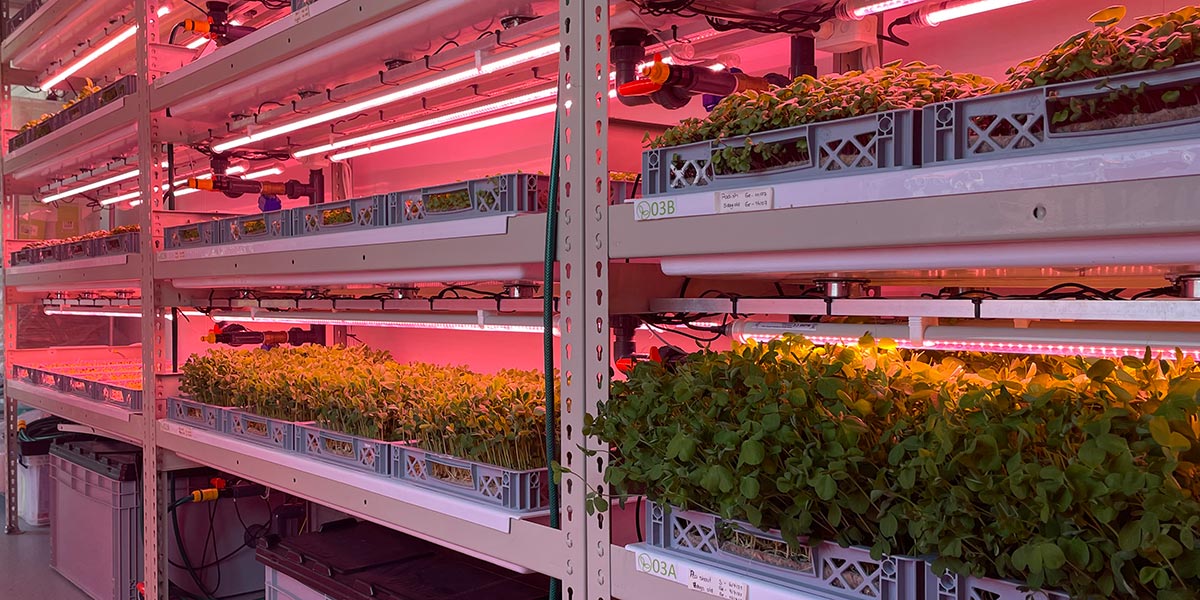
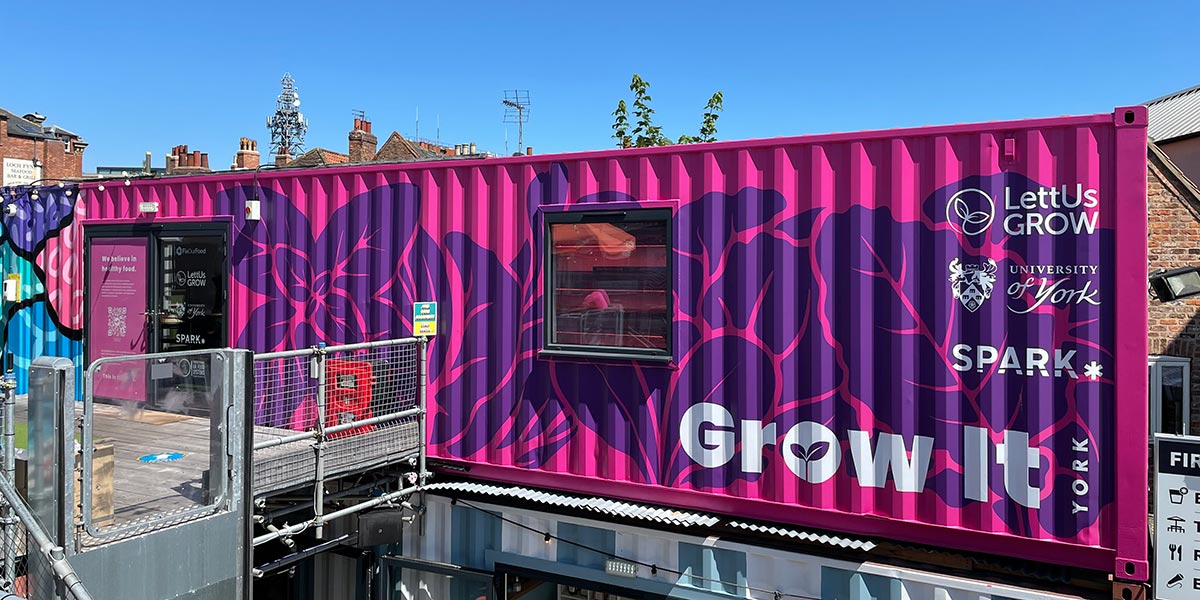
Vertical farms are popping up around the world and York is no exception. The University’s FixourFood research programme recently launched Grow It York, a vertical farm located within a shipping container in Spark:York, a Community Interest Company (CIC) in the centre of York. Grow It York uses technology from a Bristol-based SME LettUs Grow to grow crops without soil, in stacked beds under controlled lighting using aeroponics - spraying the plant roots with a fine mist. We are using Grow It York to explore how to integrate vertical farming into urban communities for social and environmental benefits.
Indoor vertical farming will not replace existing agricultural methods for food production but it has much to contribute to developing a sustainable food system. Vertical farming systems significantly reduce water use for production; water is recycled in the system and directly applied to plant roots. The indoor farm is protected from the weather and changing climate, delivering produce year-round. Our farm is located very close to food businesses greatly reducing the distance food needs to travel and lowering greenhouse gas (GHG) emissions associated with transport, cold chain and packaging. The level of control in vertical farming means minimal loss and food waste during production, with the short growing cycles giving farms the flexibility to adapt to changing produce demands.
Vertical farming technology also dramatically reduces the use of synthetic fertiliser - a major component of agriculture’s greenhouse gas emissions (GHG) - along with little or no use of agrichemicals such as herbicides and pesticides. The oft-cited drawback of vertical farming in controlled environments is the high energy use (per kg of produce) for lighting and climate control. GHG emissions associated with an indoor vertical farm depend on LED lighting efficiency but most significantly on the source of energy being used (renewable versus non-renewable). With renewable energy sources, GHG emissions from vertical farming can be lower than traditional greenhouse horticulture production in many countries.
The outcome
Researchers from FixourFood are evaluating the impact of the new vertical farm, but already produce from Grow it York is being used in restaurants and food outlets in Spark:York. We hope to offer community slots for growing in the farm and are already working with eco and food groups in schools to design events around the farm. There are plans to expand to other locations if the project is a success.
Additional project images
Katherine Denby
Professor Denby is interested in plant disease resistance and plant-pathogen interaction, and in novel approaches for enabling and enhancing breeding of improved crop varieties tolerant to environmental stress and disease.