Skip to content Accessibility statement
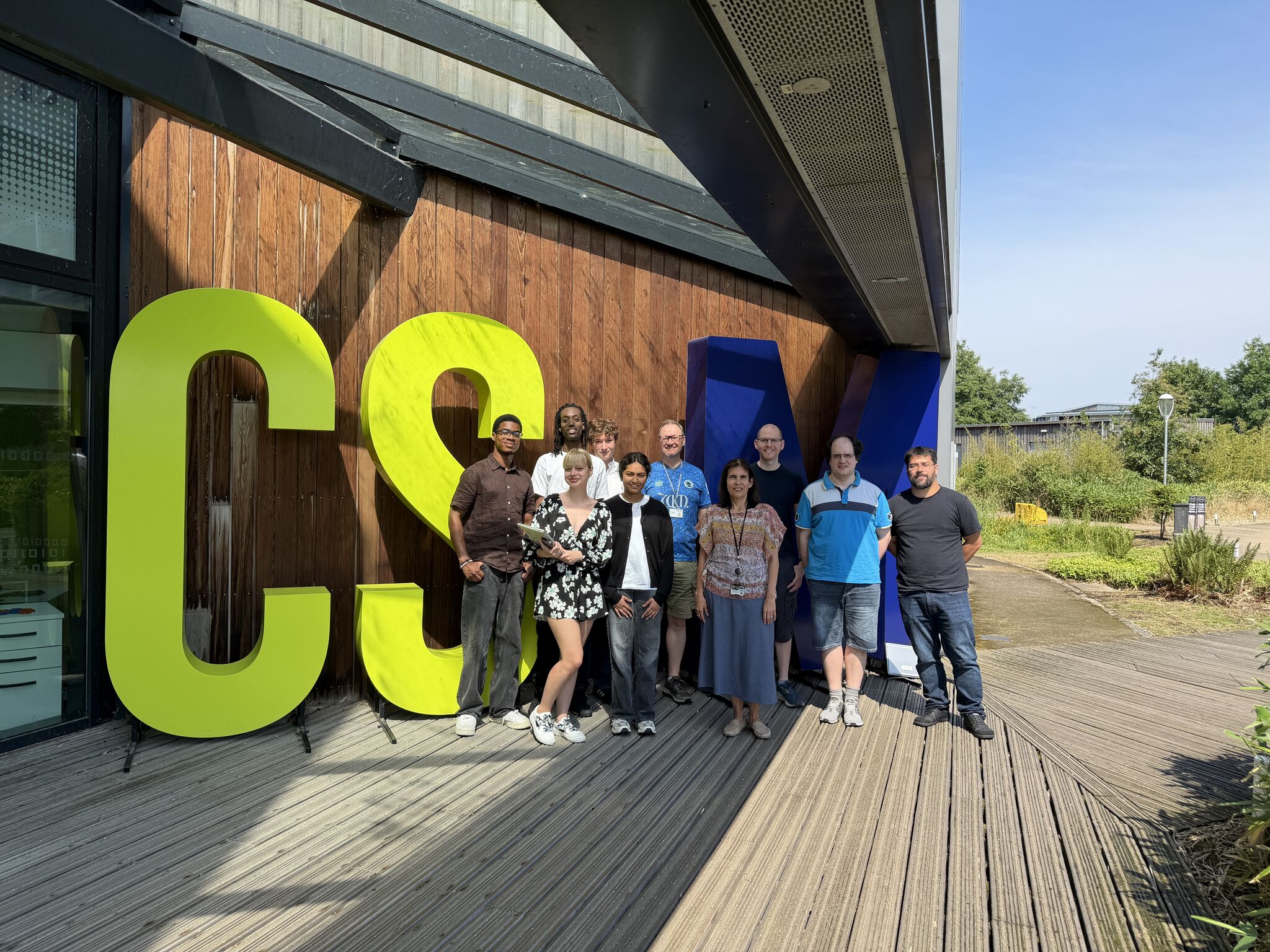
Charlie Piper (back row, third left) and the team behind the summer's robot swarm project, part of the Google DeepMind Research Ready Programme.

Building safer robot swarms for nuclear decommissioning

Autonomous robots can play a vital role in cleaning up hazardous waste materials, for example in nuclear decommissioning, or construction sites, but how do we ensure they’re operating safely? Charlie Piper was one of five students who took part in a summer internship at the University of York, as part of the Google DeepMind Research Ready Programme, getting hands-on experience of designing a robot, implementing AI-enabled software and developing a safety case. He spoke to us about the project.

What’s the problem you were trying to solve?

Nuclear decommissioning is an enormous, decades-long challenge. In the UK alone, around 4.45 million cubic metres of radioactive waste is currently in stock or expected to arise as nuclear facilities are operated, dismantled and cleaned up. A lot of this work is slow, expensive and is typically too hazardous for people.

Our project explored whether swarms of small, cooperative robots could carry out some of these tasks autonomously. But just as importantly, in an industry where safety is fundamental to public confidence, we investigated how to demonstrate that autonomous systems could be safe and trustworthy.

Developing that safety assurance was therefore just as important to our project as the robotics.

What technical approach did you use and where did the idea come from?

Our approach was inspired by nature, particularly the way social insects such as termites organise themselves. 

Termite colonies can achieve surprisingly complex tasks without any individual termite understanding the overall colony goal. Instead, they respond to changes in their environment, which influence what others do next, in a process known as stigmergy. 

Adapting an algorithm developed by Andrew Vardy, we wanted to see whether a swarm of robots could work in a similar way, each robot had a simple set of rules for finding and moving objects, with AI-based computer vision helping them recognise what they were looking at.

Behind that apparently simple behaviour was a substantial software stack: We formally modelled behaviour in RoboChart, implemented the system in ROS 2, tested it extensively in Gazebo simulations and then deployed it on TurtleBot3 robots.

How did you divide the roles between the team?

The team naturally split across two major questions behind the project: how do we make the robots work, and how do we show that they're safe?

I focused mainly on implementation, turning formalised requirements into working software, first in simulation and then on physical robots.

Other team members concentrated more heavily on the assurance side, building formal models of the system and developing the safety case. 

These weren't necessarily separate pieces of work, the implementation gave the assurance team new evidence to think about, and the safety work helped shape how we designed and tested the robots.

What was the biggest challenge?

Seeing multiple robots move around together was one of the best and most challenging parts of the project.

With one robot, you can normally understand quite easily why it made a particular decision. But with several, everything becomes much less predictable. You could have each robot doing what it was supposed to do individually, while the swarm became congested or repeated the same work. 

We therefore had to look beyond the performance of each robot and consider the system they created together.

What's been the most valuable part of the experience?

The most valuable part was seeing the project progress from an early research idea to a working system combining swarm robotics, AI-based computer vision, formal modelling, safety assurance and physical robots in a way that had not been explored before. The work may now be developed into a research paper so others can build on our findings. It is exciting to think the project could contribute, even in a small way, to making nuclear decommissioning safer in the future.


The scheme is a partnership between the Royal Academy of Engineering, Google DeepMind and The HG Foundation. It was delivered by two leading research centres at the University of York, RoboStar, a centre of excellence for software engineering for robotics and the UKRI AI Centre for Doctoral Training in Safe Artificial Intelligence (SAINTS), the UK’s first multidisciplinary PhD programme focused solely on the safety of artificial intelligence.