
Institute hosts workshop on future of maritime autonomous systems
Posted on Thursday 26 March 2026
Topics discussed ranged from state-of-the-art underwater acoustic communication and inertial navigation, to novel underwater robot designs.
Guests from the National Oceanography Centre presented on AUV-based subsea monitoring capabilities and ongoing missions. Representatives from Kongsberg and L3Harris offered practical insights on maritime autonomy and deployment challenges, including the use of safety assurance frameworks to ensure cutting-edge technologies operate reliably as they evolve.
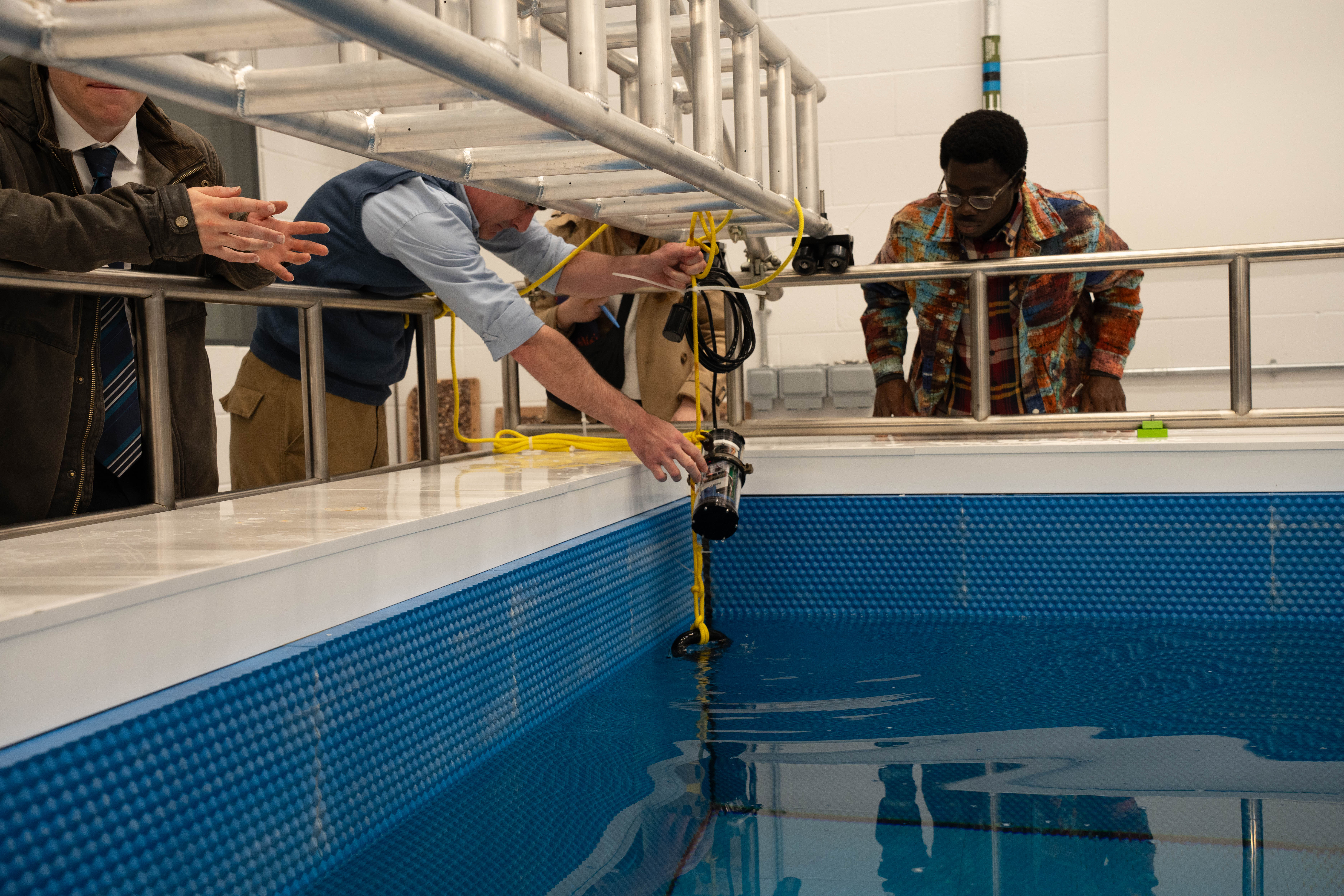
Researchers from the Institute also demonstrated their most recent experiments in underwater acoustic communication and positioning, using the building’s 18,000L tank, which is lined with specialist anechoic acoustic tiles.
The event was organised by Dr Nils Morozs and Dr Tian Gan, as part of the Institute for Safe Autonomy’s Safe Maritime Autonomous Systems cross-cutting challenge, an initiative drawing together research expertise from its three research pillars (Communications, Design and Verification and Assurance).
Dr Tian Gan said: “This was a valuable opportunity to bring together industry, academia, and policy in a way that felt both practical and forward-looking. The capabilities demonstrated in sensing, AI, communication, and real-world deployment show that maritime autonomy is moving towards practical application. It was particularly encouraging to see not just concepts, but systems being tested and used in realistic environments.
“Many of the discussions naturally focused on how we build confidence in these systems as they scale and operate in more complex settings. There was a shared recognition that alongside technological advances, we need clear and structured ways to demonstrate safety and reliability over time. Approaches such as assurance frameworks and continuous evaluation pipelines were highlighted as practical enablers, helping to link technical performance with operational trust.”
Dr Ana MacIntosh, Co-Director of ISA, said: “ISA was established to advance the design, development and deployment of safe connected autonomous systems - we’re delighted to be able to draw together all the essential expertise and skills in one place, and to work with knowledgeable and engaged industry and policy colleagues on the challenge of safe maritime autonomy.“
Participants included representatives from: Scott Aerospace, Nortek UK, National Oceanography Centre, Marico Marine, Department for Transport, Succorfish, Newcastle University, Society of Maritime Industries, University Royal Naval Unit - Wales, FET Subsea, University Royal Naval Unit Wales, Kort Propulsion Co Ltd / SMIFutures, L3Harris, Thales UK, Forum Energy Technologies, Subnero, Forum Energy Technologies, Fleetwind Limited, Stehr Consulting/SMI, DCA, Roxtec, University of Huddersfield, Rolls Royce, NPL, BAE Systems, Kongsberg Maritime, University of York.
Emma Johnson, Director of MST and MAS Groups at the Society of Maritime Industries, said progress was being made in the sector, but challenges remain: “The maritime autonomy sector is growing massively. In terms of the technology, it is there, the industry is doing it. There has been progress on the assurance and regulatory side but more still needs to be done, and so it's invaluable to get people together to talk about these issues."