
Designing Out Inequality: Why a "Just Transition" Must Start with Health and Livelihoods
Posted on Tuesday 27 January 2026
As a public health researcher who works on policy issues and evidence-informed practice, I often find myself standing at the intersection of different worlds. My days are spent bridging the divides between academia, local government, and people who live in Yorkshire.
Currently, as the Deputy Director of the Born in Bradford Centre for Social Change and lead of the Healthy Livelihoods team, my focus has shifted to one of the most pressing challenges of our time: ensuring that our path to reduce carbon emissions is not just fast, but fair.
Beyond the Ivory Tower: The "Embedded Researcher"
My team and I work as "embedded researchers." This means that we don't study communities from a distance; we work with them, for example, as part of the Bradford Council Health Determinants Research Collaboration (HDRC) Evidence into Policy and Practice Hub. Our goal as a team is to ensure that strategic planning for the economy, regeneration, and climate action is informed by the people it affects most.
For me, a "just transition" means ensuring that climate action is inseparable from economic democracy and health equity. We should not be talking about decarbonization without also addressing:
- Material Equality: Income and wealth distribution.
- Political Equality: Voice, agency, and influence in the "everyday."
- Health: Creating the conditions where everyone has the opportunity to flourish and the power to live a life they value.
Evidence in Action: The Bradford Climate Manifestos
One of our most impactful recent projects has been "Co-producing Bradford’s Just Transition." We trained six local residents as Climate Community Researchers and focused on wards that are often "left behind"—areas where low income makes it difficult to access solar energy, housing retrofitting, or reliable public transport.
Together, we developed Community Climate Manifestos. These documents reframed climate change from an abstract global threat to a tangible local issue centered around people’s neighborhoods, community safety, and everyday life and wellbeing. We are continuing this work with communities and Bradford Council—supporting Climate Fresks as a way to engage and involve residents and developing a collaborative animation.
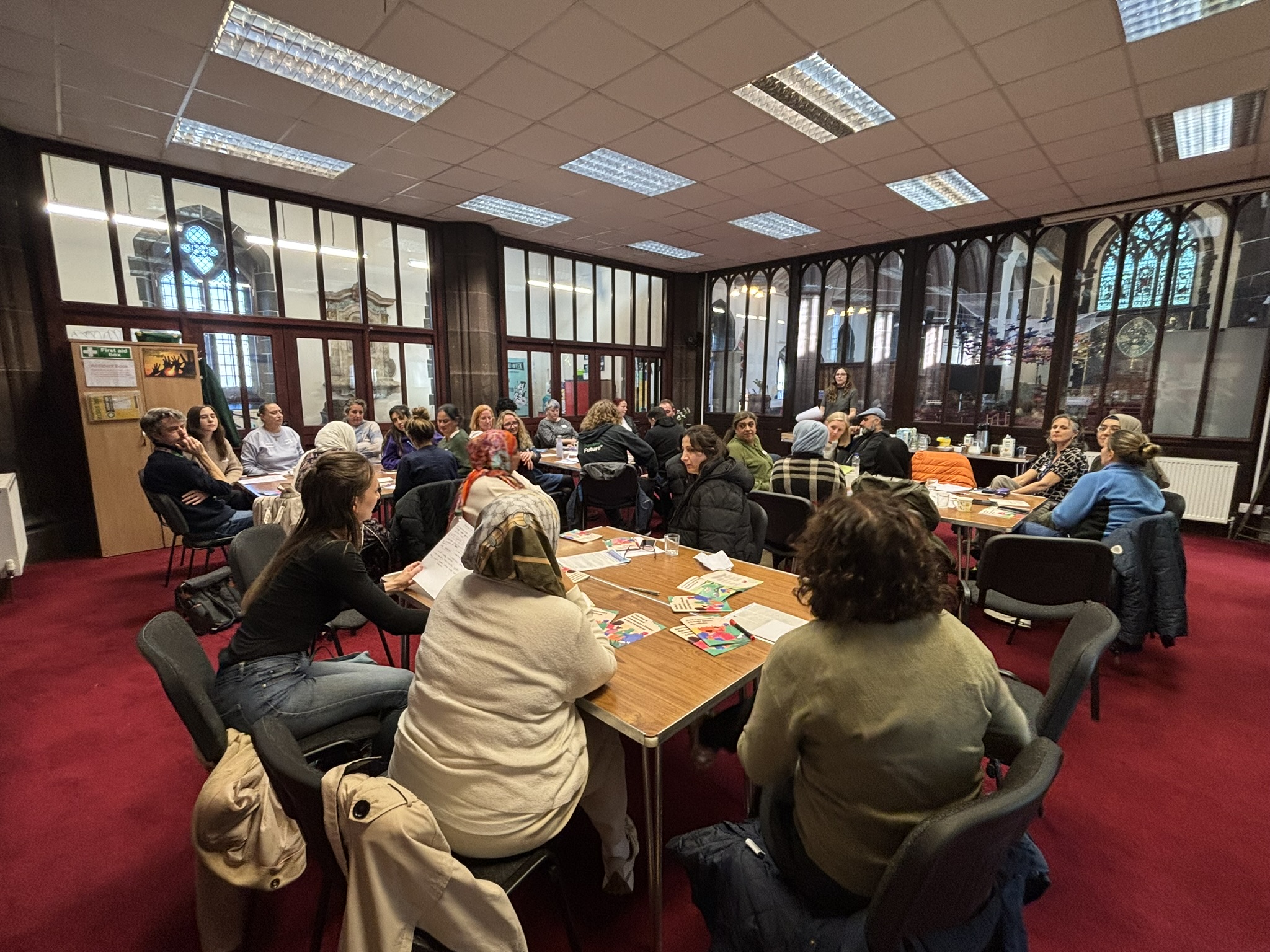
Researchers from York gathering community evidence in Bradford as part of the Climate Action Plan project undertaken with Bradford Council
The Challenges of "Closing the Loop"
The path isn't always smooth. One of the greatest challenges is sustaining community trust. We have found that residents are eager to engage, but can be weary of "project-based" consultation. One difficulty lies in "closing the loop"—ensuring that a community manifesto actually changes a department’s budget or a regional or national strategy, and making sure communities continue to be involved in that process. This is about how our democracy works in practice.
Limited, competitive, and time-limited funding for local governments makes it hard to build the long-term infrastructure that is needed for voice, influence and social justice. We try to navigate this by focusing on solution-oriented collaboration to join up climate action where we can, and across health and livelihoods.
Challenging the Imbalance of Power
Another challenge of course is a global imbalance in power. To be effective, local change and climate action plans must be coupled with a direct challenge to systemic forces—big business, extractive finance, and major polluters—that currently hold the lion's share of wealth and influence.
A truly just transition requires more than pockets of local participation; it requires a fundamental shift in economic power in our everyday lives. This means redirecting resources away from those who profit from the status quo and towards the communities, like those we are working with in Bradford, that have historically been marginalized. It is no easy feat.
The Power of "Small Places"
It is against this backdrop that Eleanor Roosevelt’s words carry much weight. She famously said that human rights begin "in small places, close to home." I believe the same is true for our climate future.
A just transition doesn’t live in national policy or corporate boardrooms; it lives in the neighborhoods where we work, play, and raise our families. We need to make sure that thriving local spaces are the foundation of a greener, lower-carbon economy - and our democracy - ensuring that progress isn't just something that happens to people, but something built with them to actively redistribute wealth and power for a fairer future.
A Call for Structural and Local Action

To move from vision to reality, we must demand change at both ends:
- Hold Polluters Accountable: Support "polluter pays" legislation and wealth taxes to ensure the green transition is funded by those with the greatest historical and financial responsibility; as well as progressive approaches to regulating advertising and sponsorship for industries that cause climate and health harms
- Invest in the "Small Places": Redirect that wealth into long-term, core funding for community infrastructure—moving away from the “hunger games” of competitive local government bidding - and creating, what Eric Klinenberg calls “palaces for the people”
- Devolve Decision-Making Power: Ensure that local evidence and community manifestos actually guide how redistributed wealth is spent in our wards and neighborhoods (such as Shipley Town Council’s Citizen’s Jury).
Value Local Knowledge: Treat people living the "everyday" reality of inequality as amongst those who are experts in building a fairer, greener future.
Find out more about how this research has played a key role in informing Bradford Council’s Climate Action Plan (CAP)