York researchers to receive UKRI funding to transform solutions in food production, metal contamination and agricultural waste
Posted on Tuesday 13 February 2024
Andrew Griffith, the minister for science, research and innovation, has announced that Professor Katherine Denby, Dr Liz Rylott and Professor Luke Alphey will be part of the five-year initiative. Their work will form part of six new UK-wide Engineering Biology Mission Hubs and 22 Mission Awards.
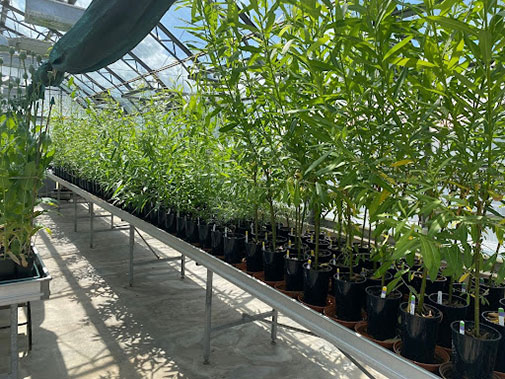
Professor Denby, in the Centre for Novel Agricultural Products (CNAP), will be engineering gene regulatory networks to design disease resistant crops.
Maximise
Her research group has identified a gene regulatory network mediating the lettuce defence response against fungal pathogens, and will now work with computational biologists at the John Innes Centre and synthetic biologists at the University of Cambridge to re-wire this network to maximise disease resistance.
Professor Denby said: “We anticipate that by tweaking how quickly or how strongly lettuce plants respond to the presence of a fungal pathogen, we can enhance their ability to fight off the pathogen whilst not impacting on other traits.”
Dr Liz Rylott’s research will focus on the environmental processing and recovery of metals: from contaminated land to industrial biotechnology in a circular economy.
Challenges
Led by the University of Kent, the hub will address the environmental challenges posed by metal contamination and scarcity, while minimising the potential risks associated with the use of engineered microorganisms in the environment. To achieve this, the Hub will harness and develop living systems to process environmental and waste metals.
Dr Rylott said: “This is a fantastic opportunity to develop ways plants can be used to remediate metal-polluted environments, and recover technology critical metals.”
And Professor Luke Alphey has received £1.5m to lead four researchers in developing advanced strains of black soldier fly.
Professor Alphey says: “This fly has gained much attention for its ability to feed on a wide range of organic waste - such as agricultural waste - and convert it to high-value products, thereby reducing waste or providing a low-carbon source of protein and fats.”
He says commercial uptake will be facilitated by inclusion of Fera Science Ltd, part of the wider BioYorkshire consortium, as a project partner.
Exciting
“Insects provide huge and underutilised potential for low-carbon waste management and food/feed production,” says Professor Alphey. “This grant is an exciting opportunity to work with the University of York and industrial partners to develop enhanced insect strains for such applications.”