Archaeologists excavate medieval timber hall at historic Skipsea site
Posted on Monday 13 May 2024
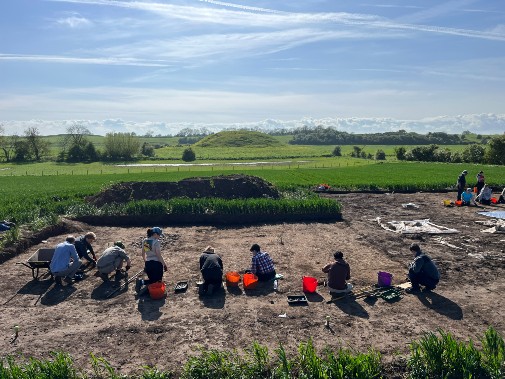
The heritage of Skipsea was highlighted almost a decade ago, when archaeologists, Dr Jim Leary and Dr Elaine Jamieson, discovered that a huge mound - 85m in diameter and 13m high - was Iron Age in origin making it unique to Britain at the time.
Originally thought to be a castle motte, radiocarbon dating showed that the earthen mound existed 1,500 years before the Norman Conquest.
Recent excavations of the surrounding area, where only the motte now survives, has revealed a long timber hall, likely older than the castle, and substantial in size at 5m wide and 16m long, surrounded by a ditched enclosure.
Rare find
The site of the building is marked out by post holes, which show the size and shape of the hall, but further excavations this month are likely to reveal that it was an area of some importance, given its size, and perhaps a place where lords greeted visitors and feasts were held.
Dr Jim Leary, from the University of York’s Department of Archaeology, said: “The unearthing of timber buildings dating to the period between the collapse of the Roman Empire and the arrival of the Vikings, a time often referred to as the Dark Ages, is an incredibly rare and significant find.
“The discovery at Skipsea is particularly interesting because we know that the area was in the hands of the last Anglo-Saxon King of England, Harald Godwinson, and then later, after the Norman Conquest of 1066, it became the estate centre of the Lords of Holderness.”
Freshwater lakes
Skipsea was once home to three freshwater lakes, Skipsea Bail Mere, Skipsea Low Mere, and Skipsea Withow Mere, linked to the River Hull through a network of tributaries. These lakes, long-vanished now, began 10,000 years ago, in the Mesolithic period, and continued into the medieval period.
The lakes were a constant draw, attracting people throughout this time, and their remains continue to fascinate archaeologists, antiquarians, landowners and locals. Mesolithic stone tools, animal remains, and bone harpoons have been discovered in them, and Neolithic and Bronze Age buildings and trackways are known on their edge, providing further glimpses into prehistoric life.
Local warlords
Dr Elaine Jamieson, from the University of York’s Department of Archaeology, said: “This era, characterised by a general lack of written records, saw the rise and fall of local warlords free from Roman influence or control.
“The discovery of these structures provides a unique window into this little-known period of history, underscoring the importance and excitement of our ongoing excavations.”
Archaeologists will be excavating the site throughout May, and first year archaeology students from the University of York will be joining the team to uncover more of its history.