Study sheds new light on behaviour called joint attention
Posted on Thursday 29 July 2021
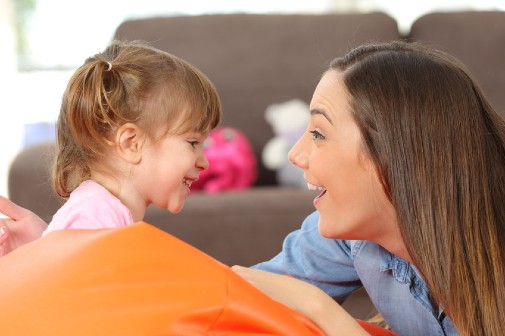
For instance, a child and mother may both see a beautiful butterfly, then look to each other to share a smile about the butterfly, so without any words they know they have seen the butterfly ‘together’.
Some experts have argued that engaging in joint attention underpins human cooperation and it has been suggested that joint attention might represent a key species-difference between humans and other great apes.
It’s an ability that doesn’t emerge until infants are 9-12 months old and scientists still don’t know if any other species can do it. Scientists say it may also be important in language acquisition, with children connecting words with objects to which they and another individual are jointly attending.
Behaviour
Given the importance of joint attention, psychologists at the universities of York and St Andrews wanted to better understand how to measure the behaviour in young infants who cannot yet talk.
Other scientists had previously suggested that the quality of look given by a child to an adult could be reliably identified by third party observers and the presence of ‘sharing’ rather than ‘checking’ looks were sufficient to distinguish joint attention from the child looking at the adult for other reasons (e.g. to monitor them). In this study this previous claim was rigorously tested and challenged.
As part of the study, they asked participants to watch videos of infants looking at their mothers and decide if the looks were sharing or checking looks.
Overall, the study revealed low agreement among raters in assigning looks from infants to their mothers, challenging the idea that the quality of infant looks can be reliably distinguished as a marker of joint attention.
Perspective
Dr Kirsty Graham, from the University of St Andrews, said: “Our participants didn’t agree very well on the types of look, suggesting that it’s really hard to tell whether joint attention is happening from this third-party perspective if you just consider the look itself.”
The study authors suggest that to understand the development of joint attention in humans and to search for it in other species, we have to take an objective approach in measuring observable behaviour, rather than subjective judgements.
Professor Katie Slocombe, from the University of York’s Department of Psychology, added:
“These results give a clear steer for how we need to identify joint attention events between preverbal infants and adults.
“Having a rigorous, objective way of identifying joint attention events will be key for the next steps in our research, as we investigate whether other species engage in joint attention events and whether joint attention develops in a uniform way in diverse human cultures.”