
The Life of Ida of Gorsleeuw: Mysticism, the Cistercians, and their Networks
Event details
As always for our December events, this will be hybrid. Please register if you would like to join over Zoom. If you are joining us in person, we will be at the University of York, Heslington Hall, room H/G17.
In the thirteenth century new models of sanctity and hagiography emerged in the diocese of Liège with the rise of the beguine movement and female mysticism. The Lives of these women are often understood as texts in which male hagiographers construct women’s piety to support their own agendas and clerical authority. Although this view has largely been developed in relation to Dominican- and
Augustinian-authored hagiographies, Liégeois Lives produced in a Cistercian milieu are often viewed in similar terms.
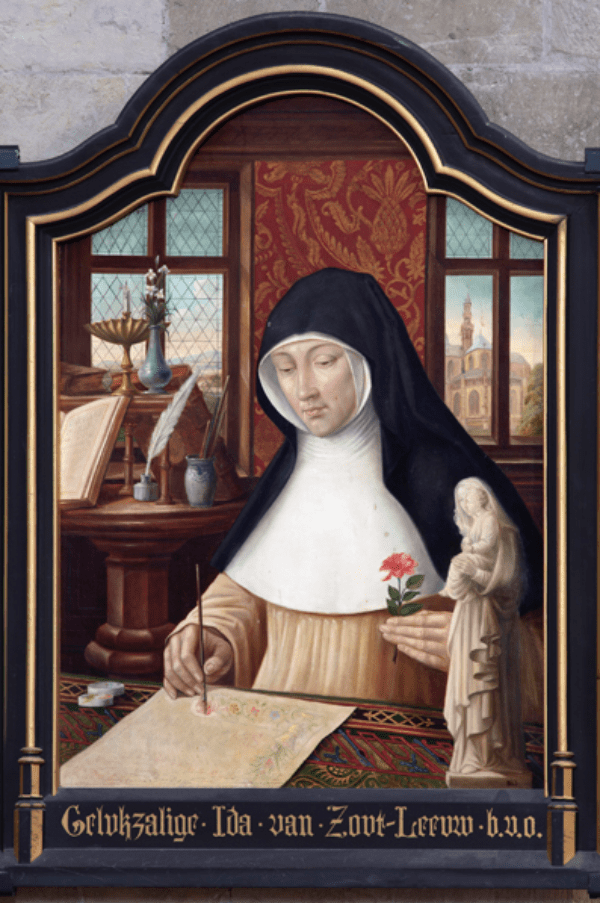
This paper examines The Life of Ida of Gorsleeuw, an anonymous hagiography usually dated to around 1260. It records the life, deeds, and visionary experiences of Ida of Gorsleeuw (or of Léau), a thirteenth-century Cistercian nun and mystic from the abbey of La Ramée in Brabant. Most work on Ida’s Life focuses on its presentation of Eucharistic devotion and her erotic relationship with Christ. Ida’s education, learning, and knowledge are also prominent themes; this paper asks how these overlooked aspects of the text contribute to the construction of her mystical spirituality. It then turns to the profuse anonymity found in the Life, viewing this not as a barrier to historical inquiry but as a literary feature. How is anonymity used to shape meaning in the Life and what does this reveal about Ida’s hagiographer? The paper then concludes by examining the Life with regard to Cistercian networks in Liège. What do these networks reveal about the context in which The Life of Ida was written and what might this reveal about the wider Cistercian order in Liège?
Please note: the zoom link for this event will be sent in the confirmation email after registering
This seminar is part of the Ideology, Society, and Medieval Religion: Impositions and Negotiations series - for more info, see here or email Tess Wingard (tess.wingard@rochester.edu) or Emmie Rose Price-Goodfellow (emmie.price-goodfellow@york.ac.uk)
Venue details
Wheelchair accessible