
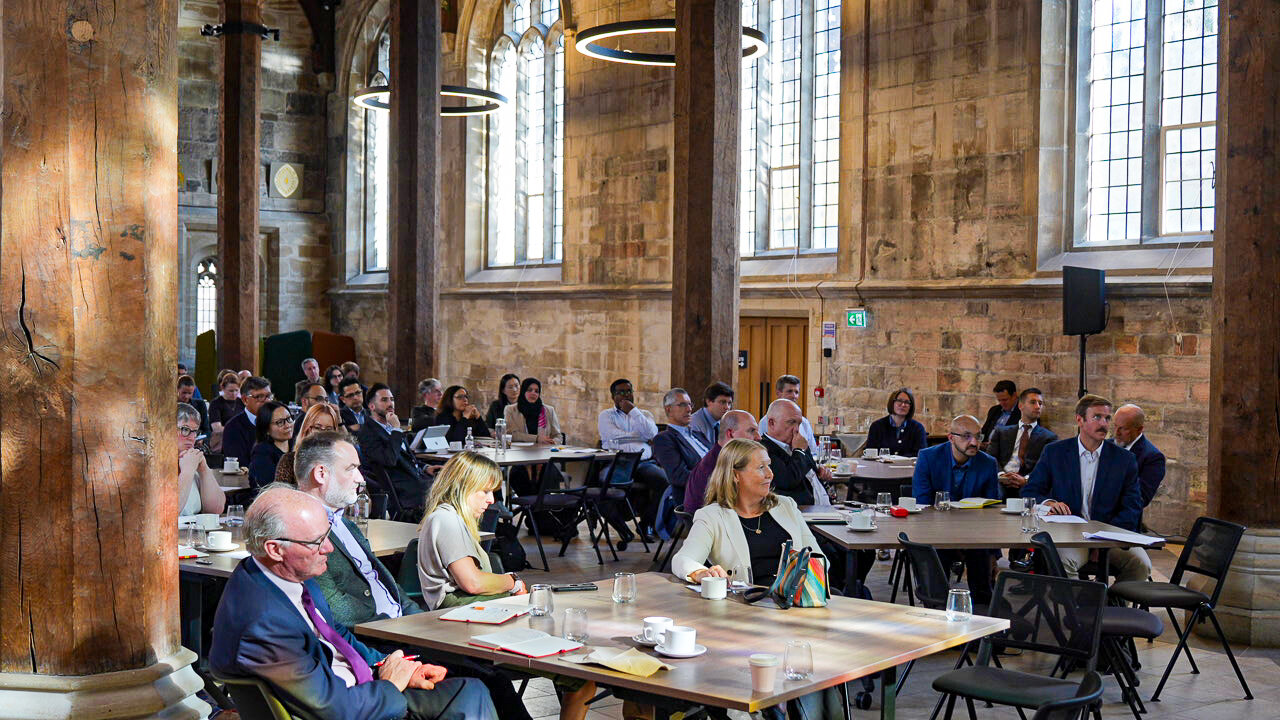
Keynotes
- Sir Michael Bibby explained why the research problem starts with identification. Some datasets identify family firms by matching directors’ surnames - an approach that can miss relatives with different names or branches of a family. He argued that weak definitions make it difficult to test claims about productivity or design policy around succession.
- James Reed described Reed as a business with a charitable foundation among its owners. The foundation holds 18% of its shares. He said the company’s purpose, “improving lives through work”, helps decide which activities it enters. As an example of what the model enables, he described Big Give’s matched-funding appeal raising £57 million for more than 1,500 charities in one week.
- Reed brought results from surveys conducted ten years apart. In the 2026 survey, 78% would consider working for a family business, down from 92% in 2016. Stability had become the leading attraction; limited career progression remained the leading concern. He asked owners to show prospective staff that senior opportunities are earned, rather than reserved for relatives.
- His point about reputation was more complicated than “people trust family firms”. The survey reported high trust, yet respondents named some companies that are not family businesses when asked where they would like to work. Reed took this as a sign that people respond to a founder’s story and a distinctive culture, but do not always understand the ownership behind a brand.
- The York and North Yorkshire Combined Authority turned the discussion towards delivery. Its chief executive said the region values firms that retain staff and invest locally, then asked owners to specify what the public sector could do to make their next investment or hire easier.
Growth and policy panel
- NatWest put figures behind the “critical middle”. The Yorkshire and North East area has more than 75,000 family businesses, including around 1,000 mid-sized family firms with combined turnover of £20 billion and 100,000 employees. These firms can be missed by policy aimed chiefly at start-ups or large companies.
- Jennifer Wood described succession happening sooner than she expected. After taking a two-week holiday, she found her senior leaders had run substantial parts of the business successfully; and enjoyed doing it. She stepped back from the chief executive role because she saw that giving them room to lead would help retain and develop them.
- Rachel Lewis identified the moments when support made a difference. Affordable space at York Eco Business Centre let the firm leave a home office, move from a two-desk to a four-desk space, and eventually buy a factory. Later decisions to invest in buildings and hire key people before the work was secured were much larger risks.
- The panel made clear that growth is not every owner’s objective. Prof Khaled Suffani distinguished firms content to sustain a restaurant or hotel from those seeking national or global expansion. Rachel said her firm grows partly to keep meeting customers’ needs and to create opportunities for loyal employees - not simply to make the business bigger.
- Owners gave specific reasons for caution. Rachel described the shortage of skilled engineers in the water sector. Jennifer said trading difficulties after Brexit had led her manufacturing business to move a facility to Poland. In the AI discussion, Rachel questioned whether systems designed around much larger companies would work for a small specialist manufacturer.
The final audience questions brought policy back to incentives. A hospitality researcher reported interviewing owners who were considering contraction or exit rather than growth. Panelists cautioned against treating those interviews as representative of every sector, while pointing to business rates, succession tax, trade and skills as issues worth examining in detail.
Social value and local impact panel
- Rennie Hoare connected values to the risks his family takes. He explained that C. Hoare & Co.’s partners have unlimited liability, giving them a direct reason to think carefully about decisions and culture. Its aim to be “good bankers and good citizens” appears in board and lending materials, rather than sitting apart from the bank’s work.
- Hoare showed what embedding that aim looks like for staff and customers. He said the bank gives 10% of annual profits to charity, matches staff payroll donations at two pounds for every pound given, and has trained its private bankers in philanthropy so they can have informed conversations with customers.
- Alan Discua Cruz used a long-established business with Quaker origins to explain “social legacy”. His research traced commitments to employees, education and welfare through changes in the firm over time. His question was what values survive when products, leaders and even ownership change. He also described “quiet giving”: substantial community activity that firms rarely talk about publicly.
- Tariq Shah OBE challenged the idea that legacy means doing the same thing indefinitely. Vigo Group has moved from improving individual properties to finding new uses for former factories and other sites. He argued that surviving across generations requires a business to keep finding new problems it can solve.
- The AI discussion exposed a useful difference in emphasis. Shah urged firms to try things and learn across industries and generations. Hoare looked further ahead to how a bank might build its values into the governance of AI-driven workflows. Discua Cruz asked what valuable conversations and relationships technology might displace.
Tax, Continuity and Succession
Panel: Key Points
Succession and continuity
- Dr Alex Kevill noted that succession is a process, not a handover date. He cautioned against accelerating the transfer of a business to someone who is capable but has not had time to work through what taking it on means.
- The same family history can motivate or burden the next generation. Seeing a parent struggle to build a business might inspire a successor, but it might equally create guilt, pressure or reluctance. Alex called for families to discuss those different experiences and assumptions openly.
Tax and ownership
- James Reed traced Reed’s charitable ownership to a family crisis. After his father’s cancer diagnosis in 1986, the family sold its 40-store Medicare business. Alec Reed donated his £5 million share of the proceeds to Reed Charity; the charity later bought shares in Reed from an investor seeking to exit. James said that sequence changed the character of the company.
- Reed identified three effects he feared from changes to inheritance tax relief: a larger potential tax bill as a business becomes more valuable; board time spent restructuring ownership instead of improving the business; and uncertainty that makes long-term planning harder. These were his assessment of the policy’s effects, rather than findings established by the panel.
- An audience member said first-generation owners need to hear about succession options earlier. Approaches from potential buyers become common as owners age, while those owners may never have transferred a business before. Reed added that transferring shares to a charitable foundation is one option his family had found valuable.
- Speakers differed on whether tax pressures would cause owners to leave the UK. Reed described people he knew who had moved away. A researcher said interviewees who currently owned place-rooted family firms generally saw relocation as impractical, but worried that younger generations might choose to build businesses elsewhere.
- Sir Michael Bibby asked for research into the net tax effect of BPR changes. His question was whether the expected revenue could be offset by changes in business activity or location. No estimate was offered at the event; Professor Kiran Trehan argued that it was precisely the kind of difficult question a future research programme should investigate.