
INTERdisciplinary Facility for IndOoR Air Quality ReSearch (INTERIORS): A globally unique research facility at the University of York.
Posted on Sunday 12 April 2026
What is INTERIORS?
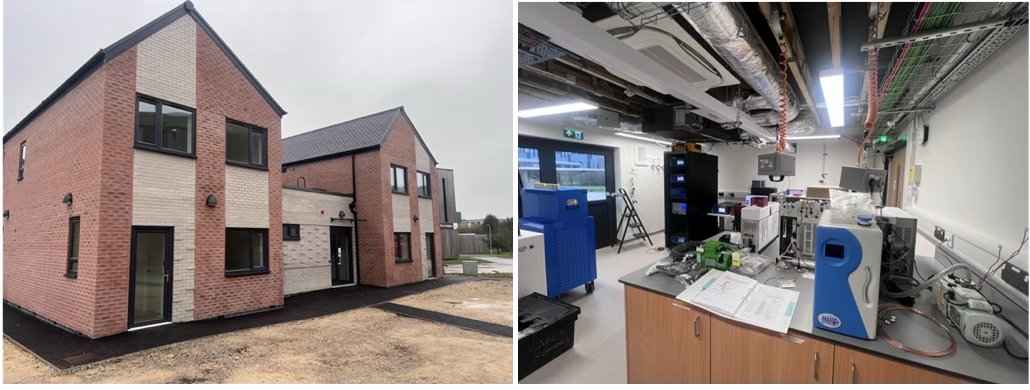
INTERIORS — which stands for INTERdisciplinary Facility for IndOoR Air Quality ReSearch — is a globally unique research facility at the University of York. Rather than a conventional laboratory, the facility consists of two identical residential properties, one built to 1990s UK building regulations, the other as a proxy for net-zero housing of the future being more efficient and with a much lower ventilation rate. The houses are linked by a central air sampling laboratory.
Whilst not permanently occupied, the two properties function as genuine homes. Acting as typical three-bedroom houses, these two-storey dwellings with semi-open plan living on the ground floor include a living room, kitchen, WC, three bedrooms, a bathroom and a hallway. Both are connected to mains water and electricity and furnished as typical residences — because the whole point is to study air quality as it behaves in the real world.
Two Houses, One Laboratory
Indoor pollution has many sources. Indoor emissions originate from building, decorative and furnishing materials, as well as occupant activities such as cooking and cleaning. Outdoor air pollutants can also enter buildings through doors, windows and cracks. From the spray of a cleaning product to the fumes from a frying pan, the air inside a home is a complex, constantly shifting chemical environment — and one that is only beginning to be properly understood.
INTERIORS is engineered to capture that complexity. A custom-built gas sampling system enables the research team to sample air from any room in either of the houses, as well as from outdoors. This side-by-side comparison is central to the facility's scientific value. By carrying out identical activities — cooking the same meal, using the same cleaning product — in both houses simultaneously, researchers can directly measure how different levels of ventilation, insulation and building design affect the air occupants breathe. Instruments housed in the laboratory enable measurements of stand air pollutants such as nitrogen oxides, ozone, carbon-monoxide and particulate matter, as well as a wide range of volatile organic compounds.
The scientific objectives of INTERIORS include unprecedented characterisation of indoor air quality under everyday activities such as cooking and cleaning; quantification of emissions from commonly-used building and consumer products such as carpets and air fresheners; and an understanding of the efficacy and potential secondary impacts of a range of consumer and material products, including so-called "green" materials used indoors. We also aim to study how emissions are chemically processed indoors, forming potentially harmful secondary pollutants., Ultimately, the facility seeks to identify solutions to improve indoor air quality — solutions that could inform improved building and product design, and be used by policy makers, building designers and managers, and consumer, furnishing and building product manufacturers.
Construction and Location
INTERIORS is located on Campus East, between Anne Lister College Block I and Goodricke College, Kenneth Dixon Court A Block. Work started in November 2024 and the facility was handed over in December 2025. Since then, the instruments and sampling system have been installed and we are currently undertaking a detailed study of emissions from new building materials, paint, flooring and furniture.
The facility is led by Professor Nicola Carslaw, Professor of Indoor Air Chemistry, in the Department of Environment and Geography, with Professor James Lee from the Department of Chemistry being the technical lead. The total project is valued at £2 million over three years and was funded by a grant from the Wolfson Foundation with additional support from the University and its benefactors.
Notes to editors:
INTERIORS can be used for academic and industrial funded research, as well as providing numerous opportunities for undergraduate and post-graduate research projects. For further details or to discuss research ideas please contact Profs Carslaw (nicola.carslaw@york.ac.uk) or Lee (james.lee@york.ac.uk).