
New materials conduct ions in solids as easily as in liquids
Posted on Friday 19 December 2025
Normally, when liquids solidify, their molecules become locked in place, making it much harder for ions to move and leading to a steep decrease in ionic conductivity. In a landmark discovery, scientists have synthesised a new class of materials, called state-independent electrolytes (SIEs), that break that rule.
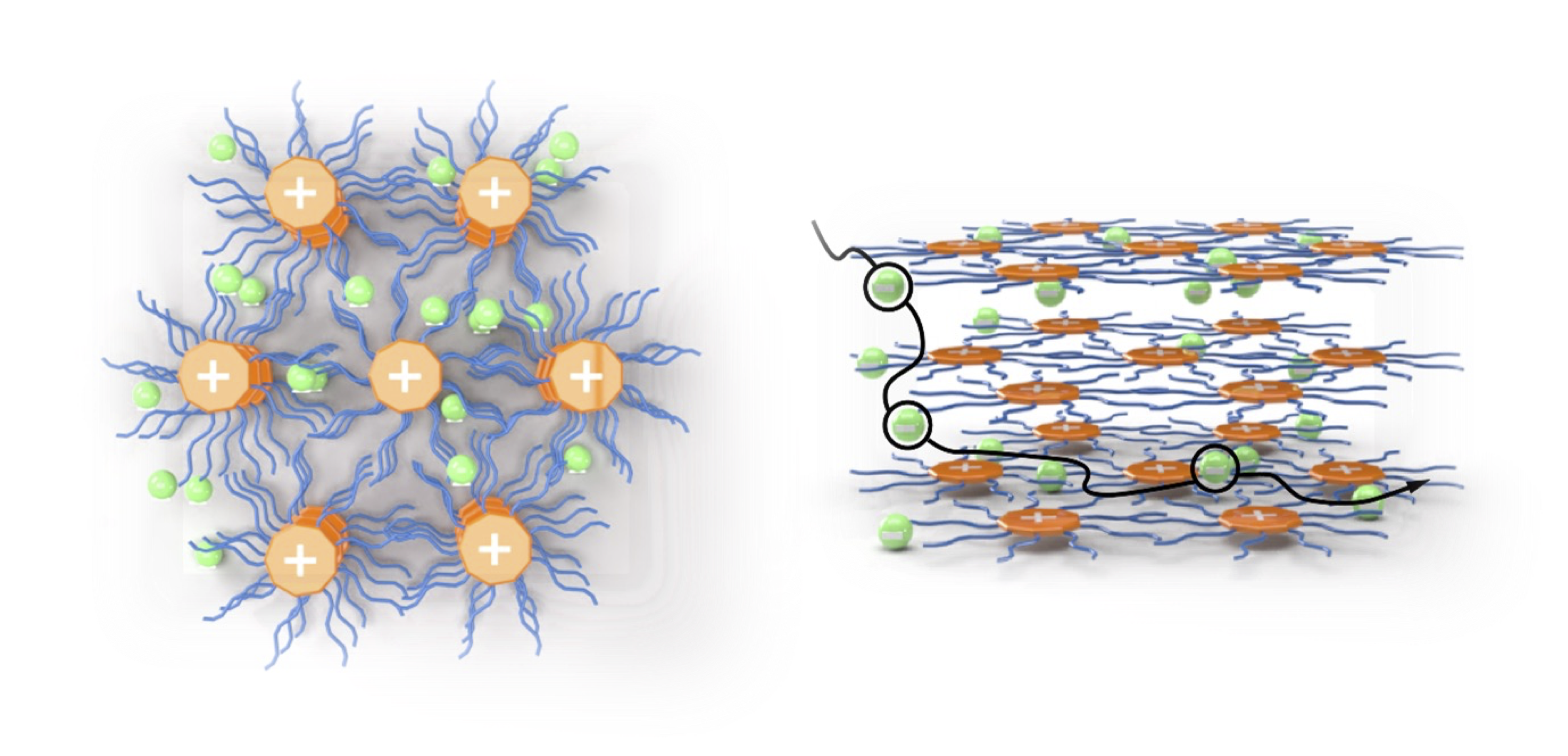
The team achieved this result by designing a new class of organic molecular ions with special physical and electronic properties. Each molecule has a flat, disc-shaped centre surrounded by long flexible sidechains—like a wheel with soft bristles (see Figure). Positive charge is spread out evenly across the molecule by the movement of electrons, which prevents it from tightly binding with its negatively charged partner. This allows the negative ions to move freely, flowing through the side-chains (the ‘soft bristles’).
In the solid state, these organic ions naturally stack on top of each other, forming long rigid columns surrounded by many flexible arms: much like static rollers in a car-wash (see Figure). Despite forming an ordered structure, the flexible side chains still create enough space for the negative ions to continue moving as freely, like they would in a liquid.
The resulting dynamic ordered structure allows the negatively charged ions to move through just as easily in the solid state as in the liquid form, with no sharp decrease in ionic conductivity.
Lead author Professor Paul McGonigal says: “We designed our materials hoping that ions would move through the flexible, self-assembled network in an interesting way. When we tested them, we were amazed to find that the behaviour is unchanged across liquid, liquid-crystal, and solid phases. It was a really spectacular result – and we were happy to find it can be repeated with a few different types of ions.”
University of York PhD student Juliet Barclay, first author on the study and recipient of the Department of Chemistry’s ‘KMS Prize’, says: “As a PhD student, it’s incredibly rewarding to discover something that changes how we think materials can work. We’ve shown that organic materials can be engineered so that the movement of ions doesn’t ‘freeze out’ when the material solidifies. This opens new possibilities for safer, lightweight solid-state devices that work efficiently over wide temperature ranges.”
The discovery could lead to new classes of flexible and safe solid electrolytes. One potential use case could be adding the electrolyte into a device as a liquid at a slightly elevated temperature, allowing it to make a good contact with the electrodes, before cooling to ambient temperature and using it in a safe solid form without losing ionic conductivity.
The resulting solid electrolytes have potential applications in batteries, sensors, and electrochromic devices, where organic solids are generally advantageous over inorganic materials because of their lightweight and flexible physical properties, and the potential to source them renewably.
This work is a collaboration between scientists at the Universities of Oxford, York, Leeds and Durham, with partners in Portugal, Germany, and the Czech Republic and is published in Science.
Notes to editors:
This work has been published in Science