
What is urban rewilding?
Posted on Monday 9 February 2026
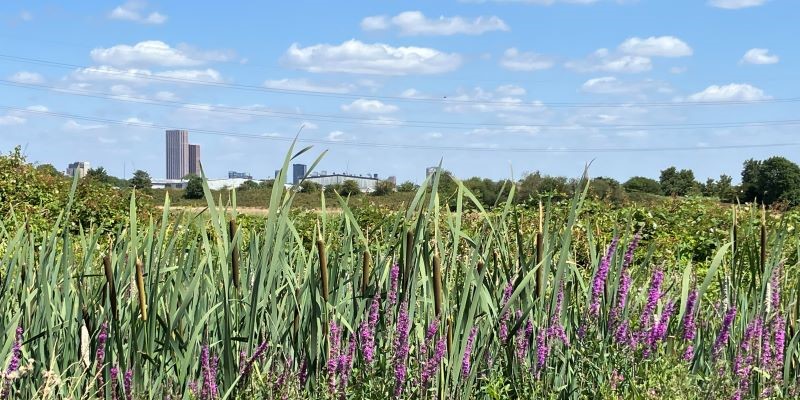
Urban rewilding broadly aims to create more self-sustaining and biodiverse ecosystems in populated areas. This includes cities, where the majority of people live (United Nations, 2025). In the UK, it is currently being realised through initiatives such as Plantlife’s No Mow May, Citizen Zoo’s Wild Tolworth in Kingston, the creation of meadows in public parks by Southwark Council and the gardening practices of individuals and communities, discussed at the recent Wilding Gardens conference I attended in Manchester.
Unlike rewilding in rural landscapes, debated since the 1990s (Lorimer et al., 2015), urban rewilding is a concept of relatively recent interest to researchers. A significant number of studies emerged in 2025, exploring subjects such as public perceptions of biodiverse urban nature (Hu et al., 2025), the potential for urban rewilding to contribute to food security (Russo et al., 2025), and relationships between people and nature created through projects such as OCT Park in Shenzhen, China (Shen et al., 2025).
Aiming to identify features of urban rewilding and discuss their wider implications, I conducted a review of 22 sources published between 2019 and 2025. The review synthesises the varied insights they provide on meanings of urban rewilding, to inform future research, practice and policy. It is transdisciplinary, i.e. it incorporates literature from both academic and non-academic sources (Vladova et al., 2025), including journal articles by researchers from varied fields, book chapters, organisational reports and a policy briefing.
Pettorelli et al (2022, p. 15) describe urban rewilding as “any low to no management initiative that seeks to improve the biodiversity of urban environments”. This is one of seven identified ‘definitions’ that highlight sites, aims and actions of the concept, features expanded upon by reviewing the selected literature. They vary depending upon context; evolving site conditions dictate whether actions are more active or passive (Shen et al., 2025), to meet aims such as increasing ecological resilience and providing increased opportunities for people to interact with biodiverse nature (Demirtaş and Güneş, 2025; Hartig, 2023), bearing in mind limitations such as human-wildlife conflicts or the aesthetic preferences of local residents (Moxon et al., 2023). These findings indicate that urban rewilding should be understood as an approach to creating more self-sustaining, biodiverse and resilient urban ecosystems, requiring tailoring to suit different contexts.
Government support for urban rewilding varies. Projects such as Nature Ways in Singapore reflect a longstanding ambition to be promoted as a ‘Garden City’ (Hwang, 2025; Velegrinis and Weller, 2007). In contrast, there are opportunities for urban rewilding to complement English environmental policy such as Biodiversity Net Gain, yet its promotion is currently limited (Overton, 2022). The Rewild London Fund indicates that this may be shifting, but requires a widespread change in mindset, towards increased tolerance of ‘messier’ ecosystems and the presence of non-native species.
I continue to reflect upon the implications of these findings and develop ideas for a second stage of research, which builds on momentum surrounding urban rewilding in London. This will enrich understanding of its meanings gained through this review, by examining the perspectives of land managers directly involved in the rewilding of unique sites across London boroughs.
References:
Demirtaş, E., Güneş, G., (2025). Rewilding-based planning against ecocide: a strategic response to infrastructure-led ecological degradation in northern Istanbul (2006–2025). Planning Perspectives 1–30.
Hartig, J.H., (2023). Rewilding the Detroit, Michigan, USA–Windsor, Ontario, Canada Metropolitan Area. Resources 12, 117.
Hu, S., Liu, J., Que, J., Su, X., Li, B., Quan, C., (2025). Perceptions of urban rewilding in a park with secondary succession vegetation growth on lake silt: Landscape preferences and perceived species richness. Urban Forestry & Urban Greening 104, 128648.
Hwang, Y.H., (2025). Urban rewilding in singapore: from a conservation strategy to a Sociocultural proposition. Urban Ecosyst 28, 153.
Lorimer, J., Sandom, C., Jepson, P., Doughty, C., Barua, M., Kirby, K.J., (2015). Rewilding: Science, Practice, and Politics. Annual review of environment and resources 40, 39–62.
Moxon, S., Webb, J., Semertzi, A., Samangooei, M., (2023). Wild ways: a scoping review to understand urban-rewilding behaviour in relation to adaptations to private gardens. Cities & Health 7, 888–902.
Overton, M., (2022). Urban Rewilding Policy Brief. University of Cambridge, Cambridge, UK.
Pettorelli, N., Schulte to Bühne, H., Cunningham, A.A., Dancer, A., Debney, A., Durant, S.M., Hoffmann, M., Laughlin, B., Pilkington, J., Pecorelli, J., Seiffert, S., Shadbolt, T., Terry, A., (2022). Rewilding our cities (ZSL report). London, UK.
Russo, A., Sardeshpande, M., Rupprecht, C.D.D., (2025). Urban rewilding for sustainability and food security. Land Use Policy 149, 107410.
Shen, Z., Qian, J., Zhu, H., Tian, S., (2025). Between binary- and mono-ontologies: The rewilding practice of Shenzhen Overseas Chinese Town Wetland Park. Geoforum 159, 104201.
United Nations, (2025). World Urbanization Prospects 2025: Summary of Results (No. UN DESA/POP/2025/TR/ NO. 12.). United Nations, New York.
Velegrinis, S., Weller, R., (2007). The 21st-Century garden City? The metaphor of the garden in contemporary Singaporean urbanism. Journal of Landscape Architecture 2, 30–41.
Vladova, G., Haase, J., Friesike, S., (2025). Why, with whom, and how to conduct interdisciplinary research? A review from a researcher’s perspective. Science and Public Policy 52, 165–180.