
TERRASAFE Project: Empowering Communities to Combat Desertification Across the Mediterranean
Posted on Wednesday 22 October 2025
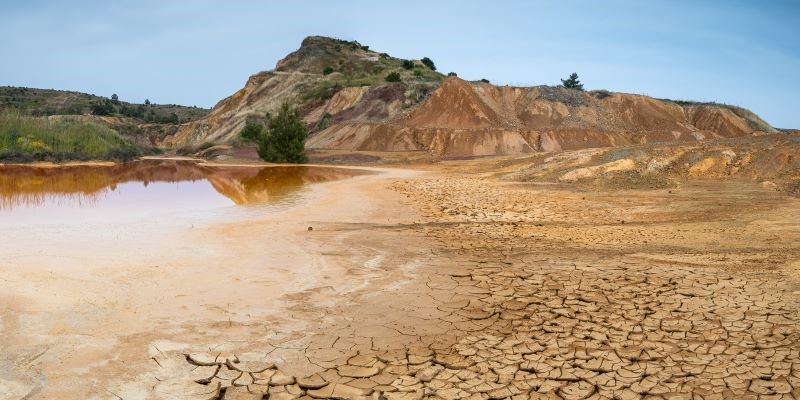
Soils are drying out, vegetation is thinning, and productive land is being lost - a process known as desertification, meaning the land degradation that occurs in dryland (arid, semi-arid, and dry sub-humid) regions. This degradation of dryland ecosystems, driven by climate change and unsustainable land use, threatens not only local biodiversity but also the livelihoods and food security of millions of people who depend on the land.
Thomas Timberlake gives an overview of the TERRASAFE project - a five-year initiative co-funded by the EU Horizon programme and UKRI which aims to tackle this challenge by empowering local communities to confront and reverse desertification through a combination of technological, ecological, and social innovations. The project brings together universities, research institutes, and innovative private companies from across Europe and North Africa. Professor Lindsay Stringer and Dr Thomas Timberlake from the University of York are co-leading the stakeholder engagement component of this project.
Understanding the Challenge
Desertification arises from the interaction of natural and human pressures such as declining rainfall, rising temperatures, over-cultivation, over-irrigation, and deforestation. This is particularly evident around the Mediterranean Basin, where roughly a quarter of the land is already considered highly or very highly vulnerable to degradation. Population density, heavy reliance on agriculture, and water scarcity make the region one of the global hotspots for land degradation and loss of soil productivity.
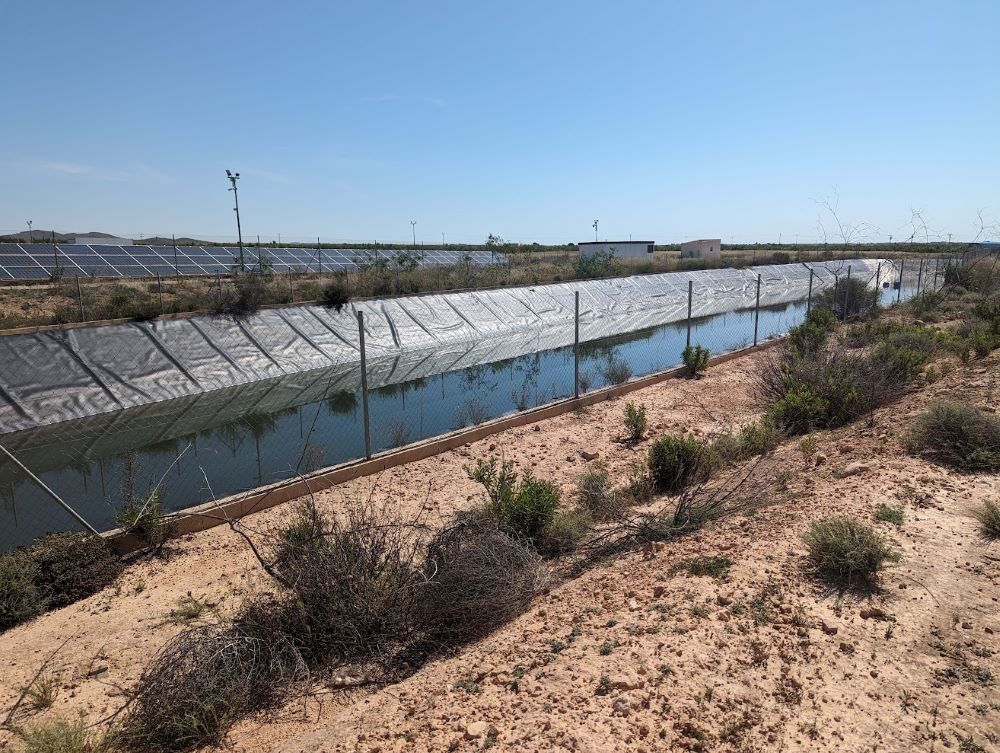 Unsustainable water use in the Campo de Cartagena region of Spain, where water is diverted from other areas to irrigate intensive agriculture in an extremely dry landscape. (Image: T. Timberlake)
The consequences reach far beyond the environment. As soils degrade, crop yields fall, groundwater reserves diminish, and rural livelihoods become increasingly precarious, fuelling poverty, migration, and social instability. TERRASAFE seeks to address these interconnected problems not by imposing one-size-fits-all solutions, but by working directly with the people most affected.
Five Pilot Regions, Five Distinct Challenges
To understand and test approaches that can be scaled up, TERRASAFE focuses on five pilot areas, each facing a different aspect of the desertification crisis:
- Cyprus – Soils are losing organic carbon, undermining fertility and water retention.
- Tunisia – Excessive irrigation has led to soil salinization, where salt builds up and threatens plant growth.
- Italy – Rural depopulation and land abandonment threaten traditional farming landscapes and social cohesion.
- Spain – In the country’s arid southeast, unsustainable water use for intensive agriculture is depleting aquifers and straining ecosystems.
- Romania – The legacy of post-Soviet land reforms has left fragmented ownership and widespread abandonment, accelerating erosion and vegetation loss.
Each region illustrates a different dimension of desertification where collaborative innovation can be put to the test.
Desertification Innovation Partnerships
At the heart of TERRASAFE are Desertification Innovation Partnerships: locally based collectives that bring together farmers, researchers, community leaders, and policymakers. These partnerships form the foundation for co-creating sustainable futures. Through a series of participatory workshops, stakeholders have defined what a “desertification-resilient” future might look like in their area and explored pathways to achieve it.
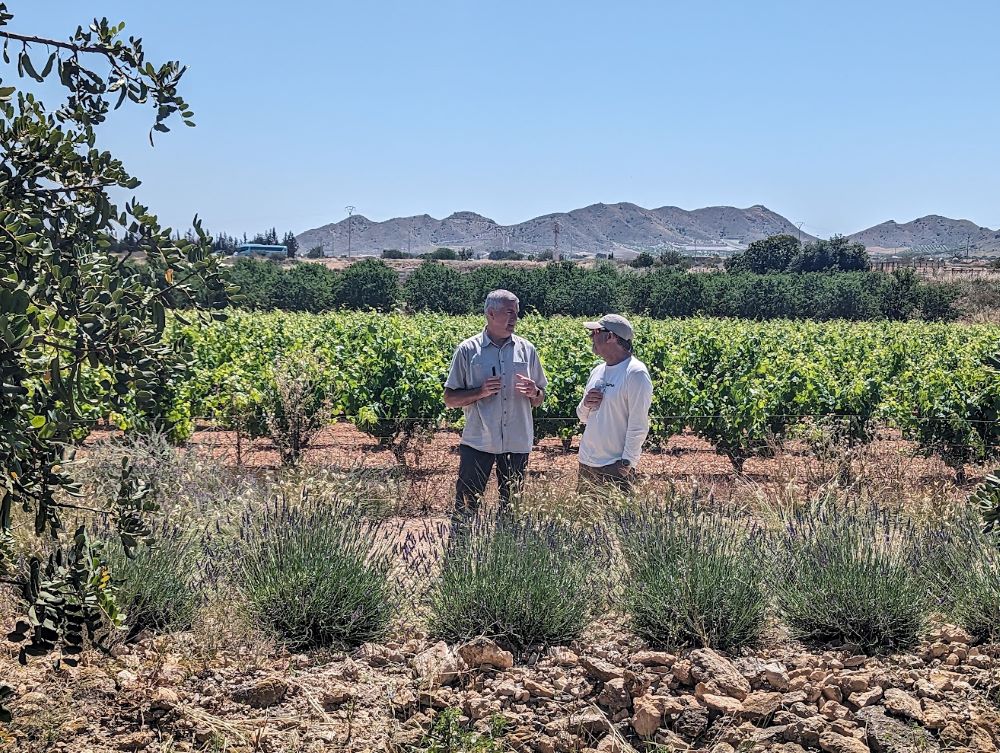 Farmers discussing solutions to reverse desertification in the Campo de Cartagena region, southeast Spain. (Image: T. Timberlake)
The process goes beyond discussion. Communities are actively involved in mapping degradation hotspots, diagnosing underlying causes, and designing field experiments to test promising innovations. Crucially, the Desertification Innovation Partnerships decide which interventions to trial and which measures of success they’d like to monitor.
Testing Innovations in the Field
The innovations being tested in TERRASAFE range from high-tech sensors to circular composting systems, reflecting the project’s interdisciplinary ethos. Examples include:
- A soil sensor system – that monitors moisture and other key variables, enabling farmers to make precise management decisions, reduce inputs, and improve sustainability.
- A lignin-based hydrogel – that boosts soil water-holding capacity and nutrient retention, helping crops withstand drought.
- Artificial Soils – created from recycled organic and inorganic waste materials to restore fertility and structure to degraded lands.
- Biochar – which is produced from the thermal decomposition of organic matter and enhances soil structure, fertility, and carbon storage.
- Circular Symbiotic Composting – A social innovation that maps and collects local green waste, processes it into high-quality compost tailored to local conditions, and redistributes it to farmers at low cost—creating a closed-loop system that benefits both waste producers and land managers.
Each pilot site has selected three innovations to test, chosen through stakeholder ranking exercises. Installation and monitoring are now underway, focusing on a suite of socio-ecological, agricultural, and economic indicators that will be tracked over the coming years.
A Model for Collaborative Resilience
TERRASAFE exemplifies how tackling environmental crises in the Anthropocene requires cross-disciplinary collaboration and community participation. By blending technological innovation with local knowledge, it aims not only to rehabilitate degraded land but to rebuild trust, agency, and resilience within communities.