
Cabin Ecology for Spaceship Earth
Posted on Tuesday 24 February 2026
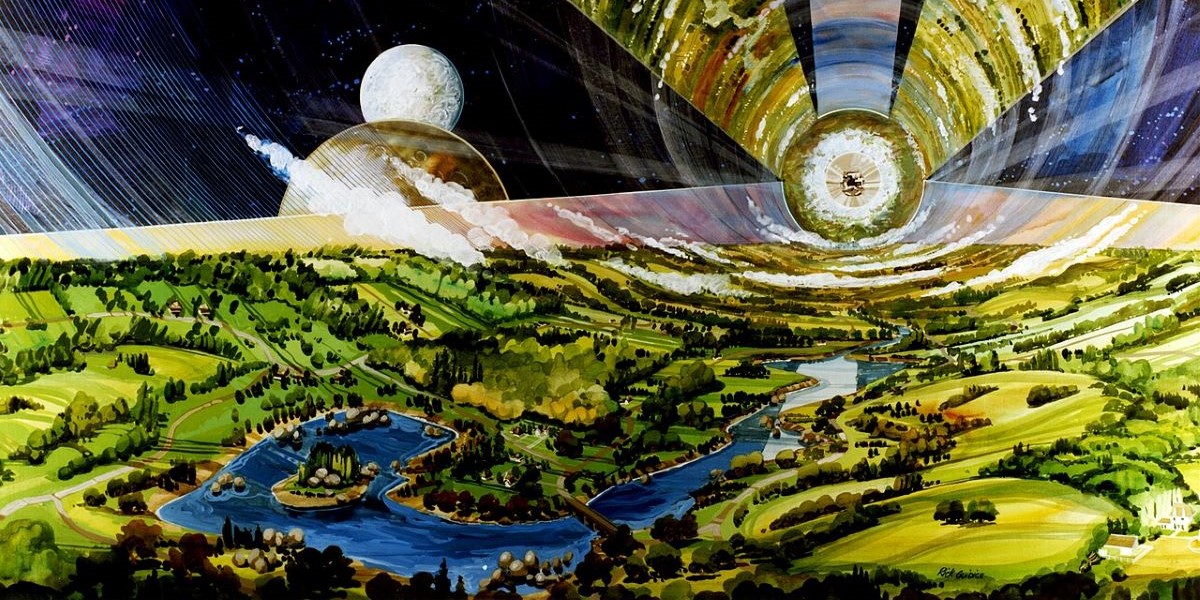
The early 1960s were some of the headiest years of the space race – John F. Kennedy had declared the ambitious goal of landing a crewed vehicle on the moon by the end of the decade, promising to usher in a new age for (US-led) humanity. The attention (and significant military funding) that was focused on extra-terrestrial travel created a fertile environment of research and speculation into the fantastic potentialities of where space travel could take the human species. Of critical importance to these fantastic potentialities was the building of systems which would enable human habitation on long-distance flight, the moon and (theoretically, still) beyond. For some of those with an ecological or biological background, such as the ecologist Odum brothers or the Soviet Space Program’s chief medical officer Norair Sisaskyan, these long-range life-support systems would need to be regenerative in order to be feasible, and the best regenerative systems were those currently existent in Earth’s biomes, such as the algae Chlorella, which could theoretically double as both air filter and foodstuff.[1][2]
Incorporating biological entities into the systems of a spacecraft was offered as an efficient, sustainable, and regenerative solution to building long-term life-support systems for theoretical future spaceflight. Biological entities such as algae already offered excellent miniaturisation and specialisation[3], vital characteristics of spacecraft components.
As the American 1960s saw a rapidly growing awareness of, and concern with, anthropogenic environmental degradation, the logic of a spacecraft cabin – maintained and engineered for regenerative sustainability – became a means of engaging with emergent global environmentalism[4]. ‘Spaceship Earth’ became a popular metaphor for a particular kind of environmentalism, one which advocated for a culture of technocratic stewardship over planet Earth[5]. If humanity had reached a point where it could affect Earth ecosystems on a global scale, humanity had a responsibility to manage these Earth ecosystems for their long-term health, rather than continue to utilise them for programs of power and profit.
Conceptually, viewing the Earth as one big spaceship mechanised organic life, describing it primarily as a component in a machine and focusing on its ‘function’ within a broader system, one which could be re-engineered, managed, and utilised. Functionally this differed little from descriptions of organisms as interconnected through ecosystems, but ethically this mechanisation of organic life re-centered the human within the ecosystem, as the astronaut of the spacecraft cabin (the human on Earth) was the ultimate purpose of the ecosystem (artificial and natural) around it. As historian Lynn Whyte Jr. famously highlighted at the time, this entitled anthropocentrism was a key driver in environmental degradation[6], and applying the logic of a cabin Earth-wide presented little ethical challenge to this predominant paradigm of Western thought. In response to a globalised threat of environmental degradation, ‘Spaceship Earth’ conceptually reframed the world around the human and advocated for a new ethic of behaviour towards the environment. However, it did little to challenge the human’s exceptionalist position within that environment, as something ethically distinct from the world around it.
In following the trajectory of the concept of a cabin ecology from speculative research into theoretical spaceflight to an ethical model for Earth during the 1960s, we can highlight the nuances in how research into space exploration influenced environmentalist discourse in the 1960s. In the image and the logic of a cabin are preconceptions around the human and its relation to the environment, some of which are reinforced and some of which are challenged by the advocation for a managed, engineered, cyborg system. As ‘Spaceship Earth’ became further popularised towards the end of the 1960s, the images of space travel – such as cabin ecosystems – opened new doors for environmentalist speculation, research, thinking, and discourse, challenging old ways of being and offering new ways of being. As crewed space travel becomes yet again a serious endeavour of nation states but also, in the 21st century, private companies, thinking about the material and conceptual environmental consequences of the space race in 1960s becomes ever more relevant for navigating the 21st century’s environmentalist world
References
[1] Odum, H. T. (1963) ‘Limits of Remote Ecosystems Containing Man’, The American Biology Teacher, vol. 25, no. 6, 1963, pp. 429-43
[2] Sisakyan, N. M. (1960) ‘Biological Program of Spaceship’, The American Biology Teacher, vol. 22, no. 8, 1960, pp. 486–88
[3] Parin, V. (1961) ‘The Cycle of Nature in the Spaceship Cabin’, The American Biology Teacher, vol. 23, no. 6, 1961, pp. 352–53
[4] Odum, H. T. (1971) Environment, Power, and Society, John Wiley & Sons, Inc: New York
[5] Cassidy, H. G. (1967) ‘On Incipient Environmental Collapse’, BioScience, vol. 17, no. 12, 1967, pp. 878–82
[6] White, L. (1967) ‘The Historical Roots of Our Ecologic Crisis’, Science, vol. 155, no. 3767, 1967, pp. 1203–07