
The eighteenth-century origins of nature connection
Posted on Tuesday 13 January 2026
Its proponents argue that human relations with nature foster such meaningful experiences that the climate and biodiversity crisis can be averted and human health and wellbeing transformed, as highlighted in a recent article in The Guardian. Some dwell on the narrative of human separation from nature in modernity and view it as playing a causative role in environmental change. More recently, researchers have begun to make claims about the value of framing human identity as part of nature and emphasise the importance of educational interventions in childhood. Meanwhile, parts of the health sector are increasingly turning to green prescribing as alternatives to pharmaceutical and other medical healthcare.
Rooted in environmental psychology, nature connection can be understood as an eighteenth-century phenomenon. Since the publication of John Locke’s An Essay Concerning Human Understanding (1689), philosophers of mind have been interested in how external material objects shape the human mind, which in turn directs human actions in nature. In the eighteenth century, theories of sympathetic connection also shaped understandings of human relations with the natural world. Medical practitioners suggested that nerves were crucial in the process of conveying external stimuli, through which animal spirits or electricity might travel to reach the human mind and soul. In 1749, the philosopher David Hartley offered a new material theory of vibrations which sought to explain the connection between the physiological and the psychological. In Observations on Man, His Frame, His Duty, and His Expectations, Hartley argued that human emotions had a material basis that could be felt in the body via the relative intensity of vibrations. Pleasure, for instance, could be induced with moderate vibrations, and pain with more forceful ones, each of which leave behind marks on the mind called ‘ideas’, which then become associated with each other, leading to the production of new ideas. Through this sensory process Hartley was able to make the moral case for observing, experiencing, and contemplating works of nature, which might be associated with ideas of ‘health, innocence and tranquillity’ and even act as an antidote to the ‘offensiveness, dangers, and corruption of populous cities’.
Hartley’s theory of the ‘association of ideas’ was widely adopted within scientific and literary circles but was particularly popular amongst rational dissenters like Joseph Priestley. ‘On Habitual Devotion’, a sermon Priestley gave to a crowd of dissenters in Wakefield in 1767, adapted Hartley’s theory to the practice of religious devotion by encouraging worshipers to cultivate the habit of associating God with every experience and ‘strongest emotions’ of the mind. For Priestley, such devotion could be practiced through agriculture, scientific observation, and investment in commerce and manufacturing to bring mankind closer to providential perfection. If Priestley’s associationism was primarily interested in encouraging the pursuit of objective science, his friend and fellow dissenter, the poet, essayist, and educationalist Anna Letitia Barbauld, was concerned with the ways in which associationism could either ‘sooth’ or ‘wound’ both people and nature. In response to Priestley’s 1767 sermon, Barbauld penned ‘An Address to the Deity’ (1769), a poem that details sensory observation of nature as an affective skill obtained through experience that leads to the surrendering of the self to a higher being. Truly connecting to God requires recognising mankind’s shared materiality with nature through sensory acts, for instance, by giving praise with a ‘mortal tongue’. Such devotional practices have an equalising force in the poem, leading to the recognition that ‘Worms, angels, men, in every different sphere/ Are equal all, for all are nothing here.’ Moving from images of human mortality (‘man is dust’) to scenes of vitalised nature (‘living waters’), the poem’s speaker submits her ‘soul’ and learns to see and hear God in the sky, flowers, trees, and leaves. Guided by the Deity, Barbauld espouses a kind of nature therapy in which connecting with natural objects has the power to relieve ‘anxious cares’ and ‘gloomy terrors’ whilst instilling ‘omnipotent’ feeling. However, at the poem’s close the speaker, instead of reaching a state of either terrestrial perfection or spiritual paradise, reaches the limits of devotional ecstasy, recognises the bounds of human knowledge, and the inability of mankind to grasp God’s will.
In an age of industrialisation, imperial expansion, and agricultural improvement, Barbauld’s brand of enlightened modesty provided a means for women, who were most associated with the feminine virtue, to engage with scientific discourse. ‘An Address to the Deity’ enjoyed a popular print afterlife in around a dozen poetry anthologies of the late eighteenth and early nineteenth centuries and became known as an important text for women’s education. Feminist scholarship on women writers of this period has thankfully long since moved beyond characterising Barbauld’s concerns with the domestic as politically conservative and now recognises the progressivism of her educational project, which revolutionised pedagogical practices and heavily influenced later British Romantic writing. Barbauld’s interest in environmental psychology extends across her corpus of writing for children, her poetry, and political essays, often operating as a critical tool for voicing dissent against economic inequality, slavery and imperialism, and unchecked political power, amongst many other subjects.
In her later poem, The Caterpillar (c.1816), written around the end of the Napoleonic wars, Barbauld describes how observing and contemplating an individual creature leads to the recognition of her own previous acts of slaughter, which she compares with the destruction of war. We join the speaker in her garden after she has cast her gaze on the ‘helpless thing’ and decided that she ‘cannot kill thee now.’ The speaker’s shift in emotional disposition is prompted by a change in visual perspective that involves closely studying the caterpillar’s ‘form with curious eye’ and interpreting its attempts to wriggle out of her clutches as a request for ‘protection’. Upon contemplating her previous exterminations she relents and, as in ‘An Address to the Deity’, recognises a ‘fellowship of sense with all that breathes’, prompting an abrupt change in poetic perspective towards the battlefield: ‘The work of death and carnage.’ Barbauld’s main concern here, however, is how feeling ‘melts for one’, but‘would not stir for thousands’ of people in a distant place. Barbauld’s insistence that ‘spontaneous’ feeling for individuals is ‘not a Virtue,/ Yet ‘tis the weakness of a virtuous mind’, offers a reframing of weakness as a mental disposition continuous with virtue. Indeed, the word ‘weakness’ here is a repetition from earlier in the poem when the speaker relinquishes control of the caterpillar, and the scene shifts to the battlefield:
Present’st thyself before me, I relent,
And cannot hurt thy weakness.—So the storm
Of horrid war, o’erwhelming cities, fields,
And peaceful villages, rolls dreadful on
Here, Barbauld indicates textually how sympathy for others at a distance follows from recognising ‘weakness’, the word here being akin to vulnerability. In Barbauld’s alignment of human and non-human weakness we might read a critique of male educational theorists like Jean Jacques Rousseau, who frequently argued that women’s mental fragility, ranked only slightly higher than that of animals, should prevent them from engaging with political and scientific subjects. We might also view the poem an example of early ecofeminism.
We might recognise features of Barbauld’s environmental psychology in nature connection discourse today. Among these are the ideas that being in nature can offer meaningful experiences to people, provide green therapy for mental health, and lead to politicisation and environmental protections. Other writers who were influenced by Barbauld’s work took environmental psychology in quite different directions. For instance, the feminist writers Catharine Macaulay and Mary Wollstonecraft emphasised how women especially might seek physical and mental freedom in nature, make themselves physically stronger, and thereby mitigate the expectations for women to make their bodies socially conform. Indeed, Macaulay and Wollstonecraft’s particular attention to the ways medical practitioners and wider society neglects and abuses women’s health may resonate with researchers exploring nature connection in certain practices that have recently become popular amongst women such as wild swimming, running, and forest bathing. However, environmental psychology’s liberatory potential contained a darker side as it fed into more coercive educational models. For instance, the Irish scientist and educationalist Richard Lovell Edgeworth believed associationism could be used to mould children into whatever form a parent might choose. His daughter, the novelist and educationalist Maria Edgeworth was particularly instrumental in deploying environmental psychology as a tool of political economy. Recently, Jon Mee has recognised the influence of environmental psychology on Unitarians in the north of England who played important roles in industrialising the mill and factory towns around Manchester.
The diversity and flexibility of early environmental psychology was a significant part of its appeal in the late eighteenth and early nineteenth centuries, providing an avenue for women to attain a degree of cultural authority which could be stretched across any number of subjects. By contrast, critics of nature connection today often point to the impossibility of consolidating scholarship into a single overarching framework or highlight parts of it they dislike as reasons to discount all of it. Yet nature connection remains a highly influential and diverse set of ideas that have shaped how we understand the world and our place in it for over two centuries.
Bibliography
Published Primary Sources
- Barbauld, Anna Letitia. The Collected Works of Anna Letitia Barbauld: The Poems Revised, Vol.1. Edited by William McCarthy. Oxford University Press, 2019.
- Hartley, David. Observations on Man, His Frame, His Duty, and His Expectations. 2 vols. S. Richardson, 1749.
- Locke, John. An Essay Concerning Human Understanding. Edited by Peter H.Nidditch. Clarendon Press, 1979.
- Macaulay, Catharine. Thoughts on Education: With Observations on Religious and Metaphysical Subjects. C. Dilly, 1790.
- Price, Richard, and Joseph Priestley. Sermons. London, 1791.
- Priestley, Joseph. Hartley’s Theory of the Human Mind. J. Johnson, 1775.
- Wollstonecraft, Mary. Thoughts on the Education of Daughters with Reflections on Female Conduct in the More Important Duties of Life. J. Johnson, 1787.
Secondary Sources
- Barkham, Patrick. ‘Britain one of least ‘nature-connected’ nations in world – with Nepal the most’. The Guardian. 01 November 2025. Accessed 10 December 2025.
- Den Otter, Alice G. ‘Pest, Parasite, and Positionality: Anna Letitia Barbauld and “The Caterpillar”: Studies in Romanticism, 43, no.2 (Summer 2004): 209-30.
- Freeman, Lizzie et al. ‘Nature Connection’. In Outdoor Environmental Education in Higher Education: International Perspectives, edited by Glyn Thomas et al. Springer, 2001, 189-200.
- Heft, Harry. Ecological Psychology in Context: James Gibson, Roger Parker, and the Legacy of William James’ Radical Empiricism. Routledge, 2001.
- James, Felicity, and Ian Inkster. Religious Dissent and the Aikin-Barbauld Circle, 1740-1860. Cambridge University Press, 2011.
- Kramnick, Isaac. ‘Eighteenth-Century Science and Radical Social Theory: The Case of Joseph Priestley’s Scientific Liberalism’. The Journal of British Studies 25, no.1 (January 1986):1-30.
- Major, Emma. ‘Nature, Nation, and Domination: Barbauld’s Taste for the Public”. ELH (2007): 909-30.
- Mayer, F. Stephan et al. ‘The connectedness to nature scale: A measure of individuals’ feeling in community with nature’. The Journal of Environmental Psychology 24, 4 (2004): 503-515.
- McCarthy, William. Anna Letitia Barbauld: Voice of the Enlightenment. Baltimore: The John Hopkins University Press, 2008.
- Mee, Jon. Networks of Improvement: Literature, Bodies, and Machines in the Industrial Revolution. Chicago University Press, 2023.
- Ready, Kathryn, J. ‘Dissenting Heads and Hearts: Joseph Priestley, Anna Barbauld, and Conflicting Attitudes Towards Devotion within Rational Dissent’. Journal of Religious History 34, no.2 (June 2010): 174-90.
- Richardson, Miles et al. ‘Macro-level determinants of nature connectedness: An exploratory analysis of 61 countries’. Ambio 55 (2026): 80-100.
- Schurch, Millie. ‘“And Breathes a Spirit Through the Finish’d Whole”: Empiricism, Poetry and Devotion in Anna Letitia Barbauld’s Poetic Epistemology’. European Romantic Review 33, 6 (2022): 777-800.
- Smith, Sharon. ‘“I Cannot Harm Thee Now”: The Ethic of Satire in Anna Barbauld's Mock-Heroic Poetry’. European Romantic Review 26, 5 (2015): 551-573.
- Stuart, Matthew. Locke’s Metaphysics. Oxford University Press, 2013.
- Tam, Kim-Pong. ‘Concepts and measures related to connection to nature: Similarities and differences’. Journal of Environmental Psychology 34 (2023): 64-78.
- Wharton, Joanna. Material Enlightenment: Women Writers and the Science of Mind, 1770-1830. Boydell and Brewer, 2018.
- White, Daniel E. ‘“With Mrs Barbauld it is different”: Dissenting Heritage and Devotional Taste”. In Women, Gender, and Enlightenment, edited by Barbara Taylor and Sarah Knott. Palgrave Macmillan, 2005, 474-92.
Copyright
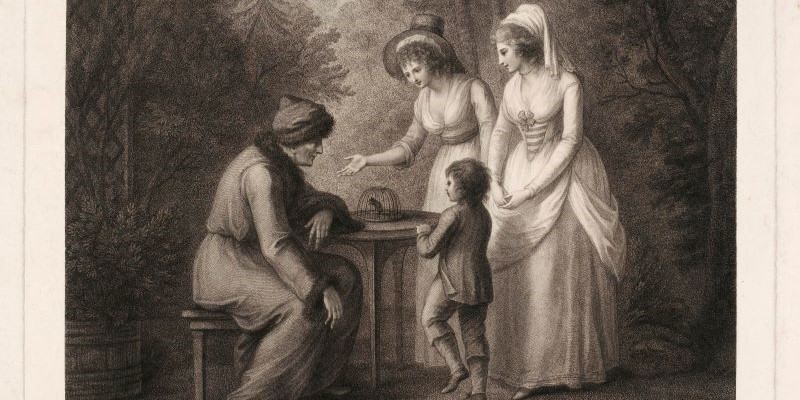
The Mouse’s Petition, by Francesco Bartolozzi, after Henry William Bunbury, published by Thomas Macklin, etching and stipple (1791). The British Museum, 1873.0809.209 © The Trustees of the British Museum. Shared under a Creative Commons Attribution- NonCommercial-ShareAlike 4.0 International (CC BY-NC-SA 4.0) licence.