
LCAB at IPBES 12: Reflections from Manchester
Posted on Monday 9 February 2026
.jpeg)
The Intergovernmental Science-Policy Platform on Biodiversity and Ecosystem Services (IPBES) is an independent, intergovernmental body that assesses the state of biodiversity and ecosystem services, the drivers of change, and options for conservation, sustainable use and equitable governance. Often described as the “IPCC for biodiversity”, IPBES brings together governments, scientists, Indigenous Peoples and Local Communities (IPLCs), and other knowledge holders to produce policy-relevant (but not policy-prescriptive) assessments and guidance. Its work is overseen by a Plenary of member states, supported by a Bureau and Multidisciplinary Expert Panel, and delivered through a work programme that includes global and thematic assessments, methodological guidance, and capacity-building and policy-support activities.
The 12th IPBES Plenary (IPBES 12) was held in Manchester from the 3 rd to the 8 th of February 2026 and was preceded by a ‘Stakeholder Day’ that provided a space for non-government stakeholders (including researchers, IPLC representatives, civil society organisations, and practitioners) to share perspectives, showcase relevant work, and engage directly with IPBES processes and leadership.
The plenary then moved into parallel working group sessions. Working Group I primarily focused on the Summary for Policymakers for the Business and Biodiversity Assessment, which examines how businesses both depend on and impact biodiversity, and explores options for shifting business practices towards more nature-positive outcomes. Working Group II considered all other business, including the platform's functions, its approach to deliverables beyond assessment reports, progress on ongoing work, and possible priorities for future assessments. The meeting also took place against a backdrop of wider institutional change, including the recent withdrawal of the United States from IPBES and the arrival of a
new Executive Secretary, Dr. Luthando Dziba.
A group of staff from LCAB attended IPBES 12 to observe proceedings, engage with stakeholders, and learn more about how the platform works in practice. Ahead of the meeting, participants were each given a set of five reflective questions (one of which was answered in advance). The sections below share their individual reflections, offering a range of perspectives on what they learned, what surprised them, and what they found most interesting, useful, or hopeful for the future.
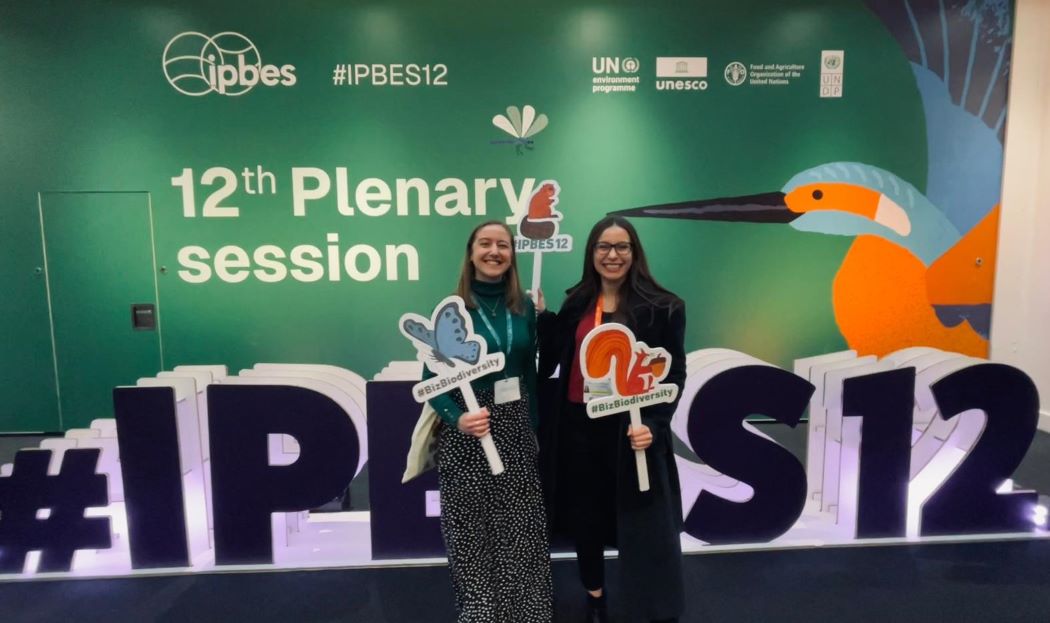 LCAB PhD Students Charlie and Kate in between the plenary sessions.
What were your main reasons for attending IPBES?
All: As a group, we attended IPBES to better understand how policymakers are thinking about the development of biodiversity markets, including the role (if any) that philanthropy is expected to play in creating an enabling environment, and what exactly is intended to be enabled – greater business and investment, improved biodiversity outcomes, or both. We also wanted to see policymaking in action: how evidence is used, how negotiations unfold, and how countries exert power and influence within an international platform. Lastly, we all hoped to meet and network with senior stakeholders and policymakers working at the science-policy interface.
What was the most interesting/useful part for you?
Jamie: The opportunities to network were particularly useful, especially during Stakeholder Day and the reception on the first evening of the plenary. I had lots of great discussions with members of the IPBES Secretariat, IPBES experts, and a wide range of other stakeholders (including civil servants and academics) from around the world, which will really help to shape my research moving forward. It was also great to network collectively as part of the LCAB team!
Kate: It was extremely interesting to get first-hand experience of how policy negotiations proceed, to understand the nuts and bolts of the process, and experience the atmosphere and tone of the conference. I was fascinated by the dynamics between countries, who spoke up more/less, the reasons why different countries appeared to speak up (e.g. technical, semantic, political) and how the experts addressed their requests and comments.
Luke: As a very early career researcher, the opportunity to network with more senior scientists and policy makers was of particular value to me. As my research sits at the crossroads between ecosystem services and climate change, it was exciting to gain the expertise of individuals who have already travelled the path that I am embarking on. I would also comment that by going as a group, more experienced people were able to provide insights into the deliberations, with others picking up on what might have been otherwise missed.
Victoria: Gaining insight into how science and policy interact at this level was particularly valuable. I found it really interesting to observe the geopolitical alliances and rivalries that were never far from the surface, with countries raising key issues that reflected their national interests. Furthermore, debates over outwardly minor points may reflect broader strategic positioning or bargaining for concessions later in the process.
Hanna: Observing the difficult balancing act the IPBES team was trying to strike between the need to be progressive (enabling transformative change to address serious global issues, in line with the recent IPBES transformative change assessment) and gaining the international consensus needed to get the wording in the document approved. Observing the painstaking progress with agreeing wording illustrated why so many of these international agreements are watered down: their structure favours those seeking to obstruct or maintain the status quo.
Charlie: I’d attended COP30 virtually in November 2025 so I’d had a taster of watching the meticulous process of going line by line through a piece of work however when you’re at an early stage of political engagement it can be hard to pick up on the nuance and context of sticking points. Sitting together, a mix of newcomers who asked thoughtful questions and more seasoned attendees who could point out what we might miss, was really valuable and I learnt a lot more than I would have sitting behind a computer screen!
What did you learn from the meeting?
Jamie: I gained a much better sense of how IPBES actually works in practice – from where its funding comes from, to how it is governed and how priorities are set. It was particularly useful to see how IPBES connects with multilateral environmental agreements (e.g. UNFCCC) and UN agencies (especially UNESCO, FAO, UNDP and UNEP), and how these relationships influence the topics it takes forward. It’s a complex entity, but pretty impressive when you see it all in action.
Kate: I learned never to miss the first day or the opening ceremony (I had no choice because I was presenting at a seminar abroad). While not much work of substance happens initially, I learned that this was a crucial networking opportunity, which I was sad to have missed.
Luke: Before attending the plenary, I had overlooked several factors, mainly related to the underlying politics. However, of particular value was a conversation I had with the chair of Working Group One. He was able to elaborate on how the deliberations over more contentious points between nations can be resolved, and how the underlying politics can play a large part in the reception of suggested changes or how points may be used to leverage other points that may arise later. From a practical point of view, it was interesting to hear how the language used in the English document can greatly impact the translated copies and how the nuances of the language can be lost. It is important for the clearest possible language to be used to convey the message correctly.
Victoria: Global collaboration is really tough, and quite slow! The requirement for complete consensus was interesting to observe, ensuring that all participants were satisfied with the final outcome. While this reflects a strong democratic model, it clearly makes progress more challenging, as individual objections may lead to the dilution of key messages.
Hanna: From the stakeholder day: That it is a bad idea to introduce speakers with a snippet of music. The intention (to liven up the event (or wake us up?)) was appreciated, the execution was not… More seriously: The constant tension between the need for clear, consistent, coherent and quantifiable impacts and actions vs the need for locally adapted approaches and acknowledgement that no-size-fits-all. It’s very difficult to get both. And as mentioned by the others: the importance of language and the weight of words.
Charlie: I learnt that you can talk to people! And indeed, they’re often happy to explain things to newcomers. On first walking into the Whitworth Hall reception, I felt a little overwhelmed, I didn’t recognise anyone outside our LCAB circle and was keen to talk to new people – but how does one go about that! It was my first time attending something as an LCAB group and here I learnt that one perk of attending as a team was that others were more than happy to introduce me to their connections. Additionally, that a lot of people are also happy to chat if you just go up and ask them, often interested to hear about your work in turn. These opportunities and discussions were a real highlight for me. I also have to say here that Luke was brilliant at catching people – even the new Executive Secretary who was happy to speak to us.
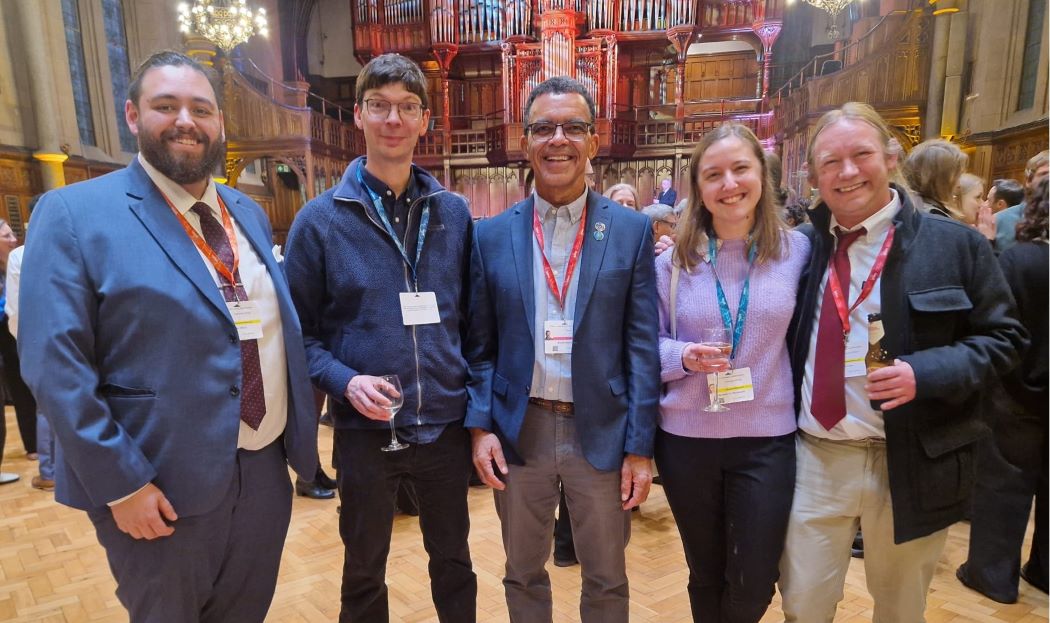 Luke, Colin, Jamie and Charlie enjoying a drink with IPBES Chair David Obura during the reception event at Whitworth Hall
What surprised you most?
Jamie: I was surprised by the extremely detailed level of scrutiny given to individual sentences – and sometimes even single words – when deliberating the Summary for Policymakers. On one occasion, almost an hour was spent debating the wording of a single sentence. I knew this process would be thorough, but I did not expect it to be quite so intensive!
Kate: I was pleasantly surprised by the humour in the room - the Chairs, the experts and the various country representatives made some very funny comments using very clever plays on the words they were debating, which kept the mood light and gave the audience several laugh-out-loud moments.
Luke: For me, the most surprising part of the event was how accommodating delegates were to first-time attenders. I had conversations with several delegates, working group chairs, and secretariat members, all of whom were more than happy to explain elements of policy as well as the workings of the panel. As an early-career researcher, it can often feel daunting to be in a room with people who are far more senior; however, people were very interested in hearing about each other's research, career goals, and seemed happy to offer advice on how one may realise these goals.
Victoria: I was surprised by the care given to the precise wording of the Summary for Policymakers. It was clear that delegates were keen to ensure that their messages were clear and unambiguous for policymakers and businesses to interpret. I was also surprised by the active role that observers were permitted to play in suggesting improvements to the documents, many of which were received and included in the final document.
Hanna: Given the theme of the assessment, I was surprised that there were very few obvious “business people” or institutions present, e.g. no visible representation of lobby organisations and companies, and no parallel sessions etc at the venue for businesses to try to influence proceedings (although there was one in another part of town). That’s probably a good thing, as the lobbying has become a serious problem at the COPs, but in general the event was less diverse and less vibrant than I expected, particularly the stakeholder day.
Charlie: What surprised me was learning about some of the “tactics” member states might use in reviewing a document. Where I was sometimes puzzled at why a particular country seemed so insistent to have a particular word included or excluded, I’d learn that actually, it was less about the current sentence, and more about having something to leverage for a different point that would come up later on. A conversation we had with a co-chair during the week spoke to this, explaining that when trying to settle two disagreeing countries you really needed to read between the lines to find the actual point of issue so you could find the right compromise.
What contributions/observations made you hopeful for the future (if any)?
Jamie: The growing emphasis on engagement with IPLCs, women, youth and other commonly marginalised groups, and on better integrating their knowledge into IPBES assessments. It was also encouraging to hear about the increasing uptake of recommendations from past IPBES assessments. As someone who is a bit obsessed with inclusivity, and also a bit sceptical about whether science really translates into policy, this gave me hope, and I hope that these trends continue.
Kate: The attention and emphasis on the rights and knowledge of IPLCs. The level of cooperation and general consensus among participants: it didn’t feel as ‘political’ as I had expected, based on my understanding of the COPs, and it didn’t seem that countries were weaponising the negotiations (although I am told by Colin that this is because these negotiations are non-binding).
Luke: Truthfully, there were few. It was encouraging to hear that there has been more of an uptake of IBPES assessments; however, I remain relatively sceptical of how much influence this will actually have in policy. Especially with a key player such as the USA withdrawing, I also worry that this will set a precedent for other countries to do the same.
Victoria: It was encouraging to see the recognition of the vital role of IPLCs, alongside reviews of progress towards gender balance and representation among experts and member states, and an acknowledgement of the need for further progress. It was also hopeful to see effective collaboration between countries (for the most part), and a largely unanimous recognition of the vital need for action, as well as repeated affirmations towards the importance of science-based policy. Whether or not this will translate into meaningful change remains to be seen.
Hanna: It unfortunately did not make me very hopeful. There were so many examples of double-standards, i.e. between what countries are agreeing to and pushing and what they are actually doing at a national level. Transformative change cannot happen simply by verbal or written agreement, radical (and costly) actions are needed to change the economic structures which underpin most of the problems we’re facing. However, these negotiations are the best we’ve got and the IPBES folks are genuinely passionate and talented, so small steps forward are definitely better than nothing.
Charlie: I think I will reserve some judgement as I think what we’ve observed at IPBES is only half the story, the Summary for Policymakers of the IPBES Business and Biodiversity Assessment is not legally binding (which I’m told is partly why the Working Group seemed to be running relatively smoothly) but will be important for negotiations later in the year and I’d like to see how it fits in there before getting too optimistic.
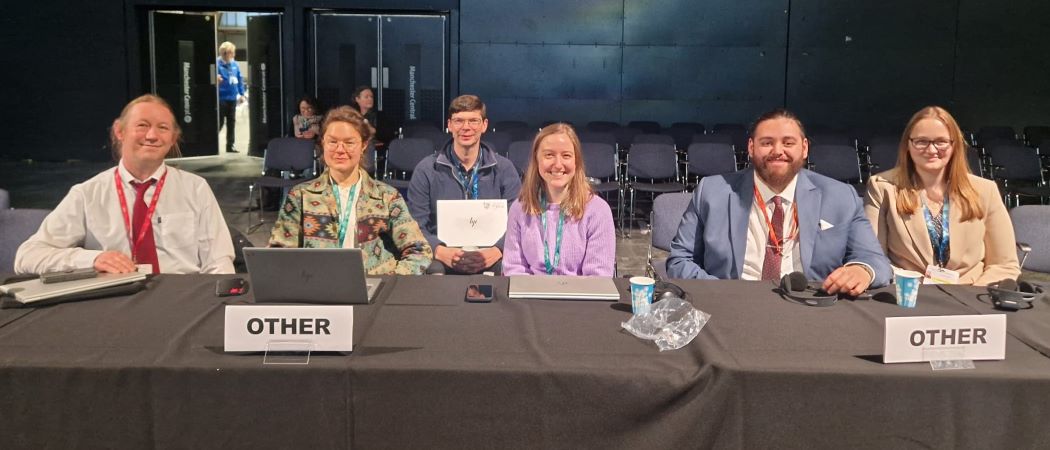 Jamie, Hanna, Colin, Charlie, Luke and Victoria in the ‘Observers’ area of the main plenary room.
In conclusion…
Taken together, our reflections highlight both the value and the limitations of IPBES as a global science–policy platform. The meeting provided valuable insights into how international biodiversity policy is negotiated in practice, revealing the importance of language, power, inclusivity and consensus-building, as well as the inevitable trade-offs these processes involve. While views differed on how hopeful the meeting felt, there was broad agreement that IPBES remains an important space for advancing evidence-informed dialogue on biodiversity, even if translating this into meaningful action remains challenging. For LCAB, the experience underscored both why engagement at the science–policy interface matters, and why it is often slow, messy, and contested.