
The essential contributions of women to fungal biodiversity data in the early twentieth century
Posted on Wednesday 17 December 2025
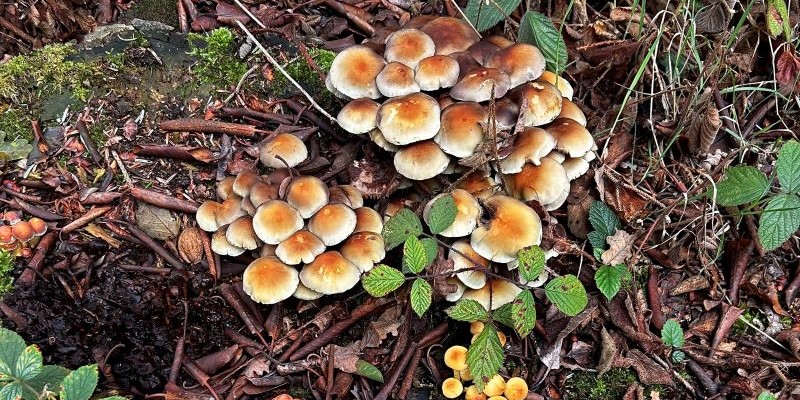
Fungi and fungi-like organisms are significant contributors to global biodiversity, yet they operate within complex systems that remain little understood. A major source of fungal diversity data is the Fungarium at Royal Botanic Gardens, Kew. This collection is one of the oldest and largest, housing over 1.25 million dried specimens that represent more than half of the known global fungal diversity, spanning from the early eighteenth century to the present.
Held in the basement of Jodrell Laboratory, the Fungarium consists of several roller-racking compressors, each stacked floor-to-ceiling with green, neatly labelled specimen boxes containing dried specimens in paper envelopes. Peppering the rest of the space is everything else fungi – models, illustrations, garlands, books, even LEGO. This basement – and the mycologists in it – can tell you almost everything western science knows about fungi. Yet, just as fungi themselves remain 'out of mind' to the majority, the fungarium retains a low profile as a data source for both historians and biologists. There are several reasons for this. Firstly, people don’t know what a fungarium is or what it does. As with other natural history collections, they have not been integrated into university teaching in recent decades. Secondly, fungariums suffer from the endemic ‘fungi-blindness’ that plagues the rest of society – we often ignore the fascinating complexities of fungi, perhaps because they are mostly invisible, and sometimes because they can be ugly, poisonous, or pathogenic.
For historians of science, the fungarium is an enigmatic space because the history of mycology is. While secondary and primary sources are plentiful if we’re looking at the history of botany, studying the history of mycology is a scarcely trodden path – there are scraps of secondary literature and limited formalised (or catalogued) archival collections. Aside from a handful of biographies; a couple of accounts of mycology’s divergence from Botany circa 1840s; and some retellings of the establishment of the British Mycological Society in 1896 the rest has remained somewhat mysterious in academic discourse until recently. Only now we are realising the importance of the history of mycology and how it affects understanding of scientific, working class, and domestic cultures from the mid nineteenth century.
There are still many gaps to fill, especially the gaping hole caused by the absence of dedicated studies on women mycologists, of which there were many. Even the big names like Elsie Wakefield (Head of Kew Mycology 1915-1945), Annie Lorrain Smith (a seminal lichenologist), and Guilema Lister (an expert on mycetozoa) are yet to receive in-depth full-length studies about their mycological careers. Hundreds more women who contributed to mycological research in the early twentieth century remain absent from academic literature; in some cases they are missing from the historical record altogether.
The mycology team at Kew is working to change this narrative; they have named each specimen compressor within the Fungarium after a female mycologist, accompanied by her picture. Kew is also planning an exhibition about female mycologists. And, in collaboration with York/LCAB, Kew is supporting my doctoral research, which intends to help us understand the significant (and so far invisible) contributions of women to Kew’s Fungarium.
I hope to establish the social history, trends, motivations, and networks underpinning the mycological practice women engaged in. I also hope to do a bit of myth-busting, proving that women’s access to mycology was not (always) limited by patriarchal agendas, or even (in some cases) class. Stereotypes of both the feminine and the scientific were more mutable than at first imagined, especially at a time of such profound social change. My research is centred in the British context from 1900-1950, a period which saw the suffrage movement, major extensions of franchise, the collapse of empire, not to mention two world wars and the profound social reset that occurred in their wake. Creating a social history in its broadest sense I will search for data related to the ‘who, what, where’ of fungi collecting, the trends, motivations, and networks underpinning the practice. This starts with the specimens held at Kew's fungarium and works outwards through archival warrens to discover human stories behind British Fungi. In so doing, we ensure that the significant contributions of women are recognised as vital parts of the vast fungal diversity data preserved in Kew's Fungarium, helping to diminish the endemic 'fungi-blindness' that still affects our understanding of intellectual and ecological diversity.