
Sharing visions of future landscapes
Posted on Tuesday 8 July 2025
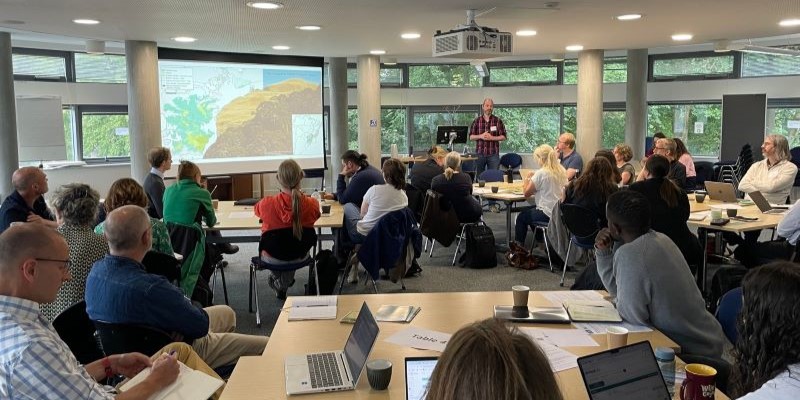
The aim of the workshop was to explore and understand the different perspectives and experiences that come into play when thinking about landscape futures, and how researchers can work in genuine partnership with those who live and work in the landscapes they are studying. Rather than deciding how future landscapes could or should look, the workshop focused on finding out which approaches are most effective and inclusive. We heard about different experiences in working with multiple partners to co-create landscape visions as well as the approaches and research methods used to work collaboratively with partners from outside of academia. Talks were themed around “Sharing experiences”, “Sharing approaches”, and “Sharing evidence and research”; after each set of talks, participants discussed in groups what they had heard, and reflected on the lessons learned for future research partnerships.
Attended by researchers from across the University, as well as external partners from the Avon Wildlife Trust, North York Moors National Park Authority, The Yorkshire Arboretum and Forestry England, a diverse range of speakers shared their experiences of collaborating with a range of stakeholders to make meaningful collaborations in land use, conservation, and community engagement projects.
Some key themes that emerged from the day:
- Building relationships and trust takes time. This must be factored into project timelines and budgets and ensure long term partnerships can be supported beyond an individual project. Engagements with stakeholders must begin early, before projects are formally launched, so that genuine co-design can take place. Such early conversations help to ensure that research genuinely aligns with local concerns, the right questions are asked and the project can build in flexibility to accept and adapt to unexpected outcomes. While the labour- time- and cost intensive nature of effective engagement were noted, working in partnership with established and trusted local organisations could help build trust and effective communication while minimising stakeholder fatigue.
- It is very important that everyone connected to a piece of land - not just landowners - is considered. Established and trusted local organisations may not necessarily represent a broad cross-section of society, and may even unintentionally participate in the marginalisation of voices. Therefore, partnerships with these groups should be viewed as complementary strategies rather than complete solutions, alongside more direct outreach to underrepresented voices. Outreach is needed to actively seek out marginalised voices, taking into account factors such as age, gender, and local power dynamics.
- Identity, memory, and emotion are critical factors in land-related decision-making. Understanding landscape history and change over multiple timeframes can help people imagine landscapes looking different to how they do now, or how they are remembered and what has driven change.
- Common difficulties relate to land use, conflicting priorities, and how change is managed. By openly and proactively addressing difficult topics, researchers can build credibility and connection Integrating biodiversity, heritage, and climate agendas with local priorities remains a challenge, requiring skillful and inclusive navigation. One on one conversations are important in understanding perspectives and building relationships. Using boundary objects such as games or models can bring participants with divergent views together in constructive ways.Accepting and summarising divergent views builds shared understanding.
- Avoiding overly structured or directed conversations using diverse forms of engagement could open the way for more spontaneous conversation and co-creation.Creative tools, visualisation, storytelling, games, analogue tools, and skilled facilitation to support inclusive dialogue and scenario planning were flagged as appealing to a broad range of participants, not all of whom would feel included via digital forms of engagement.
- Researchers can show that they value their partners’ time in material (e.g. food, money) and non-material (e.g. time, respect, gratitude) ways. Researchers need to consider the commitments of their partners such as the farming calendar, which is sometimes overlooked in academic planning. Incentives must be appropriate and ethical. Care is needed to avoid undue influence or perceived corruption. Care should be taken about giving appropriate credit and authorship; traditional academic systems may not adequately reflect collaborative contributions.
- In parallel with the previous point, academics should not be passive and should not be afraid to take the lead in conversations and research planning; the expertise offered by researchers, and their experience in navigating conflicting priorities, should not be overlooked.
- It is vitally important to provide feedback and results in formats that are appropriate and useful for user groups. Researchers should consider reports, stories, poems and art in parallel with their formal academic outputs. The risk of over interpretation of maps or model outputs was discussed; being honest about uncertainty and complexity will help build trust. Building co-created communities of practice, often based on pre-existing networks, will help to ensure longevity and sustainability of research, beyond project timelines.
Despite the range of examples discussed during the day, which hailed from Brazil, Burkino Faso, Kenya, Thailand and New Zealand, as well as Somerset, North Yorkshire and the Lake District, landscapes and sense of place were identified as unifying themes. The workshop provided valuable insights into how researchers can more meaningfully and effectively engage in participatory research. Among the takeaway messages were that researchers and participants must recognise and adapt to their role as hosts, guest and collaborators, which may change at different stages of the project development, respecting personal narratives of change and lived experiences. Being a curious and humble partner in exploring future landscapes, using facilitated spaces, with a range of approaches, adapted to local conditions, is vital in reaching a broad section of society. Finally, accepting ongoing change and allowing space for iteration, adaptation and uncertainty can help to build enduring legacies and communities of practice rather than focusing on project endpoints.
Notes to editors:
The workshop was funded by a Valuing Voices Agile funding call, the Leverhulme Centre for Anthropocene Biodiversity and UKRI SMMR Pyramids of Life project. Valuing Voices is a partnership project with the University of Mahidol, funded by the Wellcome Trust.