
Unearthed: The power of gardening
Posted on Friday 25 July 2025
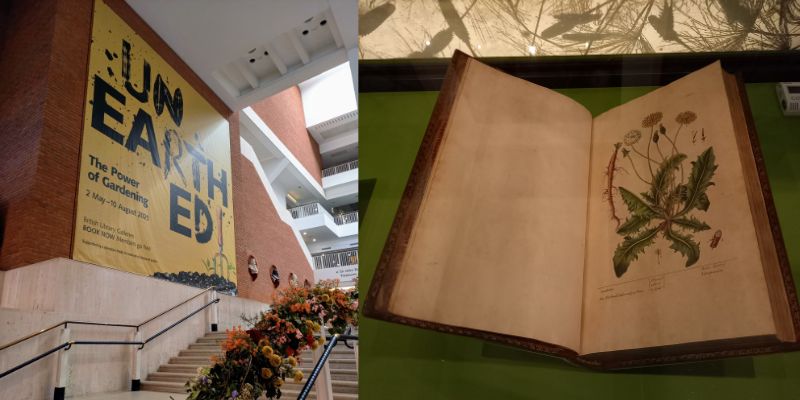
Part of the Gardens and Empires conference held at the British Library was a private viewing of the current exhibition Unearthed: The Power of Gardening. As a researcher on the environmental and cultural history of weeds, it was an event I could not miss!
The exhibition centres around the idea that gardening is transformative at an individual, community, and global level. It walks visitors through a social and political history of gardening, exploring issues like land ownership, empire, and gender. It shows how, throughout history, gardeners have had a role in bringing about change. The exhibition has been constructed around objects, such as botanical illustrations, maps, and gardening books. You get the impression that the curators delved into diverse collections and archives, bringing unique material into dialogue, including many items that have never been exhibited to the public before now. By focusing on the material, the exhibition is accessible to a range of audiences, and as a visitor, you can opt into reading information boards or simply enjoy the beauty of leaf pressings (which, after a long day at a conference, was at some points a relief). Without a fixed overall structure or route, you can follow your interests and where your eyes take you.
Whilst the exhibition reinterprets the classic and most well-known narratives of garden history, quite sensibly, drawing attention to prominent and influential women, with the gardening boots and a detailed garden plan belonging to Gertrude Jekyll, and a copy of Jane Loudon’s book ‘Mrs Loudon’s Gardening for Ladies’. It also interweaves voices that have been more marginalised in the history of gardening. There is a portrait, from 1754, of one of the earliest known Black gardeners in Britain, John Ystumllyn. He is thought to have been enslaved as a child, and then, on moving to Ystmullyn in North Wales, he became trained as a gardener. It is unusual because there are relatively well-kept records of his life. It highlights that gardening has frequently been a necessity for the socially and economically marginalised. Though the exhibition has a human focus, the relationship between people and non- humans was not absent. A book from about 1705, on vermin killing, highlights the hostility towards certain wildlife in gardens; it includes species such as badgers, ducks, and otters, which are unlikely to be seen as ‘vermin’ today. However, it brings to the foreground that concerns over ‘pests’ are deep-seated and the relationship between people and nature is complex and ever-changing. With my research, focusing on the cultural construction of weeds in the nineteenth century, I was particularly excited by the appearance of dandelions and the question of whether they are a ‘weed’ or a ‘useful plant’.
Despite becoming immersed in garden history since the start of my PhD, I enjoyed the opportunity of visiting the exhibition to learn about new ideas and discover new material items. The opportunity to see objects, such as a Wardian case (a large container for transporting plants over long distances), was not only exciting, but also seeing this item in person, you realise its immensity. Whilst wandering around the exhibition with a fellow conference attendee, we were both struck by the size and prominence of the case, which brought to life the history of plant mobility and the practicality of gardening.
This exhibition, therefore, attends to a range of questions not simply of the past but also of the present and the future, drawing upon examples of contemporary activism and gardening. If you have the opportunity, the Story Garden behind the British Library is an unexpected pocket of garden activism in the busy atmosphere of London. Understanding the varied and influential history highlights how gardening is an area we can turn to for thinking about contemporary issues.