
Art, biodiversity and collaboration
Posted on Monday 9 June 2025
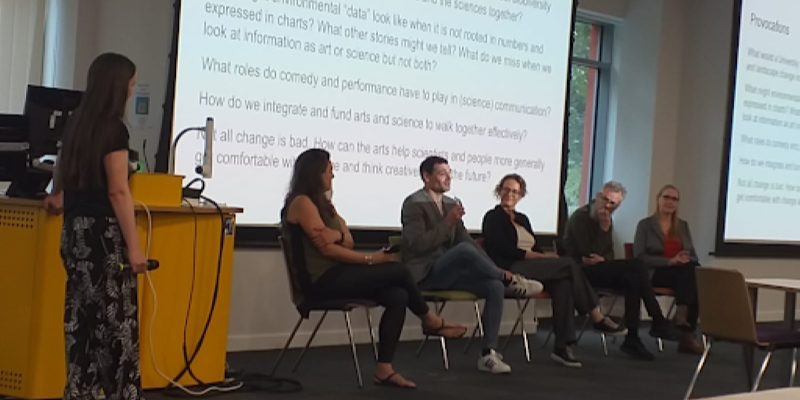
This special session focussed on the interface between art and science in understanding and relating to biodiversity change. The aim of ecoscapes is to bring together ecologists and people from other disciplines to explore together the complex issues of biodiversity change and response in the Anthropocene.
In the Festival of Ideas event, an expert panel of artists and scientists shared their work and perspectives, and discussed how collaboration can stimulate reflection, strengthen understanding and promote positive change for biodiversity and landscapes.
LCAB PhD student Chantal Berry provided the soundtrack, the podcast version of The Saltfleetby Project, a collaboration between early career researchers from University of York and Lancaster University, with The National Archives. The Saltfleetby Project is an artistic interpretation and audio walkthrough of a medieval manor in Saltfleetby, Lincolnshire, at the beginning of the sixteenth century. It explores the role of rural sound in the creation of acoustic communities and the impact of biodiversity change on rural soundscapes in England since the medieval period, emphasizing the importance of taking the biodiversity conversation across disciplinary boundaries from science into history, literature and music.
An inspiring introduction from artist and ecologist Professor Pen Holland presented science and art as different sides of the same coin; ways in which to see and reflect on what is really there, and then understand and communicate the meaning of these, to build communities and solve problems across disciplines.
Dr Helena Cox, Artist and Art Curator at the University of York then shared highlights from the University’s collection of over 900 artworks, drawing attention to the importance of sculptures as defining characteristics of our campus, and noting various exhibitions held at York (both past and future) that reflect environmental change and societies responses to it. Helena's own artistic work is mainly focused on abstract watercolours inspired by Japanese Zen aesthetics, ink painting and calligraphy, which she has previously exhibited in Prague, Tokyo, Manchester and Stockport. Helen’s work draws on music, nature and the patterns in everyday life, to present an emotional and joyful response to life as a symphony of connections. You can find out more at www.helenacox.com.
Dr. Richard A Carter, an artist and Senior Lecturer in Digital Culture in the School of Arts and Creative Technologies at the University of York, discussed how he used technology, often seen as inimical to nature, to help engage, interact and explore change. He showcased his artwork Lines of Flight, a digital, moving poem, based on the flight path of a glider. Richard’s work as an academic and as an artist show how art and in particular the relationships between the digital and natural worlds, can be used to tell different stories about change and the future, and ask us to reflect on what kind of world we want to live in.
Next, we welcomed York alumnus Dr Veronica Ongaro. Veronica is a biologist and artist, taking inspiration from microscopic forms of life including diatoms and algae. Nature is the unlimited source of inspiration and the driving force of Veronica's work: she uses printmaking, ceramics, stained glass to make those things in life that we cannot see, large enough to wonder at and begin to appreciate, in colour, light and three dimensional pieces. Veronica noted that for her, and for all of us, art is a universal language that can start conversations and make connections across disciplines, to bring us out of our corridors and departments and into shared endeavours.
Moving to the written and spoken word, our next speaker was Suw Charman-Anderson, founder of Ada Lovelace Day, an international celebration of women in science, technology, engineering and maths (STEM) which she began in 2009. She has also worked as a technology journalist, writing for The Guardian, CIO Magazine and Forbes amongst others. She introduced her current project Fieldwork, an eco-sitcom podcast, in collaboration with ecologists at the Universities of York and Edinburgh. Exploring the science of rewilding, and how that can help us increase biodiversity and bio abundance, Fieldwork aims to engage a wide variety of people with the science that can help us tackle climate change and environmental degradation. With Fieldwork, which has been described as The Archers meets the Detectorists, she aims to provide a counterpoint to the prevailing sense of overwhelm and despair, through humour and sound but entertaining science, and help listeners don an ‘ecologist mindset’ no matter what their personal and professional goals might be.
The final speaker Paul Shields, is the photographer for the University of York, a role that he has held for over 23 years. He photographs everything from architecture to archaeology artefacts, and his photographs have appeared in many books, magazines and national newspapers. His most recent exhibition of Brutalist and modernist architecture was held on campus at York. Paul works with Helena, the University of York art curator and is involved in the photographing and the guardianship of the University art collection. He encouraged us, the audience, to use nature photography as a way of slowing down and engaging more deeply with nature and our environment: the key to a good photograph is not to take many, but to learn to see what is there.
Prof Holland finished by highlighting Vice Chancellor Professor Charlie Jeffery’s comment on the University’s Curator and Keeper podcast that our campus is a place of discovery, enriched by artworks around every corner that ask us to stop and reflect on what the University is, and stimulate creative thinking about the meaning and application of our disciplines and ideas. The panel discussed how the University could look if all our conversations about biodiversity and landscape change incorporated ideas from both the scientific and artistic angles, touching on how art can provide a common language across disciplines, a way of recording past, present and future aspirations, and bring us together to find and pursue common goals.
The audience participated by creating their own doodle art and feedback on hexagonal papers, providing a rich and artistic mosaic of commentary on the event. But what comes next for the Ecoscapes ABC? The Art and Biodiversity team are looking for Collaborators to make a new exhibition come into being. You can read more about The Hive Mind on the art on campus webpages, and sign up to be a contributor or supporter, to bring a honeycomb of perspectives on biodiversity and landscape change to a York exhibition in 2026. We look forward to hearing from you!