Your questions answered
Our frequently asked questions are grouped under the following headings:
- The course
- The application process
- Overseas, mature or non-standard applications
- Fees, bursaries and scholarships
The course
Should I do an MChem or a BSc degree course?
In making the choice between BSc (3-Year) and MChem (4-Year),
you need to consider how useful the additional MChem year will be in
preparing you for your likely career, and whether it provides
experiences and challenges that will be interesting and worthwhile.
Students who take the MChem courses are generally aiming for a
scientific career, whereas students taking the BSc may be interested in
a variety of possibilities, for example teaching.
Our course is designed to be flexible, so that you can transfer
between MChem and BSc courses at any time during the first two years.
How many hours' teaching will I have, and in what size groups?
In a typical week, the number of contact hours with chemistry staff is around 21 to 22. Your timetable will include practical work in the lab, lectures, tutorials and workshops.
Weekly tutorials (4 to 5 students) and workshops (up to 25 students), organised on a college basis, are used to support the material covered in the lecture courses. Five to six staff in your college will arrange your tutorial and workshop programme, and guide your work throughout the 3 or 4 years of your course. This continuity of teaching and the small size of the groups (normally 4 or 5 students) make it easier for you to get to know your tutors, and you are welcome to seek help from them whenever you need it.
How do you organise practical work?
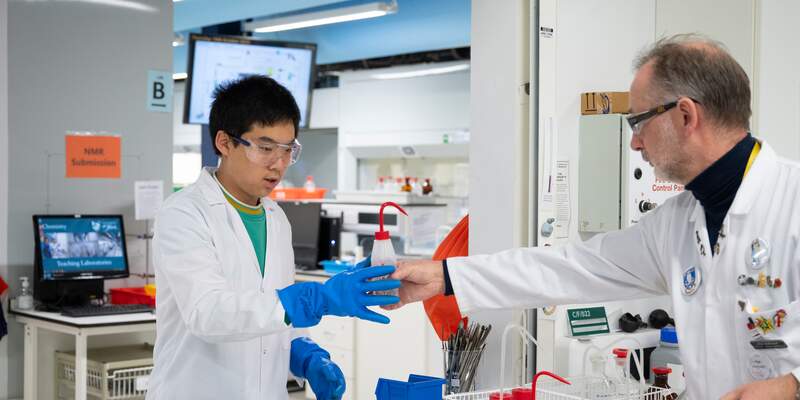
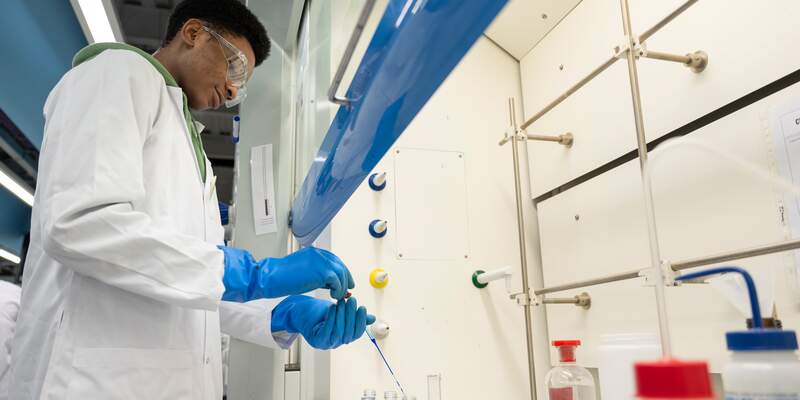
Practical work is spread over two days in Years 1-2 and labs are open for up to 13.5 hours per week. At the beginning of the course, you will carry out a range of synthesis experiments, guided by academic staff and postgraduates, and there is an emphasis on teaching you fundamental practical skills and building up your confidence in the lab. As the course progresses, you have an increasing range of choice in the experiments you do, and these also become more open-ended
View a student view on practical work.
Can you give me any advice on purchasing prescription safety glasses?
The standard we require if you do wish to purchase prescription safety glasses is EN166F and they must have side panels fitted. There is a wide range of frames available, and it is important that they provide good coverage of your eyes.
Do you teach in terms or semesters?
What forms of assessment do you use?
Students are typically assessed through end-of-module examinations
and continuous assessment, such as practical work and/or coursework.
For some modules, presentations are assessed.
Students who fail modules have the opportunity to take resit examinations.
What feedback will I get?
We pride ourselves on delivering useful written and verbal feedback to all of our students. Whenever you complete and hand-in a written piece of work, you will receive feedback on its good and bad points, and guidance on how you can improve further. In some cases, this work will be assessed towards your degree mark (eg examinations, practical work and assessed workshops), whereas in other cases the work, and feedback on it, is primarily intended to assist your own personal development (eg for tutorials and workshops, each week, written work is marked and returned giving our students prompt feedback on performance and understanding)
Who monitors my progress during my degree?
The Board of Studies in Chemistry is responsible for monitoring the progress of all of our students. However, at the beginning of your degree, you will be assigned a supervisor who will be a member of academic staff within the Department of Chemistry. Your supervisor will monitor your progress and provide you with advice, encouragement and support as may be necessary. You will meet with your supervisor at the beginning and end of each term (reports on your tutorial and workshop activities are sent to your supervisor by your tutors), and occasionally within each term, to receive and discuss your examination or coursework marks. Our students are encouraged to turn to their supervisor if they have difficulties that may affect their academic work or enjoyment of University life.
Does the Department have a peer-mentoring scheme?
Yes, some of our second, third and fourth year Chemistry undergraduates
provide informal help and support to students throughout their first
year of university. The mentors offer help and advice to our first year
students on a range of social issues, as well as a range of issues
relating to their course. The Department also has a student-run
Chemical Society (
ChemSoc) that organises a programme of social events for its members to meet away from lectures and labs.
What proportion of students fail or drop out?
A small number of students may transfer between courses, both to and from Chemistry (perhaps up to 4% students will make some change), but the number of Chemistry students who fail and/or drop out of the university is very small indeed – typically, around 4.5 per cent each year. As recently published in The Times Good University Guide 2011, "York has one of the lowest drop-out rates in the country".
Our student feedback regularly places us as one of the top Chemistry departments in the UK for teaching according to the National Student Survey (NSS).
What proportion of chemistry students are women?
Can I study other subjects as part of my degree?
Yes. As part of any Chemistry degree course you can choose to take 'elective' modules: up to 20 credits in your second and later years can be freely chosen from across the university (subject to timetabling constraints and your background knowledge).
Is it possible to spend some of my degree studying abroad? If so, do I need a language qualification?
Yes. You can sign up for an MChem course where you spend Year 4 at an overseas university. You have the opportunity to spend an academic year in Finland, France, Germany, Italy, Singapore or Spain.
Students applying for a year in France, Germany, Italy or Spain are
generally required to have a minimum of GCSE grade B in an appropriate
European language. The University, through the “Languages for All”
programme, provides further language training and this is free of
charge to Chemistry students who register for our "Year in Europe"
courses.
York also has exchange schemes with the USA for students on the
standard degree courses - there is one with the University of
California, for example - though these are usually very popular and a
place is not guaranteed. You apply for these exchanges when you are
already at York.
I am interested in a career in teaching. Do you provide any special support?
York has a highly successful and supportive programme of student volunteering in schools (
YSIS).
BSc students interested in teaching also have the opportunity to do a
research project in local schools as part of the Undergraduate
Ambassadors Scheme (UAS).
What career options will a chemistry degree give me?
Employers value the training in logical thought, and numerical and
communications skills that you will receive through a chemistry degree.
Major employers of chemists include pharmaceutical companies,
agrochemical companies, oil companies and the makers of detergents,
paints, dyes, cosmetics and explosives, but the diversity of employment
is endless. The Royal of Society of Chemistry (RSC) provides lots of information on the various career paths open to chemists.
View information on career prospects for York Chemistry graduates
Once accepted onto a chemistry course, what information is provided by the department before the course starts?
The admissions process
What is your standard offer?
We consider all applications on their own merits and therefore the exact nature of offers can vary to match individual cases. For A level students, offers are typically based on three subjects at A level, one of which must be Chemistry. Grades are in the region AAA to AAB. For International Baccalaureate students, offers are usually based on a minimum score of 35 points overall, including grade 6 in Chemistry and another science/Mathematics at Higher Level.
View a complete list of our entry requirements
Do you have different offers for different Chemistry courses?
Offers to applicants for the MChem programmes are the same as for BSc
programmes, except that applicants wishing to be considered for the
'Year in Europe' programme are generally expected to have a minimum of
GCSE grade B in an appropriated European language.
I am doing an unusual combination of A level subjects. Will you still consider me?
We will consider applicants with Chemistry and no second science or Mathematics. Grades required are in the region AAA including an A grade in Chemistry plus an A or B grade in AS science/mathematics.
Do I require an A level in Maths?
Maths
is a very useful subject to help support some of the quantitative
topics in a chemistry degree course. However, we do not require
students to have A level maths. In Year 1, we provide a maths skills
course (taught by Chemistry staff) to support those students who have
not taken Maths beyond GCSE (or equivalent).
Do I choose which college to be in?
The Department of Chemistry is unique at York in that Chemistry students are taught in college groups for the small-group teaching sessions (weekly tutorials and workshops). All teaching takes place within the Department of Chemistry. Most students will live in the same college as their teaching group. Prior to applying for accommodation we write to students asking them for their
college accommodation preferences (to help you select your accommodation, you may find it useful to look at the college's accommodation website) and we use this information when assigning students to their college teaching group.
When do I apply for accommodation?
When you have met our offer, following the release of the A-level (or equivalent) results in mid-August, you will be sent an email from Student Administrative Services explaining how to apply for accommodation. There are a variety of room types available with different letting periods in the seven colleges. For further information of the different types of accommodation please take a look at the
accommodation website for new students.
Do you have any catered accommodation?
Yes,
catered halls are available in Derwent and Langwith Colleges. Two substantial meals (breakfast and dinner) are included in your accommodation charges.
Does it matter which school/college I attend?
No, not at all. All applications receive equal treatment, irrespective of educational background or geographical location. We welcome students from all sorts of backgrounds and with a wide range of experience, and consider every application on its own merits. York is a socailly diverse university and the most recently published Times Good University Guide 2011 noted that at York, "eight out of ten undergraduates are state educated".
If I apply for medicine, how will my application be treated?
We consider all applications on their own merits and each year we make
a number of offers to students applying for medicine. We recognise that
students who apply for medicine will need to focus their UCAS personal
statement on their interests in medicine, so we ask that these students
submit a separate personal statement (to reflect their Chemistry
interests) directly to the Department of Chemistry (please contact
Katrina Sayer for
further details). If selected for interview, this will be an
opportunity for us to discuss your level of commitment to Chemistry.
After submitting my UCAS application, when will I hear from you?
Normally, we will contact an applicant within 2 to 3 days of receiving
their UCAS application. For a UK applicant, after attending an
interview in the department, we will write to you and send our decision
to UCAS within a few days of the interview. A few days later, you will be able to view the offer on UCAS Track.
Will I have to attend an interview?
For applicants who are based in the UK, we make it a policy always to interview applicants before we make them an offer of a place. The
interview day is not only aimed at finding out more about you, it is very much an opportunity for you to see the Department, the teaching facilities we have to offer, meet members of staff and see the campus.
What happens during the interview?
Our
interviews typically last around 25 minutes and they are designed for you to get to know us and vice versa. We want to know more about your chemical interests, your hobbies and any work experience you may have. The interview is not supposed to be a 'grilling' - we want to find out more about you and whether we think you are likely to do well at York. It is also an opportunity for you to ask any questions you may have. We hope your interview day will be relaxed and informal and we do not have a dress code so please wear whatever feels most comfortable.
Do you accept A level General Studies?
Normally, we do not include General Studies in terms of an offer.
Can I offer two AS levels instead of an A level?
Yes, in some cases, UCAS Tariff points offers may be made, for example
when a student is taking 2 subjects at A2 (one of which would have to
be Chemistry) and 2 AS subjects.
What will happen if I miss my offer?
If in August it turns out that you narrowly miss your offer, we will use your UCAS application and performance at interview to help us make a decision. You may well still get your place, especially if you have a good grade in Chemistry, although this cannot be guaranteed. If you do not quite meet the conditions of your offer, and there are extenuating circumstances, you should
contact us as soon as possible. This will allow us to keep you in the picture as much as possible during what we realise can be a very stressful and difficult period.
What is your view on re-sits?
Each year we receive a number of applications from students who are planning to re-sit examinations. This will not affect your application in any negative way and we would like to reassure you that we do make offers to students in this category.
Overseas, mature or non-standard applicants
Do you encourage applicants to take a gap year before starting university?
A significant number of our students defer entry for a year to
enable them to travel or earn some money before beginning their
degrees. We welcome such applications, and find that many students
benefit enormously from this experience, which is sometimes - but not
always - in an area connected with their future studies. We encourage
students to talk about their plans for their gap year in their UCAS
personal statements.
When you apply through UCAS you should indicate that you want to
defer your entry for a year. Then, if you make the grades we ask for,
we will hold a place open for you for a year. Note that you cannot
normally apply to defer for more than one year.
What if I left school some time ago?
The Department of Chemistry encourages
applications from students over 21
including those who have completed a suitable Access or Foundation
course. Syllabuses must contain a significant portion of Chemistry,
other sciences and Mathematics: applications will be considered on an
individual basis. You are encouraged to contact the
Admissions Tutor in Chemistry prior to making an application.
English is not my native language. Will I have to obtain an English qualification before being accepted?
If overseas applicants have not had all their school teaching in English we usually ask them to obtain a grade of 6.5 in IELTS (or equivalent) with a minimum of 5.5 in each component. We would make that requirement part of any conditional offer.
As an overseas student, may I offer an A level in my native language?
This is usually not possible. For example, the A level examination in
Chinese is aimed at people learning the language. So we do not include
A level Chinese in offers that we make to native Chinese speakers.
Do you accept applicants from International Foundation Programmes?
Yes, although the syllabuses must contain a significant portion of
Chemistry and other science subjects: applications will be considered
on an individual basis. You are encouraged to contact the
Admissions Tutor in Chemistry prior to making an application.
I have a rather unusual set of qualifications. Will you still consider me?
Yes. We'll consider, in principle, any type of qualifications, which
include material equivalent to the Chemistry A-level core, together
with evidence of school-leaving achievement across a wider range of
subjects. You are encouraged to contact the
Admissions Tutor in Chemistry prior to making an application.
I am an international student - what will be my typical offer?
View a list of our international qualifications by country. If you have any further questions do not hesitate to
contact us.
Can I transfer to York from another university?
If you have completed the first year of a comparable degree at another
university, we would normally consider a request to transfer into the
second year of a BSc or MChem course. If you have completed the first
two years of a comparable degree, then we can consider a request to
transfer into the third year of an MChem course. Your formal
application must be made through UCAS. If you have extenuating personal
circumstances and if there are pressing reasons why you need to be in
York, then we will always be prepared to consider you.
Fees, bursaries and scholarships
What fees will I have to pay?
Tuition fees for Home undergraduates (UK or EU students) in the academic year (2012/13) is £9,000 per year, increasing each year in line with inflation. You will not have to pay your tuition fees when you are at university. You can take out a fee loan each year through Student Finance Direct, and begin to repay the total cost of the fees after you graduate. The DirectGov site contains lots of detailed and useful information on student loans.
For Overseas students, fees for 2012/13 entry are £16,540. Tuition fees are due at the beginning of each year of study, but you may be able to pay in instalments.
Please see full details of the University's bursaries and scholarships for home and EU undergraduates starting their courses in 2012/13.
Do you offer bursaries or scholarships to home students?
Yes, each year the Department of Chemistry offers 30
departmental and industrial sponsorships for all BSc and MChem Chemistry students. All of our Chemistry students are provided with a
Teaching Package, free of charge, which includes a laboratory coat (through sponsorship from Sigma-Aldrich), a full set of laboratory equipment, safety spectacles, a molecular model set, affiliate membership of the Royal Society of Chemistry, a Chemistry Data Book, detailed laboratory scripts and an Undergraduate Skills Record.
Do you offer bursaries or scholarships to overseas students?
Yes, as well as the
University International Office Scholarships for overseas students, the Department of Chemistry offers a minimum of 30 5
departmental and industrial sponsorships for all BSc and MChem Chemistry students and up to
5 scholarships for overseas students. All of our Chemistry students are provided with a
Teaching Package, free of charge, which includes a laboratory coat (through sponsorship from Sigma-Aldrich), a full set of laboratory equipment, safety spectacles, a molecular model set, affiliate membership of the Royal Society of Chemistry, a Chemistry Data Book, detailed laboratory scripts and an Undergraduate Skills Record.