The Department is very well equipped to sustain a wide-ranging research activity with first-class mechanical, electrical and glass-blowing workshops. Specialised experimental officers support research across all departmental research activities. In particular, experimental officers support X-ray diffraction, NMR, MS, CRD, EPR and the Laser Centre. The Department has access to a wide range of state-of-the-art equipment.
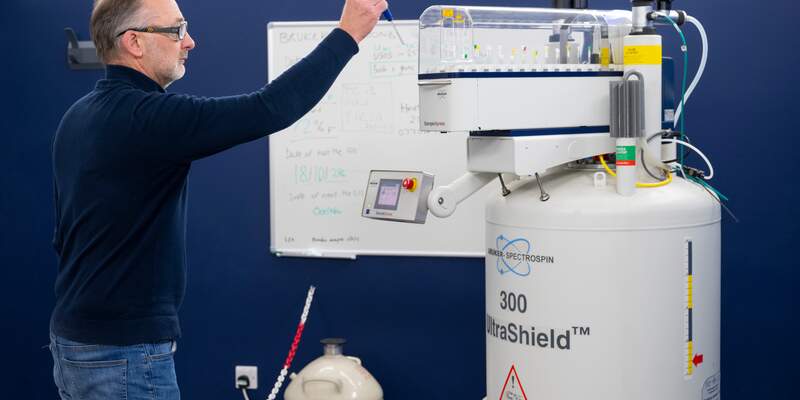
A wide range of NMR facilities are available in the Department. The Centre for Magnetic Resonance houses 700, 600 (wide bore), two 500 and 270 MHz spectrometers and elsewhere in the department are two high-resolution 400 MHz NMR spectrometers, a 300 MHz spectrometer, a widebore 400 MHz instrument suitable for solids. A 500 MHz instrument, with cryo-probe is available at the Central Science Laboratories.
The department has a very wide range of mass spectrometers, offering both research instrumentation and service provision. The Centre of Excellence in Mass Spectrometry is a joint undertaking between the departments of Chemistry and Biology and offers access to state-of-the-art research instrumentation for both University and business researchers. The mass spectrometry (MS) service needs are supported in the department by two instruments:
These instruments allow the analysis of solids, liquids and gases and provide accurate mass EI measurements, and potential compound identification through comparison of EI spectra with NIST libraries, along with FI and LIFDI measurements.
The recently established York Centre for Laser Spectroscopy and Photochemistry (YCLS), led by Professor Bernath, offers facilities that includes a SpectraPhysics/Light Conversion Ti:sapphire ultrafast system, a Continuum Panther UV-VIS solid-state OPO, a LaserVision IR OPO/OPA, IR diode lasers, as well as a wide range of Nd:YAG and Excimer-pumped dye laser systems providing broad spectral coverage at high resolution.
There are three X-ray diffractometers available for general use, a single-crystal Bruker Smart Apex CCD with Mo source, a single-crystal Oxford Diffraction Xcalibur with Cu source and a Bruker D8 powder diffractometer equipped with a Cu source. The YSBL have three X-ray diffractometers which are used for determination of proteins structures.
The department has three EPR spectrometers; a Bruker EMX, a Bruker ESP300E and Jeol RE1X. There is also range of ancillary equipment including variable temperature unit, two- and three-stream continuous and stopped flow systems and 300 W and 1 kW UV-visible photolysis lamps
In collaboration with the Departments of Physics and Electronics, the Department is part of the University’s Centre for Nanoscience (£5.5 million) with access to Environmental SEM and Transmission Electron Microscopes.
The YSBL has a dedicated crystallisation suite which include nanolitre-drop dispensing Mosquito robots, crystal imaging system and a large, temperature controlled crystallisation room. In addition, there are series of incubators for crystallisation at different temperatures.
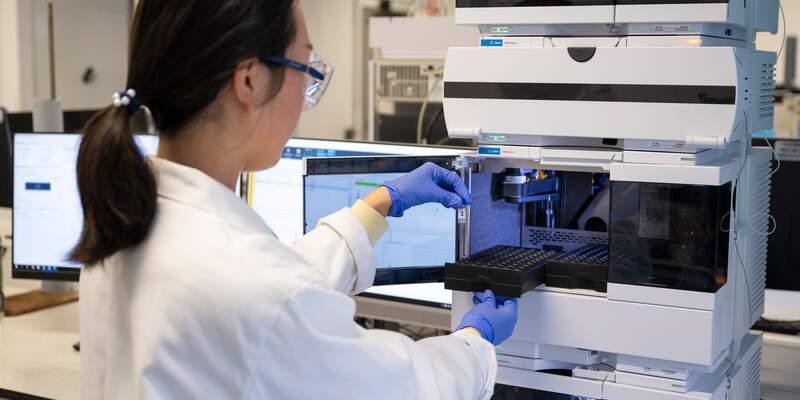
The department also has a range of FTIR spectrometers and facilities for Raman, fluorescence spectroscopy and transient absorption spectroscopy. There is also a range of other modern analytical and spectroscopic equipment including equipment for DSC/TG analysis (100 to +1500 ºC), chiral analysis, and capillary electrophoresis, surface area analysis and porosimetry, HPLC and GPC, Princeton potentiostat and cyclic voltammeter, potentiometric titration apparatus for pKa evaluation. The YSBL shares the Technology Facility with the Department of Biology, providing extensive equipment for protein expression, as well as offering access to a wide range of additional analytical facilities. These include HiTel (a joint Chemistry/Biology initiative) for high throughput protein production from both prokaryotic and eukaryotic systems.systems.
Putting a sample into the NMR spectrometer List of Academic Research Publications for 2008 (PDF
, 360kb)