
Storytelling for Policy: Reflections from the Open Innovation Team
Posted on Friday 23 January 2026
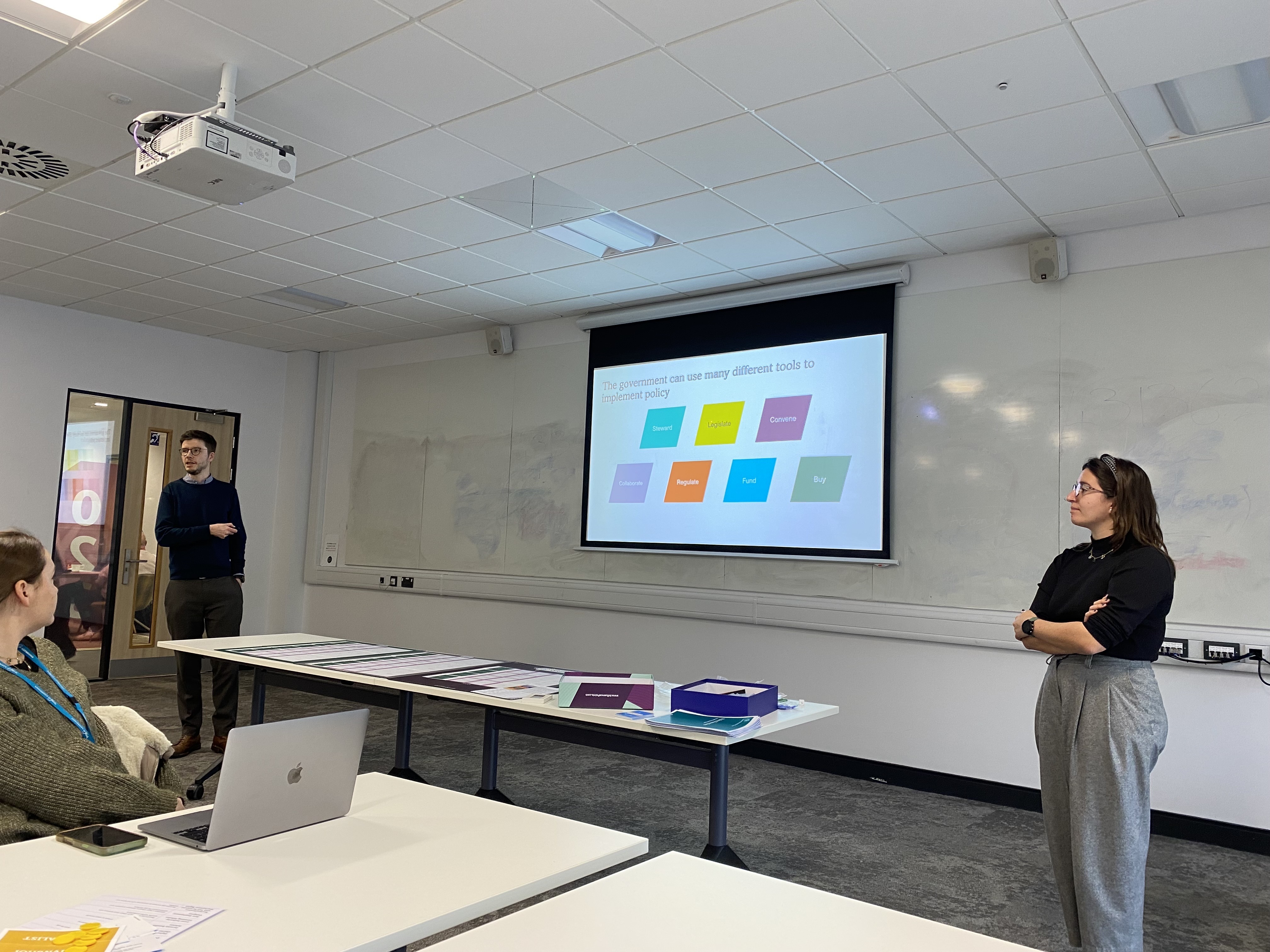
On Tuesday 2nd December, we delivered our Storytelling for Policy training at the University of York. This session complements our Policy Masterclass by focusing on specific techniques that help researchers and academics translate their work into formats that resonate with policymakers. While understanding the policy landscape is essential, knowing how to communicate research findings in compelling, accessible ways is equally critical for achieving impact.
Through this training, we aim to equip researchers with some practical communication strategies drawn from our experience in government. The training is hands-on and interactive, giving participants numerous opportunities to apply what they learn directly to their own research contexts.
What we covered
The workshop addresses four key topics. We begin with a brief overview of how policy is made and the role of government, setting the context for why communication strategies matter in this environment. We then introduce core storytelling techniques, with particular focus on the story arc - a narrative structure that can be applied when researchers write or speak about their work.
Following interactive exercises where participants practise these techniques, we explore how to bring storytelling into policy engagement strategically. This includes understanding when narrative approaches are most effective and how to adapt them for different policy audiences. Finally, we cover practical guidance for tailoring writing specifically for policymakers, including how to write an effective policy brief that cuts through the noise and delivers actionable insights.
Reflections from the session
Several themes emerged that made for a particularly rich discussion. Early in the session, we identified common challenges that academics and researchers encounter when engaging with policymakers: uncertainty about what information to prioritise, limited time to make an impression, and difficulty capturing attention amid competing demands. After practising storytelling techniques, it became clearer to participants how narrative structure can provide a useful framework for deciding what information to include and how to present it persuasively.
We explored the power of language choices, discussing how using words and phrases that connect to policymakers' priorities, such as cost-effectiveness, scalability, or public benefit, can make research feel immediately relevant rather than abstract.
Perhaps the most stimulating discussion centred on the ethics of storytelling in policy contexts. Participants raised thoughtful questions about the tension between narrative persuasion and scholarly objectivity, the responsibility academics have when advising on policy, and how to tell compelling stories without oversimplifying complexity or cherry-picking evidence. These discussions underscored the sophistication participants brought to thinking about their role as research communicators.
Practical takeaways for researchers
There are some key takeaways that emerged as particularly valuable for academics and researchers looking to apply these concepts to their own work:
- Storytelling techniques can help you select and structure information. A well-constructed narrative arc that includes a clear context, recommendations and outcomes, helps you decide what information to include and in what order. This is technique is about presenting your research in an engaging way that follows how people naturally process information. Be clear about the problem your research addresses, why it matters now and what should happen as a result.
- Tailor your story to your audience’s concerns. The same research can be framed differently depending on who you’re speaking to. Before you approach any policy engagement consider how your research speaks to their specific challenges?
- Master the differences between academic and policy writing. Policy documents prioritise brevity, action-oriented language, and front-loaded conclusions. Unlike academic papers that build gradually toward findings, policy briefs must lead with the "so what", the implications and recommendations, before providing supporting evidence. Sentences should be shorter, jargon eliminated or explained, and the tone should be confident and direct.
Looking Ahead
I want to extend my thanks to all participants for their engagement, thoughtful questions, and willingness to experiment with new approaches to communicating their research. The energy and insight you brought to the discussions made the session genuinely enriching for all involved.
If you are interested in participating in future Storytelling for Policy training or other sessions delivered by the Open Innovation Team, please contact Katie Heffron at the York Policy Engine (TYPE) at katie.heffron@york.ac.uk.
The next Storytelling for Policy session takes place on 21 April 2026, for more information on how to sign up visit our events and opportunities page.