
OIT Fellowship blog by Senior Policy Advisor, Iain Cuthbert
Posted on Thursday 22 January 2026
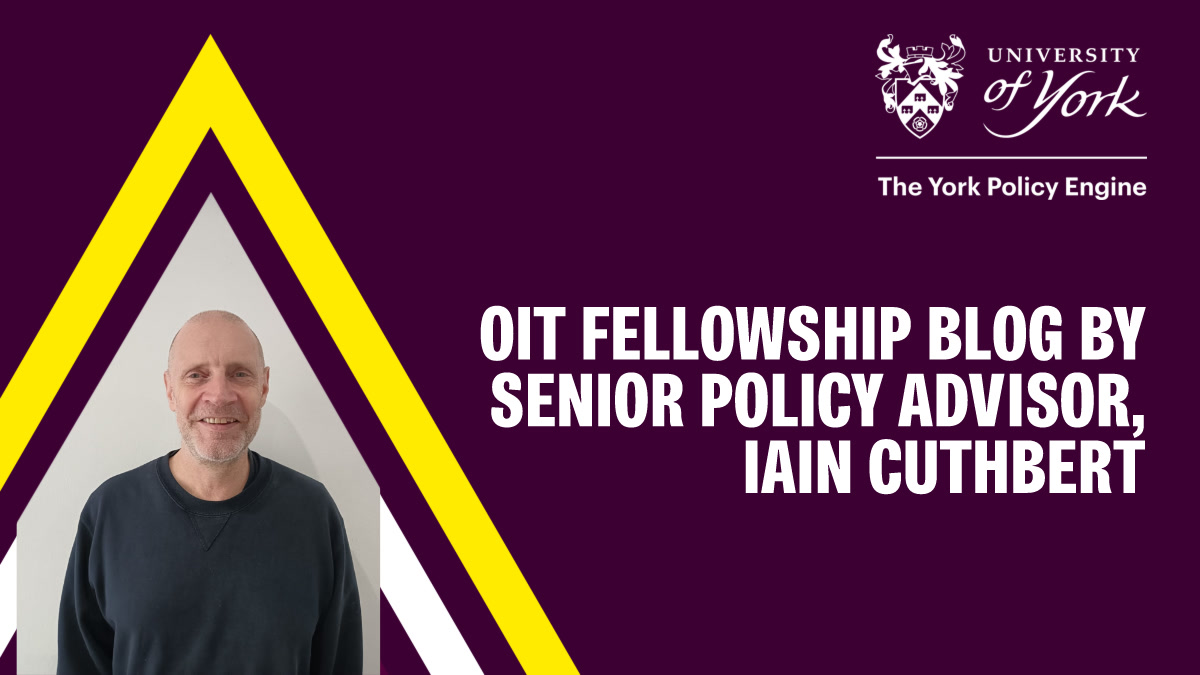
I am a senior policy advisor in the Department for Education (DfE). I recently took part in the Open Innovation Policy Fellowship; a cross-government programme providing opportunities for civil servants to be partnered with academic mentors to help answer specific research questions related to their policy areas. I was supported by Professor Joe Tomlinson from the University of York’s Administrative Fairness Lab.
With Joe’s help, I completed a literature review of the familial circumstances of children who attend alternative provision in England. This sector provides education and support for children of compulsory school age who, for varying reasons, are unable to attend mainstream primary and secondary schools. The review draws upon a blended range of qualitative and quantitative research on this subject which has been undertaken by academics, charities and third sector organisations, together with administrative data and research commissioned and published by DfE, Ofsted and the government.
The alternative provision cohort is widely recognised by policy makers, academics and others with an interest as being among the most vulnerable and marginalised in the English education system. While the quality of alternative provision is variable across England, outstanding alternative provision settings are system leaders, centres of excellence and important resources for improving inclusivity in mainstream schools.
The review explores some of the challenges for these children and their families as they navigate the complex and sometimes adversarial education system, and highlights some of the techniques used by highly-skilled alternative provision practitioners to restore the broken trust that often precedes children entering this sector. It also explores changes in relationships between families and alternative provision that have emerged in response to the growth of independent alternative provision, which now delivers education and support to a sizeable proportion of the alternative provision cohort.
As well as enhancing my own subjective knowledge of alternative provision, I hope that this literature review will help colleagues in DfE and those in related policy areas across government to better understand the complexities of this sector and the value it can add to mainstream education. Government officials like me are ably supported by analysts and social researchers and as well as helping me to develop new analytical and research skills, completing this project reinforced the importance of data and research in evidence-based policy making. I was able to use York University’s Open Athens portal to access, for the first time, valuable academic texts on alternative provision. Academic research like this is often hidden away behind paywalls and is therefore not readily accessible to those working on the development or implementation of government policies. I therefore also hope that programmes like the Open Innovation Policy Fellowship will help government policy makers to engage more closely with their counterparts in the academic sector in the future.
You can read Iain's literature review, titled 'The familial circumstances of children in alternative provision' here: The familial circumstances of children in alternative provision (PDF  , 678kb)