
Cannibals, Curiosities or Catholics? Indigenous peoples in early seventeenth-century France
Event details
Join us for research seminars hosted by the Department of History with a selection of visiting academics, alongside University of York researchers. All students and staff are very welcome.
A zoom link will be made available for distance learning PhD students on request. Please contact Dr Purba Hossain or Stephanie Mawson if you have any questions. You can view the full schedule for the semester here
Speaker: Prof Caroline Dodds Pennock (University of Sheffield)
Abstract: How did six Tupinambá men come to be barricaded in a Parisian convent, while inquisitive people from twenty leagues around hammered on the doors, demanding to see the Brazilian visitors? And how did a Caripou ruler-in-waiting find himself ordered to pull a pig out of a castle ditch?
This lecture follows the trails of some of the many Indigenous people who travelled to France in the early seventeenth century, from the three surviving Tupinambá – who were acclaimed as diplomats and converts, caricatured in pamphlets, and baptised Louis, Louis and Louis after their royal godfather – to the Caripou translator and go-between, tricked into a traumatically brutal voyage to France, who saw the Tupi feted at court while he was made to suffer the indignities of a common servant.
These travellers are emblematic of a transitional phase of empire when Indigenous visitors to Europe managed to be both spectacularly exotic and utterly unremarkable, normalised in imperial discourse but astounding on European shores. In this lecture, Caroline Pennock reveals both the ubiquity and spectacle of Indigenous peoples in early seventeenth-century France, showing the ways they were influential from the apex of power to the cracks of imperial politics.
Whether as objects of abuse and exploitation, honoured allies or idealised Christian converts, the lives of Indigenous travellers in this period often appear to us in fragments, their stories seen only in snapshots and through the eyes of those who kidnapped or coerced them. But although their tale is often told only in outlines, their experiences bespeak a rich history of Indigenous experience on European soil which reflects not only the traumatic legacies of enslavement, epidemics, and oppression, but also the reality of resistance and adaptation.
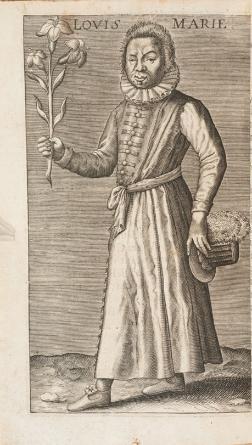
Image: Itapucú drawn by Gaultier from Claude d’Abbeville, Histoire de la mission des pères capucins… (Paris, 1614). Copyright: BNF [May be used with copyright acknowledgement]