
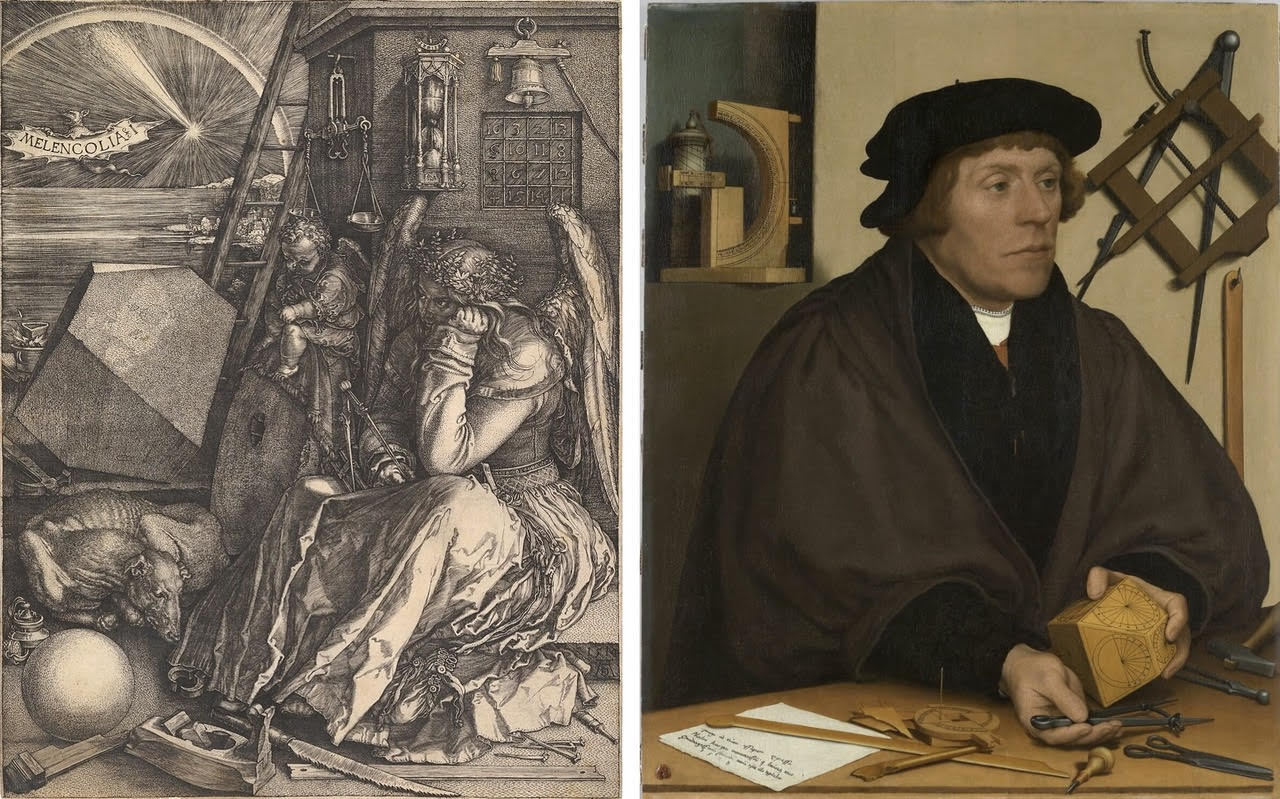
The Imperfection of Applied Mathematics in the Art of Dürer and Holbein
This event has now finished.
Event details
Join us for research seminars hosted by the Department of History of Art with a selection of visiting academics, alongside University of York researchers. All students and staff are very welcome.
Please contact Dr Ivan Knapp (ivan.knapp@york.ac.uk) if you have any questions. You can view the full schedule for the semester here:
History of Art Research Seminar Schedule Semester 2 2026
Abstract:
Between the 1470s and the 1540s—during the lifetimes of Albrecht Dürer (1471-1528) and Hans Holbein the Younger (1497/98-1543)—numerous publications in German-speaking Europe outlined the structure of the cosmos and explained how to measure objects in the heavens and on the earth. Most of these books, and the images they contained, blissfully ignored a foundational concept in mathematical theory: an insurmountable gap, however small, always separates the perfection of abstract geometry from the approximations achievable in the material world. This talk explores how these ideas intersect with the art of Dürer and Holbein, who each collaborated with professional astronomer-mathematicians at certain points in their careers. Where Dürer endlessly sought—and failed to find—a mathematical foundation for aesthetic judgments, Holbein typically disregarded mathematical rules, but he used distorted geometry in two iconic paintings to thematise the limitations of human knowledge.
Images: Albrecht Dürer, Melencolia I, 1514, and Hans Holbein the Younger, Nicolaus Kratzer, 1528.
Professor Jeanne Nuechterlein
Jeanne Nuechterlein has taught at York since October 2000. Her work centres on northern European art, primarily Germany and the Low Countries in the 15th and 16th centuries and its receptions in the 19th and 20th centuries, with further interests extending out to related geographical areas and periods. Her teaching and research investigates religious and secular imagery in the late medieval and early modern periods, particularly the cultural role of art for its makers, patrons and viewers. She is a member of York’s interdisciplinary Centre for Medieval Studies as well as the Centre for Renaissance and Early Modern Studies. Currently she is completing a monograph on Holbein and the visualization of mathematical knowledge in the early sixteenth century. She has written two previous monographs, including Hans Holbein: The Artist in a Changing World for Reaktion Books' Renaissance Lives series, published in 2020. She has also co-curated two exhibitions, Strange Beauty: Masters of the German Renaissance at the National Gallery, London (2014) and Making a Masterpiece: Bouts and Beyond at York Art Gallery (2019-20).