
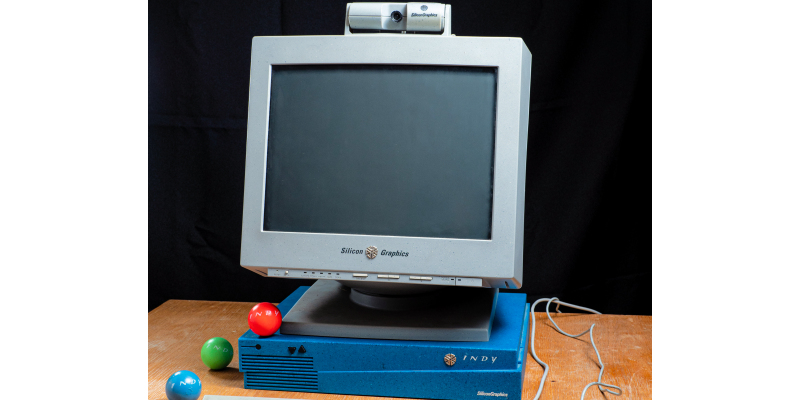
SGI Indy Workstation
Further details
Indies used the MIPS R3000 processor, a breakthrough in processor design as it was designed in record time compared to the Motorola 68000 used in the SUN.
The base Indy model was launched in July 1993 at £4,000 (equivalent to about £7,500 in 2022), without a hard drive, or diskless, and is intended for networked use. The model with a 2GB hard drive was launched at £6,000.
In March 1994, the series was refreshed with a new 150 MHz R4400 CPU.
- the low end model has 8-bit colour, 32 MB RAM, 535 MB hard drive, and 16-inch 1280 x 1024 monitor for £12,500 (equivalent to £22,500 in 2022)
- the high end has 24-bit colour, 64 MB RAM, 1 GB hard drive for £18,300 (equivalent to £33,500 in 2022).
Sales of low-cost high-performance workstations were projected to triple from 1994 to 1999, and competition for that market increased between Sun and SGI.
The Indy is the first computer to have a standard video camera, and the first SGI computer to have standard video inputs. Each Indy has an amateur quality composite, S-Video, and digital video input built into the motherboard, which collectively are known as "Vino" (video input, no output) video. The digital input is a SGI Digital Video Interface (proprietary D-sub connector) with a rectangular high density array of 60 pins, and is used by the IndyCam. The connector incorporates two digital video ports, but only uses the first one for input on the Indy.
The IndyCam is a small fixed-focus digital video camera, co-developed by SGI and Teleview Research. It can be mounted above the monitor, or hand-held. It is one of the first desktop video cameras and the first to come standard on a computer. With the bundled software, it can be used for video conferencing, video editing, or video email.
At launch, SGI said it expected to sell $1 billion worth of Indy units. Byte magazine said in September 1993 that Apple and SGI were trailblazers by setting audio and video as default features of the Macintosh and Indy desktop PCs, which "could change the way businesspeople communicate". In 1994, Byte called the new Indy "low on price but high on graphics performance", noting its interoperability with Windows and Macintosh.