
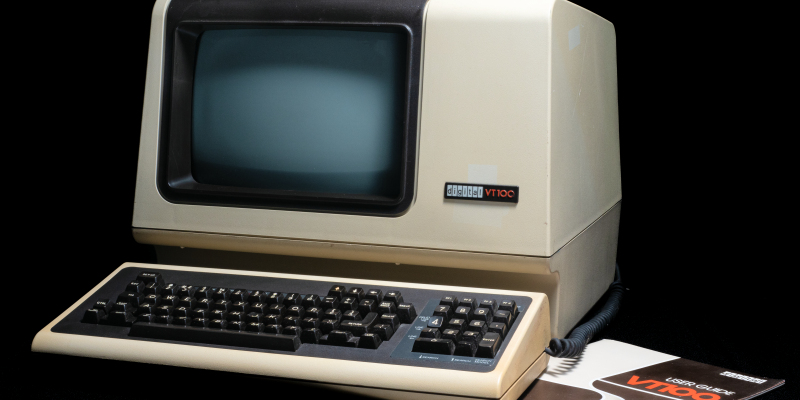
DEC VT100
Further details
The VT100 is a video terminal, introduced in August 1978 by Digital Equipment Corporation (DEC). It was a robust and well-built machine. It was one of the first terminals to support ANSI escape codes for cursor control and other tasks, and added a number of extended codes for special features like controlling the status lights on the keyboard. This led to rapid uptake of the ANSI standard, which became the de facto standard for hardware video terminals and later terminal emulators.
The VT100 series, especially the VT102, was extremely successful in the market, and made DEC the leading terminal vendor at the time. The VT100 series was replaced by the VT200 series starting in 1983, which proved equally successful. Ultimately, over six million terminals in the VT series were sold, based largely on the success of the VT100.
Main storage for these machines typically existed on large disk drives which might store 10-50Mb per disk. An example is shown below.
To hold large datasets and backups, the department used tape drives. Large spools of magnetic tape. This example shows a tape that could hold XX Mb of data. Access times were slow although storage was relatively reliable. The tapes had to be loaded by hand.
The VT100 also introduced an additional box-drawing character set containing various pseudographics that allowed the drawing of on-screen forms. All configuration setup of the VT100 was accomplished using interactive displays presented on the screen; the setup data was stored in non-volatile memory within the terminal. Maintainability was also significantly improved, since a VT100 could be quickly dismantled into replaceable modules.
In 1983, the VT100 was replaced by the more powerful VT200 series terminals such as the VT220.