
Chemistry and Photonics join forces! Calixarenes help power new photonic acetone gas sensors.
Posted on Thursday 5 March 2026
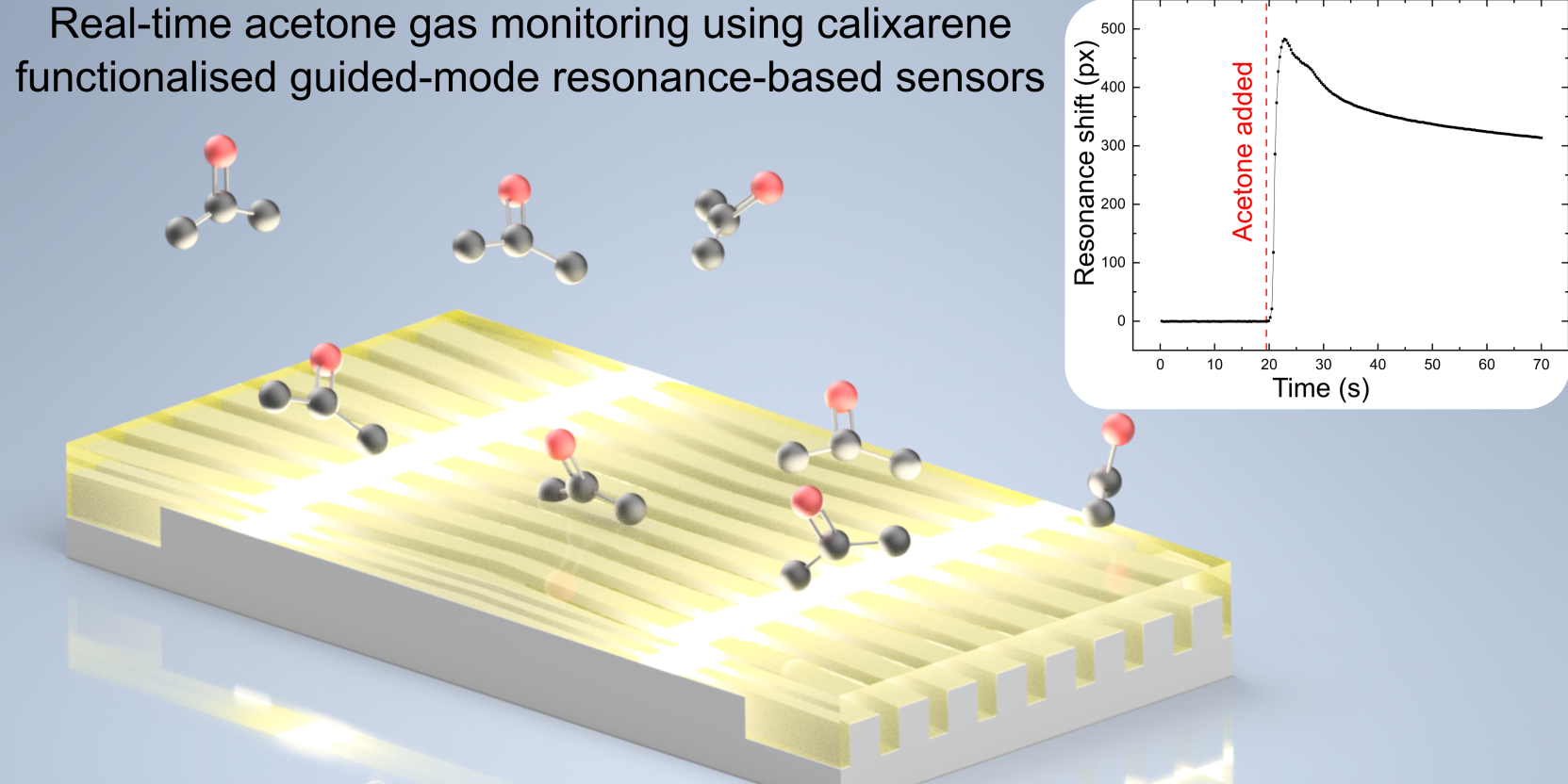
The detection of volatile organic compounds is an important challenge for many societal and industrial applications, as their inhalation can cause significant harm. In a collaboration between the Department of Chemistry (Dr. William Unsworth) and the School of Physics, Engineering, and Technology (Prof. Thomas Krauss, PhD student Adam Rigler), researchers have created a new photonic sensor coated in a calixarene capable of measuring ppm levels of acetone, now published in ACS Photonics.
Acetone is an important precursor in many chemical reactions and is used widely in industrial settings, and developing a reliable acetone gas sensor could help monitor worker safety. Acetone is also a key biomarker for the potential of breath-based diabetes monitoring – diabetics can exhale as much as 10x the amount of acetone as healthy individuals. An effective sensor could therefore also lead to advances in healthcare, such as screening for individuals at risk of diabetes.
The sensor consists of two parts; a functionalisation layer which preferentially binds acetone molecules, and a photonic chip which transduces the tiny signals generated by the acetone. The sensor utilises Guided-Mode Resonance (GMR) gratings which react to changes in surface refractive index during binding. The system requires only the light from an LED to operate and utilises a ‘Chirped’ grating design, pioneered by the Photonics group here at York, allowing the signal to be read via a simple camera.
The sensor design is now being expanded further using an array of cross-reactive peptides for multi-species detection.