
Chemistry Controls Biology – Tuning Supramolecular Gels to Direct Stem Cell Growth
Posted on Thursday 29 January 2026
Human mesenchymal stem cells (hMSCs), typically extracted from bone marrow, have the potential to differentiate into a wide variety of mature cells, such as fat, muscle and bone, depending on the environment in which they grow and the stimuli to which they are exposed. Such cells have great potential in 21st century medicine where they may play a key role in regenerating or replacing damaged tissue and organs.
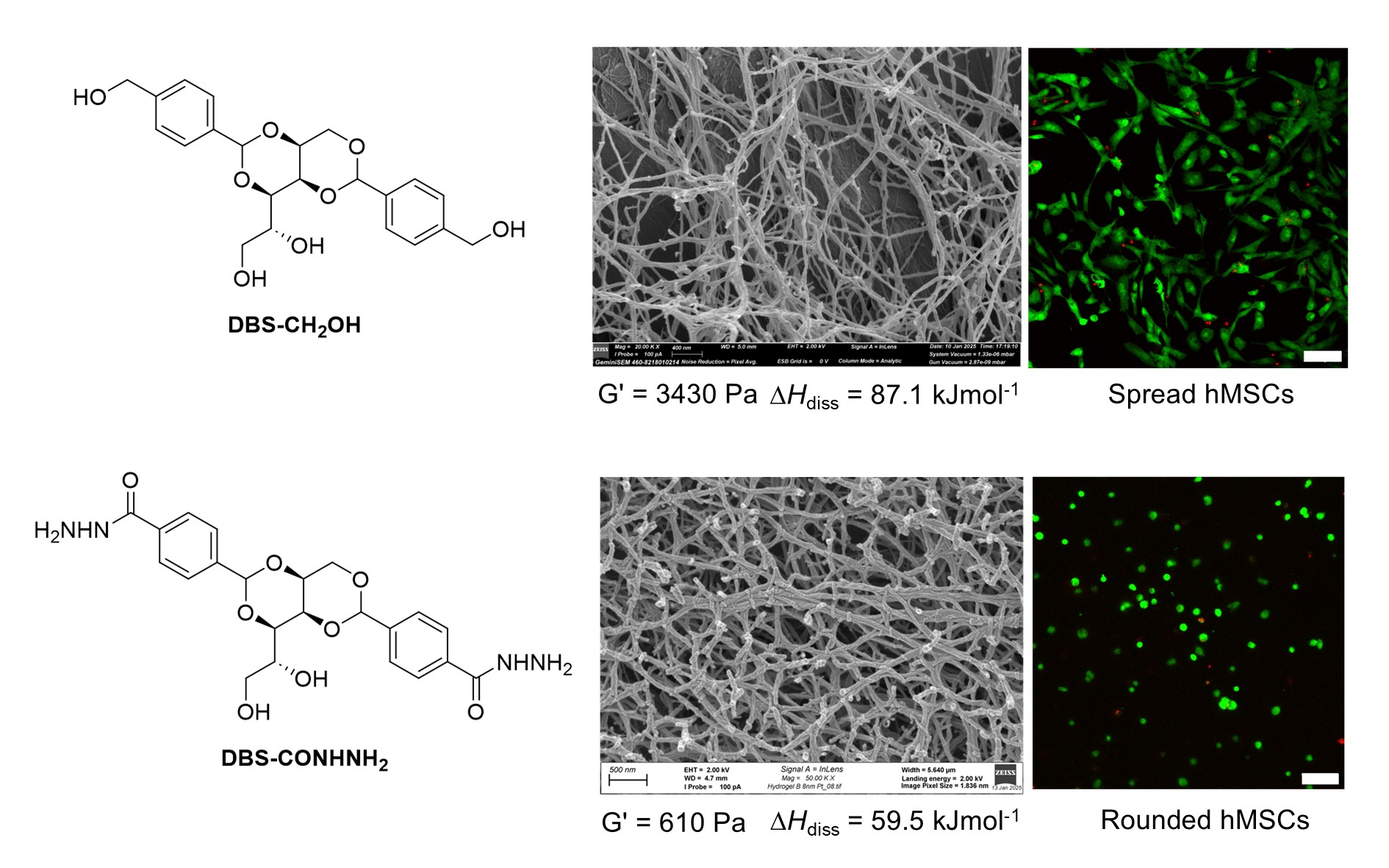
Hydrogels are useful materials that can support the growth of hMSCs, mimicking the role of extracellular matrix, and directing the way in which the hMSCs behave. Supramolecular gels, that assemble small molecule building blocks into nanofibre networks capable of supporting cells (see Figure), have promise as a result of their tunability, reversibility and adaptiveness. However, there remains a lack of simple ‘rules’ to help predict how such materials behave.
In research recently published in Angewandte Chemie, the research teams of Professor David K. Smith (Department of Chemistry) and Professor Paul Genever (Department of Biology) have reported a new supramolecular gelator. By comparing it to a similar molecule, they have demonstrated that small changes in chemical structure can have major impacts on stem cell growth.
Specifically, the new gelator (DBS-CH2OH) encourages stem cells to form spread shapes that are usually a precursor to differentiation into bone cells. Conversely, their previously established analogue with just a small structural change (DBS-CONHNH2) causes hMSCs to take on a rounded shape more typical of differentiation into fat cells (see Figure).
Using detailed characterisation methods, including studying gels that co-assemble from a combination of the two gelators, the research team determined that gelator structure, gel stiffness and the molecular-scale dynamics of the self-assembled gel all play a role in controlling the interactions of the gel matrix with the growing hMSCs and directing the biological outcomes.
Dr Chayanan Tangsombun, lead author of the study, says “Trying to develop rules to fundamentally predict how supramolecular gels can direct stem cells is vital – it means you can choose the right molecule for the right biological outcome. In the future, we hope to use the new gelator reported here to fabricate shaped and patterned gels that direct stem cell growth in sophisticated ways, with clinical relevance in tissue engineering.”
The research paper ‘Molecular-Scale Tuning of Low-Molecular-Weight Gelators Controls Supramolecular Assembly and Directs Human Mesenchymal Stem Cell Growth’, is published in Angewandte Chemie.
Notes to editors:
This work has been published in Angewandte Chemie.