
Putting energy metabolism back into bacterial spore germination
Posted on Thursday 8 January 2026
Bacterial spores are the most robust biological objects, being resistant to chemical attack, desiccation, or heating and able to survive for tens of thousands of years. Not only are spores fascinating biological objects, they also cause common hospital acquired infections (C. difficile), mediate food spoilage (Bacillus cereus), and sadly have been weaponized (Bacillus anthracis, anthrax).
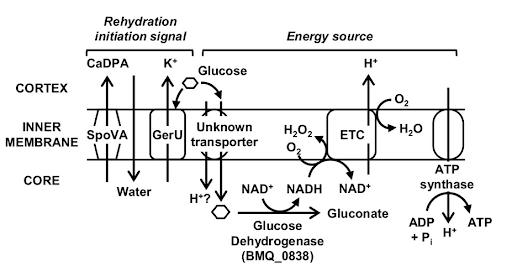
A dormant spore does little and has to germinate to grow or cause trouble. Historically, the field has considered germination a process of water ingress and ion egress, relaxing down concentration gradients set up in the extravagant spore-formation process, with metabolism only restarting at the very end of the process. However, using non-invasive spectroscopic measurements, Dr Pooja Gupta, working in the laboratory of Professor Jamie Blaza, has demonstrated that energy metabolism starts from the very beginning of the germination process, meaning the early stages of germination are actively energized to power the transformation of the spore into a ‘vegetative’ cell.
Fascinatingly, the charge imbalance is so strong across the inside of the membrane of a spore that the normal reactions of O2 consumption cannot proceed and the ‘oxidase’ enzymes are stuck in a nonradical ferryl state, the first time this intermediate has been measured in abundance in a physiological condition. To get around this thermodynamic restriction, spores express an alternative route to O2 that had historically only been considered to scavenge O2. This allows the spores to kick-start their germination process.
The paper includes two project students, Beth Hardman and Elodie Wells, who carried out their work as part of their final year research projects on the MChem and MBiochem programs respectively, and Dr Rowan Walters in the York Bioenergetics Lab. Key collaborators were Dr Rebecca Calbeck and Dr Graham Christie (University of Cambridge, Department of Chemical Engineering and Biotechnology) and Dr Roger Springett (Cellspex Inc).
The paper, which effectively upturns our understanding of spore germination, is published in the journal PNAS.
Notes to editors:
This work has been published in PNAS.
Gupta P, Caldbeck R, Walters RC, Wells EC, Hardman BL, Christie G, Springett RJ, Blaza JN. Early activation of bioenergetic metabolism powers bacterial spore germination. Proc Natl Acad Sci U S A. 2025 Dec 30;122(52):e2510996122