
Next-Generation Anti-Icing Fluids for Aviation Applications
Posted on Monday 8 December 2025
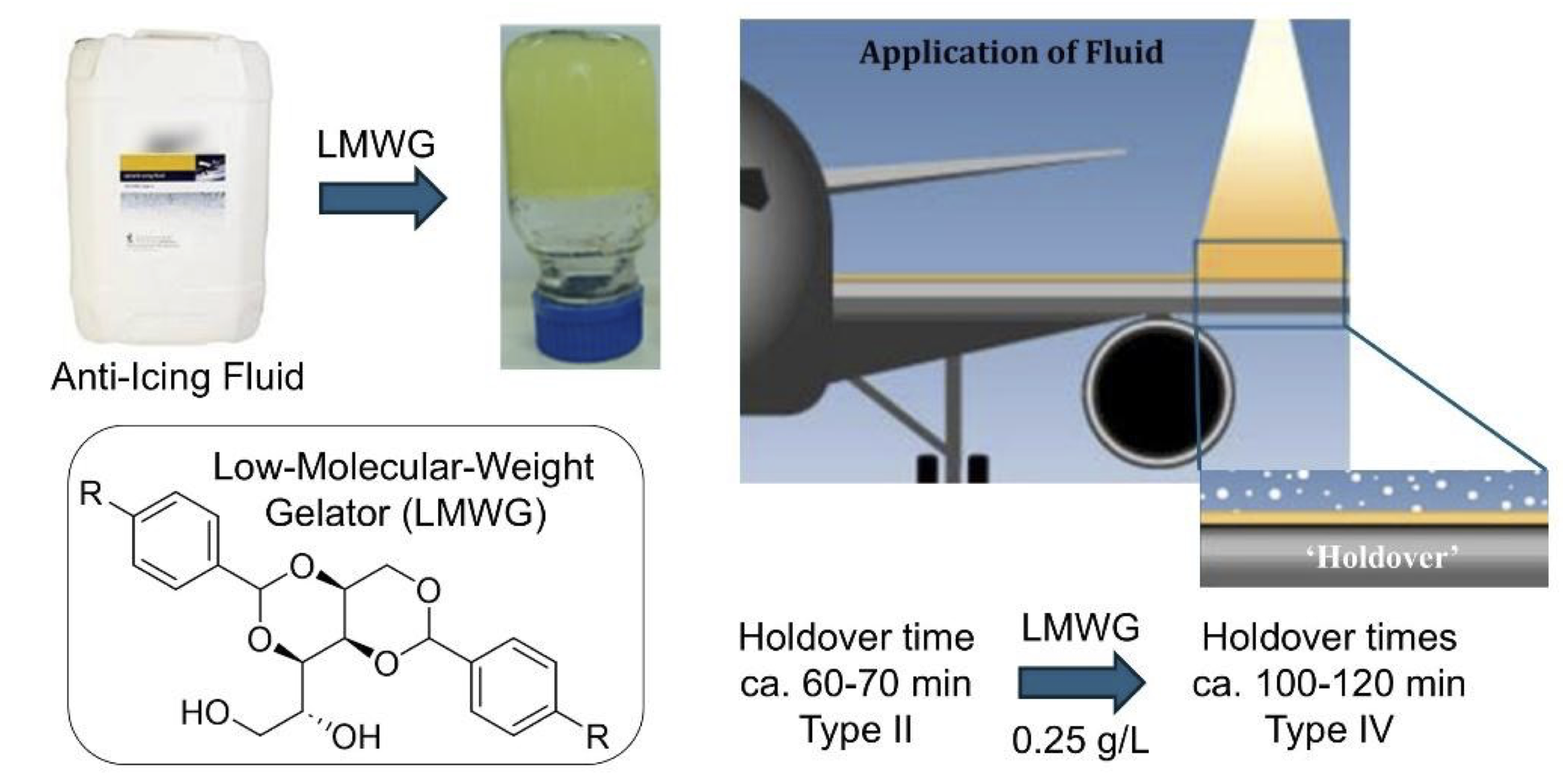
In two recent papers published in Langmuir, Professor David K. Smith and Dr Nicole McLeod from Kilfrost report that these fluids benefit from the presence of a simple self-assembling additive. Specifically, they optimised low-molecular-weight gelators that could thicken such fluids, forming gels at very low loadings (<<1% by weight).
In their first paper, the researchers demonstrated that the self-assembling additive converted a simple de-icing fluid into an anti-icing agent, capable of preventing the build-up of ice – a simple way of enhancing performance.
In their recent second paper, Smith and McLeod showed that when employed in a more complex anti-icing fluid, the gel-forming additive further improved the performance, preventing ice build-up for significantly longer periods of time. Indeed, a standard Type II anti-icing agent was converted into a much higher performance Type IV fluid.
The self-assembled nature of the gels means they are easily broken down by the shear forces experienced on aircraft take-off – an important requirement for any anti-icing fluid, which must not persist on the surface of aircraft once in flight.
Reflecting on the research, Professor Smith said: “The low-cost gelator additives we developed improved the performance of de-icing and anti-icing fluids offering a potential step-change in this technology. We anticipate that these additives may lower glycol usage and eventually enable polymers to be replaced with simple self-assembling molecular materials, significantly reducing the environmental burden of such fluids.”
Notes to editors:
The papers reporting the modification of de-icing fluids have been published in Langmuir: https://pubs.acs.org/doi/full/10.1021/acs.langmuir.5c00755 and https://pubs.acs.org/doi/10.1021/acs.langmuir.5c05067