
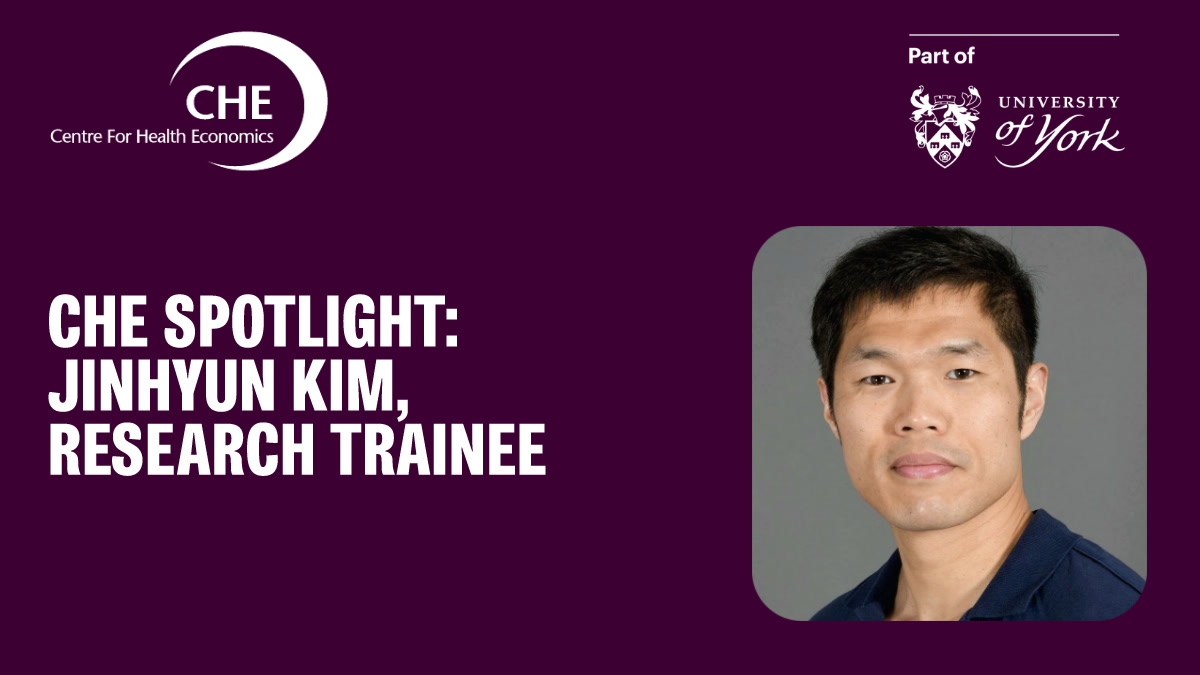
CHE Spotlight: Jinhyun Kim
Posted on Friday 6 March 2026
Tell us about your journey to CHE
When I was in medical school in South Korea, I observed many doctors recommending significantly more expensive treatment options that offered only slight improvements in outcomes compared to conventional options. This experience sparked my interest in the cost-effectiveness approach, which led me to pursue a master’s in Health Economics at the University of York.
During my degree, I came across a compelling research area: estimating the marginal productivity of healthcare as a proxy for health opportunity cost, a concept developed by health economists at CHE. This research investigates the healthcare cost required to gain one quality-adjusted life year (QALY) in the current system and compares it with the cost of a new treatment option to gain one QALY. This work can inform decisions about whether or not to introduce a new treatment.
I then started my PhD at the Department of Economics and Related Studies at the University of York, applying this methodology to the South Korean healthcare system. During the second year of my PhD, I applied for a research trainee position at CHE to advance my research. Fortunately, I was offered the opportunity to work with excellent health economists at CHE. I am now continuing to investigate this research theme within the context of the English NHS, under the supervision of experienced researchers at CHE.
What are you currently researching?
I am currently involved in the Research and Economic Analysis for the Long term (REAL) Supply Unit project and the Economic Methods of Evaluation of Health and Care Interventions Policy Research Unit (EEPRU) project at CHE, which are closely related to my PhD topic: the marginal productivity of healthcare expenditure and healthcare capital investment.
For the REAL Supply Unit, I am investigating the effect of hospital capital expenditure on regional treatable deaths in England. Estimating the amount of capital investment needed to avert one treatable death would provide a useful benchmark for the investment decisions within the English NHS.
For the EEPRU project, I am conducting feasibility studies to estimate the effect of healthcare expenditure on regional mortality in the post-COVID years with an alternative approach, refining the original methodology to incorporate the more recent NHS allocation regime. Updating and comparing post-COVID healthcare productivity is crucial, given that the healthcare system was under a lot of pressure during the period of Covid.
Why is CHE the best place for you to undertake your research?
I have been impressed by the interdisciplinary interactions of brilliant health economists at CHE. Researchers exchange their ideas and skills across different fields, including economic evaluation, health policy, and global health. I have been inspired by various health economists working in different areas, often without needing to attend external conferences. Moreover, CHE offers many learning opportunities for PhD students and early-career researchers. The short courses and seminars I have attended have been beneficial to my studies. Finally, CHE provides a flexible working environment for researchers, which has helped me a lot to balance my PhD research and my role as a research trainee. Managers and supervisors carefully observe researchers and step in with support when appropriate.
Learn more about what's like to work and study at CHE.