
CHE Spotlight: Itamar Megiddo
Posted on Tuesday 10 March 2026
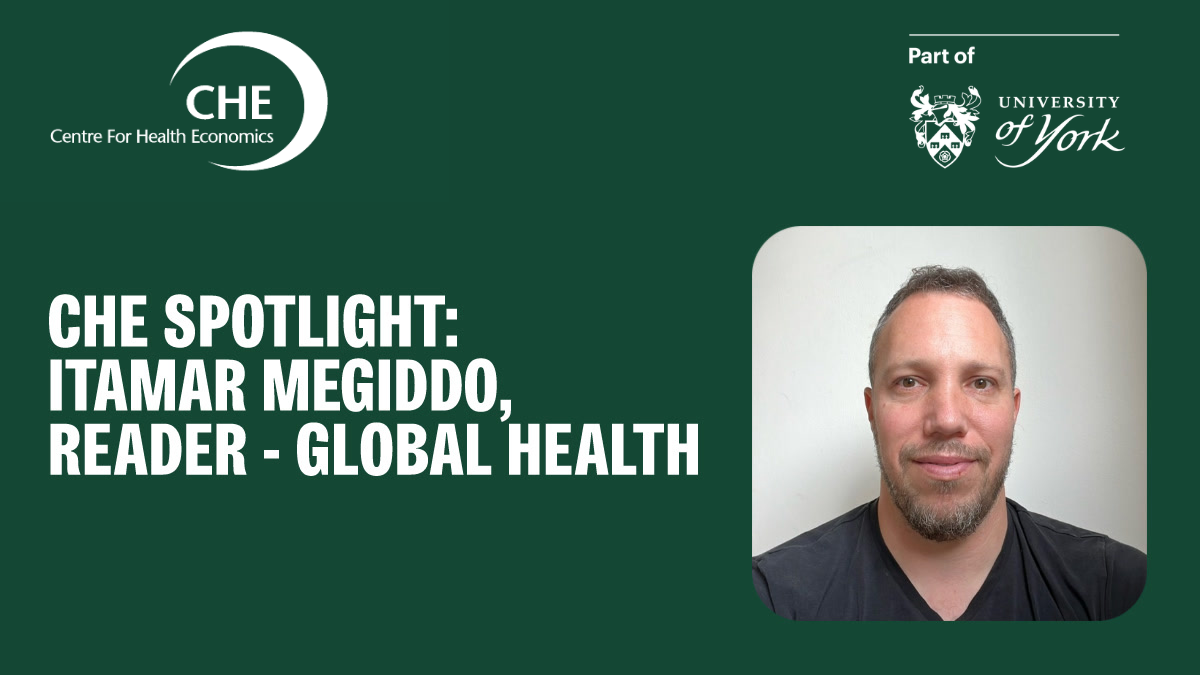
What was your career route to CHE?
I did my undergraduate and master's in economics at McGill University in Montréal, a city that will convince you the best bagels in the world are not, in fact, from New York. I graduated in 2009 unsure whether I wanted to work in health economics or environmental economics. My first position neatly avoided the choice: I joined Resources for the Future (RFF) in Washington DC, a city whose cherry blossom season is beautiful, even through the sneezing from hay fever. RFF is an independent research institution that has shaped US environmental policy since the 1950s, but I worked within their health-focused unit, the Centre for Disease Dynamics, Economics & Policy (CDDEP, now the One Health Trust).
At CDDEP, health won out. I learned infectious disease modelling, working with modellers to build individual-based simulation models for malaria and pneumococcal disease and using these in economic evaluations. Antimicrobial resistance (AMR) was a major focus for CDDEP, and became one of my core areas too. A formative experience was hearing the ecologist Simon Levin talk about complex adaptive systems: like ecosystems, health systems are adaptive, shaped by feedback and emergent behaviour, and evaluating changes to them must account for this. A major milestone was developing IndiaSim, an agent-based model of the Indian population and its healthcare use for the Disease Control Priorities Project, which pushed me beyond infectious disease toward broader health system questions.
As it happens, the person who selected my CV from the pile of applications at RFF was Abby Colson, who became my wife seven years later, though neither of us knew that at the time. In 2015, CDDEP needed someone based in Europe to work on an antimicrobial resistance project. Through circumstances and a personal connection to Strathclyde, we both ended up in Glasgow, trading Washington's hay fever season for a greyer but more temperate climate. I found myself in a Department of Management Science. In 2017, I completed a PhD by publication there, drawing together my work on cross-disciplinary modelling for health economic evaluation. Then taking a faculty position, over my ten years at Strathclyde I learned from a rich systems thinking and modelling tradition, broadened my methodological toolkit, and helped build a Health Systems Research Group.
Having known and thought highly of CHE colleagues through workshops and projects, joining was an opportunity to return to my roots in health economics, and to work alongside some of the best thinkers in the field while bringing the systems perspective.
What have you been working on since you came to CHE and what are you currently doing?
Much of my work centres on a deceptively simple question: when do we need to account for the complexity of health systems in economic evaluation, and when can we safely use simpler approaches?
Health economic models typically evaluate interventions in isolation, assuming the rest of the system holds still. Sometimes that is perfectly reasonable. But sometimes it misses things that matter, or prevents us from exploring questions that do. When a new health programme is introduced, it does not land in a vacuum. Patients change where and when they seek care, providers respond to new demands and incentives, and supply-side constraints like workforce and infrastructure capacity shape what is delivered. These responses interact with each other, affect different population groups differently, and the programme's real value depends on all of this together.
My work tries to identify when this complexity genuinely matters for decisions, and to develop practical methods for incorporating it when it does. This spans health systems resilience, resource allocation in low- and middle-income countries, and the economics of antimicrobial resistance.
What are your future plans in CHE?
I am working to deepen collaborations within CHE's global health programme and across the centre, while building systems thinking and simulation modelling capacity. The collaborative environment has made this a pleasure. I am developing several proposals with CHE colleagues and working within programmes like Thanzi and HFACT, where systems approaches can complement the strong existing economic evaluation, optimisation, and econometric work, while also pursuing collaborations on AMR economics, including surveillance and its connection to health security. Working with research fellows, I aim to build this system's capacity further.