Skip to content Accessibility statement

Frequently Asked Questions (FAQs)

Find answers to the most common questions about our geothermal energy project.

Here are some answers to frequently asked questions about geothermal energy, our project, and the seismic survey works.

You can also explore our geothermal web pages to find out more about our project progress, community engagement, events, news and how to get involved.

Geothermal energy FAQs

With thanks to sources from the British Geological Survey (BGS) and GeoScience Limited for informing the development of our Frequently Asked Questions (FAQs).

What is geothermal energy?

The term geothermal means “heat from the Earth”. Geothermal energy comes from the natural heat stored beneath the Earth’s surface. The Earth’s crust contains a virtually limitless amount of thermal energy which is being continuously replenished by heat conduction from the mantle below it. The temperature at the base of the crust is about 1000°C and, as a result, the deeper you go underground, the hotter it gets, on average at a rate of 25°C per km.

Geothermal is normally associated with volcanic regions such as Iceland and New Zealand, as this heat is more easily accessible being closer to the surface. In volcanic areas and places where the Earth's plates meet, the underground heat is much stronger. Just a couple of kilometres below the surface, temperatures can reach several hundred degrees. In some locations this heat creates natural pockets of hot water or steam underground. By drilling into these areas, we can bring the heat to the surface and use it to generate electricity and provide heating.

But geothermal resources exist away from volcanic regions too. Most countries around the world can access geothermal, albeit at lower temperatures, and around 90 countries are now harnessing it for heat or power. Some are drilling much deeper wells in non-volcanic areas to access the temperatures they need because they recognise the environmental benefits of the technology.

Geothermal is a clean, sustainable, renewable, low carbon energy source that has a very small surface footprint and minimal environmental impact. It can be harnessed from just a few metres below the surface or from deep underground and used for heating, cooling, and electricity generation. It is already present across the UK and can be accessed using different technologies to provide low-carbon heat and power.

You can find more information about geothermal energy on the British Geological Survey website and through GeoScience Limited.

Watch the British Geological Survey’s Geothermal Energy Lesson Introductory video.

Why is geothermal energy important?

The climate emergency, along with concerns over energy security and rising fuel costs, makes it clear that our energy systems need a complete transformation. We need energy that is locally produced, affordable, and built to last. At the same time, urgent action is required to tackle climate change—meaning we can no longer rely on fossil fuels.

By 2050, the UK aims to reach Net Zero greenhouse gas emissions. To achieve this, both electricity and heating must be as close to zero emissions as possible. Geothermal energy has the potential to provide renewable electricity and heat 24/7.

Geothermal energy has, but is not limited to, the following benefits:

  • Renewable and sustainable: Geothermal energy comes from the Earth’s natural heat, which is constantly replenished, making it a long-term energy source.
  • Low carbon and environmentally friendly: Unlike fossil fuels, geothermal energy produces little to no greenhouse gas emissions, helping to combat climate change.
  • A constant supply: Unlike solar and wind, geothermal energy isn’t affected by the weather. It provides a constant, 24/7 energy supply.
    Improves national energy security: By using geothermal energy, countries can rely less on imported oil and gas, improving energy security.
  • Cost-effective in the long run: While initial setup costs can be high, geothermal energy has low operating costs and provides stable energy prices over time.
    Efficient for heating and cooling: Geothermal systems can heat homes, businesses, and even entire cities efficiently. They can also be used for cooling in summer.
  • Small land footprint: Unlike large-scale wind or solar farms, geothermal plants take up very little space to generate power, making them suitable for urban and rural areas.
  • Supports economic growth: Investing in geothermal energy provides a multitude of jobs in the green energy sector.
How does geothermal energy work?

Geothermal energy works by using the natural heat from beneath the Earth’s surface. This heat is captured by drilling wells into the ground to access hot water or steam. The steam is then used to power a plant that generates electricity, or the hot water can be used directly for heating buildings, greenhouses, or even pools. The process is sustainable and produces very little pollution, making it a clean source of energy.

Where is geothermal heat located?

Geothermal heat is the natural heat found within the Earth. This heat exists in various forms and is found beneath the ground almost everywhere. However, it’s unevenly distributed. In places like Iceland and New Zealand, where volcanic activity is common, geothermal heat is close to the surface and can even be seen in hot pools and geysers. In the UK, we need to drill much deeper—usually thousands of metres— to reach the temperatures required for power production or direct heat supply.

What is geothermal energy used for?

Today, geothermal energy can be used for heat and power generation.

Geothermal heat

To meet our commitment to Net Zero by 2050 and the UK's target of a 81% emissions reduction by 2035, we must decarbonise how we generate heat. Geothermal energy is a renewable and low carbon source of heat, which can be used to warm our buildings, workplaces, homes and leisure facilities. It can also be used in district heating systems, where hot water from the ground is circulated to heat multiple buildings in a community or city. Geothermal wells can also be used to store heat in the rocks below for extraction later.

Geothermal power

Geothermal can also be used to produce dispatchable, low carbon electricity. While heat can be extracted from almost anywhere, geothermal electricity generation needs specific geological conditions, which aren’t found everywhere. Geothermal energy can provide reliable, continuous electricity and can also be adjusted as needed, making it a valuable support for both the national grid and local distribution networks. This flexibility is becoming increasingly important as more solar and wind energy are added to the grid.

How do you access heat from below the ground?

To access heat from below the ground, boreholes (called ‘wells’) are drilled to intersect permeable rocks at high temperatures. The water within the rocks is pumped to the surface and can be used directly for heating or to produce electricity. Once it has been cooled by the end-use, the water is injected back into the ground to be reheated by the hot rocks, ensuring the system remains sustainable.

What are the benefits of geothermal energy?

Geothermal energy has, but is not limited to, the following benefits:

  • Renewable and sustainable: Geothermal energy comes from the Earth’s natural heat, which is constantly replenished, making it a long-term energy source.
  • Low carbon and environmentally friendly: Unlike fossil fuels, geothermal energy produces little to no greenhouse gas emissions, helping to combat climate change.
  • A constant supply: Unlike solar and wind, geothermal energy isn’t affected by the weather. It provides a constant, 24/7 energy supply.
  • Improves national energy security: By using geothermal energy, countries can rely less on imported oil and gas, improving energy security.
  • Cost-effective in the long run: While initial setup costs can be high, geothermal energy has low operating costs and provides stable energy prices over time.
  • Efficient for heating and cooling: Geothermal systems can heat homes, businesses, and even entire cities efficiently. They can also be used for cooling in summer.
  • Small land footprint: Unlike large-scale wind or solar farms, geothermal plants take up very little space to generate power, making them suitable for urban and rural areas.
  • Supports economic growth: Investing in geothermal energy provides a multitude of jobs in the green energy sector.
Is geothermal energy renewable?

Yes, geothermal energy is renewable. It comes from the Earth's natural heat, which is constantly replenished from the core. As long as the Earth exists, this heat will continue to be available, making geothermal energy a sustainable and long-term energy source.

In contrast, fossil fuels like coal, oil, and natural gas are non-renewable. They take millions of years to form and are being depleted much faster than they can be replaced. When burned, fossil fuels release harmful greenhouse gases into the atmosphere, contributing to climate change and air pollution. Unlike geothermal energy, which is clean and virtually limitless, fossil fuels harm the environment and will eventually run out.

Geothermal energy offers a reliable and environmentally friendly alternative, helping to reduce our reliance on fossil fuels while providing a sustainable source of power for the future.

Is geothermal energy the same as ‘fracking’?

No it isn’t. The geothermal development project at York involves circulating water through naturally permeable rock or natural fractures. This is not the same process as fracking, which involves injecting large volumes of fluid with complex chemicals at high pressures to create new fractures in solid rock to extract oil or gas. Fracking also raises concerns about waste disposal and contamination.

In contrast, geothermal development uses naturally occurring water in existing fractures and, once the heat is extracted, the water is reinjected into the same formation. All activities are permitted through the Environment Agency.

Is geothermal energy safe?

Yes, geothermal energy is safe. The technology is well-established and carefully regulated to ensure that it has minimal environmental impact. The drilling process and heat extraction are carefully monitored to avoid any harm to the surrounding area. Additionally, unlike fossil fuels, geothermal energy produces very little pollution and carries no risk of explosions or spills. Overall, it is considered a reliable and safe energy source.

What is seismicity? What is the risk of inducing seismicity?

Natural seismicity occurs all over the world, all the time. It refers to ground movements caused by natural forces. These movements are sometimes referred to by different names, including earthquakes, earth tremors, earthquakes, and seismic events. For millions of years, the Earth's crust has been shifting, reshaping continents, and forming mountains and volcanoes. The most active areas are along tectonic plate boundaries, where plates collide, slide past each other, or move apart. However, faults exist in various shapes and sizes everywhere—even in places like York! As tectonic plates move, pressure builds up along faults of all sizes. When the stress becomes too great, the rock shifts, releasing energy in the form of a ‘seismic event’. They are usually very deep underground.

Seismic activity is only noticeable if the shock waves are strong enough to reach the surface. For any real damage to occur, the shaking must be powerful enough to move the ground forcefully. Smaller or deeper seismic events often lose their energy as it spreads through the surrounding rock, and may go completely unnoticed.

Explore more about seismicity

Induced seismic events are exactly the same as natural ones, except that the trigger for the movement is human activity, rather than a gradual build-up of geological pressure over time. Testing and developing geothermal reservoirs on York’s campus may cause minor seismic activity. Most of these small events will go unnoticed, though occasionally people might hear a faint rumble or feel a slight vibration. These events are not dangerous and pose no risk to buildings or infrastructure. A seismic monitoring system will be installed before drilling which will allow any vibration to be monitored.

Why aren’t there more geothermal systems in the UK?

There are several reasons why geothermal projects are not more widespread here:

High initial costs

Building the infrastructure needed to harness geothermal energy requires significant investment. These upfront costs can be prohibitive.

Regulatory challenges

The rules and regulations surrounding geothermal projects are not well-developed, making it difficult for developers to navigate. A lack of clear guidelines can create uncertainty around costs and project timelines, which many investors find risky.

Geographic limitations

Geothermal energy is highly dependent on location. To be effective, the heat source needs to be relatively close to the end user, especially for heating purposes, making it less versatile in areas where such resources are not easily accessible.

Project specific FAQs

This project is currently moving forward at pace and continues to develop. The following information provided reflects its current stage, though some details may evolve as the project progresses.

Why is the University of York investing in geothermal energy?

The University of York is undertaking this project as part of its ambition to achieve Net Zero by 2030 through the development of a secure, low-carbon energy supply. Reducing reliance on natural gas for heating is essential, and the geothermal project provides a pathway to reach that goal.

As a leading Russell Group University, we also aim to be a pioneer in sustainable energy, demonstrating leadership and supporting the UK’s wider efforts on decarbonisation and energy security.

How will the project be run?

A Geothermal Project Board has been established, chaired by the Dean of Sciences, to manage and oversee its delivery.

What will the geothermal project aim to achieve?

The project is an important part of the University’s Sustainability Plan 2030, targeting a 78% reduction in fossil fuel consumption. By exploring this low-carbon energy source, the project hopes to lower the University’s carbon emissions and play a pivotal role in York’s broader efforts to achieve its climate change targets and will directly support the city’s ambitions to become a leader in sustainable living.

How does the project help save energy or reduce pollution?

Simply put, the geothermal project replaces the gas currently used to heat most University buildings with an essentially carbon-neutral, pollution-free natural resource.

This reduces both energy consumption from fossil fuels and associated greenhouse gas emissions.

What exactly does the work involve?

Early assessment has already taken place, focused on Campus East. The next steps include going through the planning process and obtaining the necessary approvals. Later in 2025, more geological surveys will be carried out to better understand the underground conditions. This includes a seismic survey, which involves placing thousands of sensors in the ground and using a special machine that vibrates the surface—helping to create a detailed 3D picture of the ground beneath our campus. If all goes to plan, initial groundwork could begin in 2026, with drilling anticipated in 2027.

Where is the geothermal energy site located on campus?

The geothermal energy site will be located on the east side of Campus East (the exact location hasn't been chosen yet).

How big is the drilling rig going to be?

The drilling rig chosen will depend on availability when contracts are being issued, which will be after planning consent has been given. However, any rig capable of drilling to 5,000m will necessarily be large. We anticipate using a rig with a maximum mast height of 55m. The rig will not be a permanent structure and will only be on site during the drilling phase of the project (around 1 year).

How deep do you have to drill to access the heat?

The University is conducting both a 3D seismic survey and a gravity-based survey to gather detailed information about the ground beneath the site. This helps us target the most optimal point, known as the “toe” of the well. The exact depth will only be confirmed once these surveys are complete.

We currently expect the well to reach approximately 4 to 5 kilometres deep, allowing us to bring water to the surface at close to 100 °C.

Will there be light pollution during development?

The impact on the environment and local community is really important to us and is something we will be closely monitoring and keeping to a minimum. The drill rig’s mast will have lighting for health and safety reasons, and a red flashing light to warn of its presence to aircraft. The site will also be lit with working lights to allow 24/7 operation during drilling.

Will there be any ground vibration during drilling?

Some minor ground vibration is possible during drilling. However, it would be very localised and unlikely to be noticed outside the site boundary.

How much noise will there be from the geothermal site?

The site design and choice of drilling rig will take account of potential noise levels outside the site. A noise monitoring system will be put in place to ensure that any noise is kept within permitted levels.

Will there be night-time noise from operations?

The drilling rig will operate 24 hours a day but activity will be carefully planned to minimise any noise disturbance and keep within permitted limits.

How are you approaching risks to health and safety?

We are conducting a comprehensive Environmental Impact Assessment (EIA) to identify and address all potential risks at this early stage. Protecting human health is a key part of this EIA process and will be rigorously considered within the detailed assessments that make up our Environmental Statement.

Are there any risks from materials or heavy metals associated with the project?

The design of our system includes strong safeguards to prevent any risk from materials, including heavy metals. During operation, the risk of contamination is effectively zero because:

  • The production and injection wells will be securely cased to at least 3,000 metres, creating a protective barrier.
  • All geothermal water will be fully recirculated underground, with no deep water brought to the surface or released into the environment.

The only stage where geological material reaches the surface is during drilling, when rock cuttings will be safely processed. Detailed assessments of these samples will be carried out in full compliance with relevant legislation and guidance to ensure the protection of both human health and the environment.

How are you managing Risk and Regulatory Compliance throughout the project?

We are managing risk and regulatory compliance through a robust, multi-layered framework.

The project is regulated by the Environment Agency (EA) through licensing that ensures full protection of groundwater throughout all stages. During construction, all activities will follow a detailed Construction Environmental Management Plan (CEMP), which includes comprehensive risk assessments and health and safety measures comparable to a Health Risk Assessment.

Together, the Environmental Impact Assessment (EIA), EA licensing, and CEMP provide a multi-layered and robust framework to manage any potential health, safety, or environmental risks throughout the project.

Should I be worried about seismicity induced by the geothermal project in York?

No, there is no need to worry. Although the testing and development of geothermal reservoirs on York’s campus is likely to cause some seismicity, most induced events will be incredibly small and release very little energy. A full risk assessment will be carried out by experts to help guide the design of the project. Seismic activity will be closely monitored throughout, with operating conditions adjusted as needed to ensure safety and stability.

See geothermal energy FAQs for more information about seismicity.

Will geothermal extraction cause subsidence? What analysis are you conducting on this?

An important feature of our scheme is that we drill two wells, allowing all water brought to the surface to be reinjected back into the aquifer after heat extraction. This means that, unlike other schemes, there is no net removal of water.

Assessing these risks is a key part of the project’s planning process. We work closely with the Environment Agency (EA), which requires a strict and thorough review before any water can be extracted or reinjected.

A central part of obtaining this approval is a Hydrogeological Risk Assessment - a detailed, third-party study reviewed by the EA that models potential impacts, including any risk of subsidence.

Will the project impact the water table? What are you doing to prevent any impact?

The water table is located many kilometres above the deep aquifer from which we will extract water. The water table, along with any drinking water sources, is separated from our geothermal source by layers of rock and other aquifers, so there will be essentially no interaction.

Assessing these risks is a key part of the project’s planning process. We work closely with the Environment Agency (EA), which requires a strict review before any water can be extracted or reinjected. A central part of this process is a Hydrogeological Risk Assessment - a detailed, third-party study reviewed by the EA that models potential impacts and ensures the water table remains unaffected.

Will taking heat from underground make any difference to the Earth’s temperature? Will it affect my garden or plants?

The amount of heat extracted by the project is extremely small compared to the natural heat at the Earth’s centre and will have no measurable effect on surface temperatures or the planet as a whole.

The wells are located more than 3 km below the surface, far deeper than anything that could influence surface conditions. Garden plants and soil temperatures are controlled by sunlight, not underground heat, so they will be completely unaffected.

Importantly, the project will help reduce the need to burn fossil fuels, making a positive contribution to tackling global warming.

When will the project be completed and producing energy?

The project is expected to begin generating heat by March 2028. Once operational, the initial focus will be supplying energy to the campus, with potential for wider use being explored depending on the system’s performance.

What type of energy or heating does the project provide, and could it benefit the wider community?

The first stage of the project is focused on providing enough heat to meet the University’s building heating needs. We also hope to explore ways to access additional heat and make full use of the specialist drilling equipment.

With further funding, several exciting opportunities could be pursued:

  • Electricity generation: Using geothermal heat to power plants and generate electricity, an emerging technology internationally that could help strengthen the UK’s position in this field.
  • Community heating: Extending the heat supply beyond the University to provide an alternative to gas heating for the wider city.
  • Cooling systems: Using geothermal heat to drive cooling systems, offering another way to save energy in the future.
Will you be able to heat my house?

At present, the scheme is designed to supply heat only to buildings on the University of York campus. However, we are exploring opportunities to extend heating to the wider city and hope to work with interested parties on this possibility in the coming years.

How will the project contribute to future scientific research and innovation in geothermal energy?

This project offers a pioneering opportunity to advance scientific understanding of geothermal energy. Our goal is to use this knowledge to help the UK develop geothermal technology at scale and at lower cost. By deepening our understanding of the underlying science, we aim to position the UK as a competitive player in the growing global geothermal market.

To support this ambition, the University has established a steering group that brings together other universities, Salix, and key partners to drive research and collaboration in this field.

Can this system be used as a model for other universities or buildings?

Absolutely. This project is designed to serve as a model for how deep geothermal technology can be successfully applied at other universities and buildings across the UK and beyond. We aim to share our findings and experience openly to support future projects and encourage wider adoption of this sustainable energy solution.

We’re also exploring opportunities to expand the scheme in the future, including the potential to supply heat to the wider city.

Will students or staff see any difference or benefit from this project?

We hope University staff and students will notice positive benefits from the project. It is creating new opportunities for engagement in energy and sustainability, building links with initiatives such as the Sustainability Clinic, which supports external partners on sustainability projects. We are also looking at ways for the scheme to support both teaching and research in the exciting field of geothermal and sustainable energy generation as a whole.

During construction, we aim to share real-world learning experiences across the University community and beyond, offering an exciting, hands-on example of renewable energy in action. This is incredibly exciting to inspire a new generation of talent and jobs for the future of the UK.

While there may be some temporary noise and construction traffic near the site, this will be carefully managed, and noise surveys have already been completed to guide our planning.

In the longer term, we hope the project will help pave the way for more geothermal developments, contributing to a more secure and sustainable energy future for the UK.

When and where did the initial testing take place?

There has been no new physical testing carried out. Initial studies used existing data from boreholes and historical coal mine exploration. Using this data has given us a good picture which will be refined through a new survey carried out in the second half of 2025.

What is the £35m funding being used for?

The geothermal project is supported by a £35 million government-funded grant from the Public Sector Decarbonisation Scheme, run by the Department for Energy Security and Net Zero, and delivered by Salix Finance Ltd. The University of York is also contributing 12% of matched funding to the project.

The funding will be used to contribute to the following:

  • Planning, design and construction of the geothermal wells system.
  • Integration of the geothermal system as the heat source into our existing district heat network.
  • Adding a range of existing buildings to our District Heat network.
  • Carrying out insulation and lighting improvements across a range of building.
  • Decommissioning a number of gas powered boilers which can be permanently removed.
Can I visit the site?

We envisage creating opportunities for site visits when the site is under construction.

What happens next?

Early assessment has already taken place, focused on Campus East. Next steps include going through the planning process and obtaining the necessary approvals. Later in 2025, more geological surveys will be carried out to better understand the underground conditions. This includes a seismic survey, which involves placing thousands of sensors in the ground and using a special machine that vibrates the surface - helping to create a detailed 3D picture of the ground beneath our campus. If all goes to plan, initial groundwork could begin in 2026, with drilling anticipated in 2027.

Keep an eye out on this web page for project developments.

Seismic survey FAQs

As the next step in our geothermal project, a seismic survey will take place on Campus East and surrounding areas in late October 2025. Read answers to common questions about our seismic survey works.

More information can be found on our seismic survey web page.

What is a seismic survey?

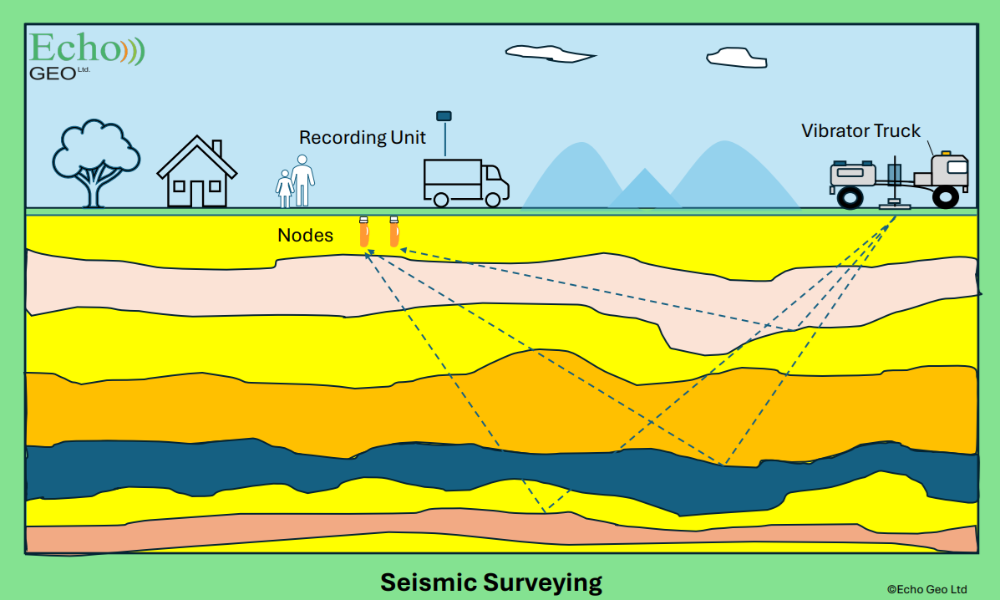
A seismic survey is a safe, non-intrusive method of mapping underground rock layers. It works by sending controlled sound waves into the ground and recording the echoes that bounce back, similar to ultrasound scanning during pregnancy.

The data helps geologists understand the subsurface and assess whether geothermal energy extraction is possible.

How does it work?
  • The survey will run for approximately 30 days of which 10 will be spent on the acquisition, covering approximately 7km of survey profiles each day.
  • At each survey point, a seismic vibrator (mounted on a truck) will lower a plate to the ground every 25m and generate a seismic source. The pad generates a 16-20 second sweep from 8-100 Hz before moving on to the next point.
  • In areas with difficult terrain, this same system can be mounted on a small tractor or all-terrain vehicle.
  • The sound waves are recorded by sensitive seismic sensors (nodes), which will be temporarily placed in the ground. All survey work will be carefully planned to avoid obstacles and minimise disruption.
  • The data from these nodes is then downloaded and analysed to produce a 3D map of the geological structure beneath the survey area.
When will the seismic survey take place?
  • Mid September: Test Survey -  A one-day test survey takes place on University campus.
  • Mid October: Nodes begin to be laid out across the survey area.
  • Late October: Vibroseis trucks work their way along the survey lines.
  • Mid November: Nodes are collected and data analysis begins.

Will I feel anything?

The survey is designed to be low impact and will only be felt in the immediate location of the seismic lines, which you can find on the map above. In residential areas, our monitoring teams will be actively checking vibration levels.

Will I hear anything?

Although fitted with engine sound proofing, the seismic truck engines may be heard when in close proximity. A small distant thud may be heard from time to time when a weight from the truck drops to the ground.

Will there be any traffic delays?

Most of the work is taking place off-road on private land, however, there are some survey lines around the University campus and to the north of the University near Osbaldwick, Murton Park and Derwenthorpe. The work will be during daytime hours and for short periods only.

There may be some short-term traffic delays, and some evening and night work may be required on farm tracks and on some roads, such as the A64.

What if I see a sensor?

Small sensors (called “nodes”) may be occasionally visible. These pose no danger to the public or animals, and should be left alone as they are recording sensitive signals. They will be collected after the survey is completed.

The Seismic survey is taking place near my house. Does this mean you are going to be building near me?

No. The construction will take place on the University of York’s Campus East site and will involve only a small number of vertical wells, likely two or three, each roughly the size of a large pizza.

The seismic survey may extend near your property because imaging the ground 5 kilometres below the University requires vibration sources and sensing nodes over a wide area. The large survey area is needed solely to gather accurate data at depth, not to indicate construction nearby.

I’m a staff or student based on Campus East. How will this affect me?

The majority of work will be done during working hours between dawn and dusk on Campus East. There is only one truck operating during the data collection and although it will work along roads on Campus East it will be during daytime and for short periods only. 

There will also be some evening and night work required on some roads such as the A64, and other other units working on farm tracks while the units in the urban areas are detouring.

How are you managing risks during the seismic survey?

We can confirm that Echo Geo, the contractor carrying out the seismic survey for the University, has decades of experience safely conducting surveys in urban environments. Choosing a contractor with this expertise was a key part of ensuring careful operations in a city as valued as ours.

Echo Geo carefully plans survey lines to meet project requirements, screening each route for utility services and nearby buildings. Survey points are programmed using a safe distance chart, with the number of units and power level tailored for each location.

As no two sites are the same, active vibration monitoring will be carried out along each survey route. Vibrations from the equipment are limited to 5 mm/s - half the British Standard limit for cosmetic damage to buildings (BS7385-2). For context, everyday traffic over potholes or speed humps generates similar vibration levels.

We are committed to keeping the community informed. To receive updates or share any questions or concerns, please sign up for our project mailing list or contact us directly via geothermal@york.ac.uk

How will this help the geothermal project?

This important early-stage activity will build a detailed 3D map of the ground and help us understand the size, shape and depth of the geothermal reservoir beneath our feet.

We are very grateful to our staff, students and the local community for their support and apologise in advance of any inconvenience.

Who should I contact?

Echo Geo are delivering the works on behalf of the University. For any questions or queries about the survey works, you can email, WhatsApp or call them:

Email address: york_info@echo-geo.net

Phone number: 07384 297 761

Contact us

Geothermal Project enquiries