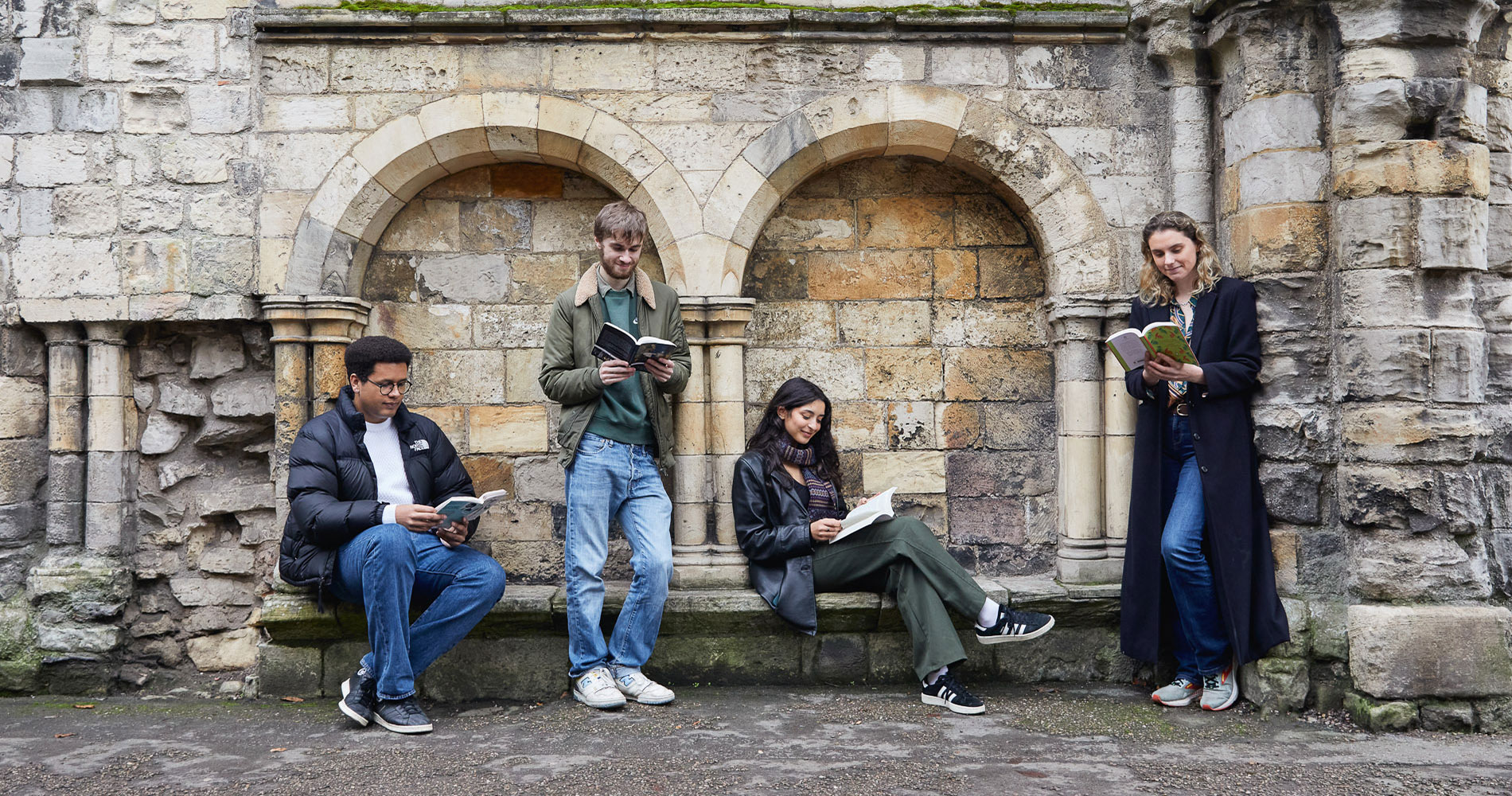

The study of English brings both the pleasures of reading and the challenges of understanding human culture: it offers access to a vibrant array of literature and ideas, and asks students to embrace new ways of thinking about the world and new possibilities of expression.
No discipline equips its students better to understand and interpret a wide range of texts, whether literary, historical, political, or social, or to formulate articulate and persuasive responses to a range of challenges and questions.
I wanted to spend three years being taught by academics who were excited about literature and the buzz surrounding the department was tangible.
Gemma-Jane, English
Here at York, we offer a flexible and wide-ranging course that will encourage you to engage analytically both with the texts you read and with your own practice as a critic and reader.
Depending on your interests, the course may take you from Viking Scandinavia to the contemporary Arab world, or from Homer to Samuel Beckett. Both drama and film modules are featured within our degree, together with topics as varied as Renaissance discoveries, myths and fairytales, and fictions of human rights.
Your programme of study will culminate in the opportunity to explore your interests in depth in an extended dissertation, supervised by an expert in the field.
Students can participate in a wide range of extra-curricular activities, and will be offered the chance to develop interests in creative writing, music and drama, journalism, and a host of other activities.
The York undergraduate degree stands out in offering a wide historical range alongside a broad array of specialised, research-driven modules. We are unusual in asking students to get to grips with literatures in other languages, which may include Latin, Old Norse, Anglo-Saxon, French, Italian, German, Spanish, Arabic and Hebrew. This is compulsory for single-subject students (see Foreign literature requirement), and an option which combined course students are welcome to explore.
Our students are cosmopolitan in their intellectual interests, and feel thoroughly supported to navigate previously unfamiliar literatures, and to recognise the importance of understanding the international as well as the historical heritage of the English literary tradition.
York is consistently ranked as one of the top ten universities in Britain and one of the top 100 in the world. The University was named THE (Times Higher Education) University of the Year in 2010, and has an international reputation for top-quality teaching and research.
The Department of English and Related Literature is an exceptionally lively and creative department with an innovative and forward-looking approach to teaching and assessment. We were ranked top in the UK for the quality of our research in the most recent national assessment — so our students learn in the most stimulating and exciting academic environment possible.
Studying at York is a unique experience. Our academic quality, campus community, supportive staff and beautiful city make us an increasingly popular choice among students from a variety of backgrounds.
It’s a lot of fun studying at York, and there are so many societies to join and things to do that there really is something here for everyone.
Caius, English
The University’s main campus is in Heslington, on the edge of the city. Here, colleges and departments are grouped around a large lake in 200 acres of landscaped parkland, creating a welcoming community feel. The Department of English and Related Literature is based in Langwith College.
The college system breaks the university into smaller units, making it easy to meet people and make friends. York thus combines the advantages of a university large enough to provide a vibrant social and cultural environment with those of a smaller community able to be welcoming and friendly to its students.
York has been an important political, cultural, religious and trading centre since Roman times, but it is more than just an historic city. With a population of approximately 180,000, York is a university town that’s big enough to feel cosmopolitan but small enough not to be overwhelming.
York is centrally located in the UK, midway between the major capitals of London and Edinburgh, with excellent transport links. We’re just two hours from London by train, and well served by international airports at nearby Leeds and Manchester.
Sterne's Tristram Shandy was first published in York
York was already a centre of learning in the eighth century, when Alcuin, the great Anglo-Saxon scholar and poet, was the head of York Minster’s school, and was invited by the Emperor Charlemagne to teach at his court.
Viking poets are known to have visited York in the tenth century, and the city’s most famous work of medieval literature was created by unknown authors in the fourteenth century -- the Corpus Christi cycle of Mystery Plays, first performed by the craft guilds in the Middle Ages and still acted in the city today.
York’s greatest medieval work of art, its gothic Minster, owes the preservation of its treasury of stained glass to the Civil War commander Sir Thomas Fairfax who won the city from the Royalists in 1644, and Fairfax's integrity was celebrated by the poet Andrew Marvell in Upon Appleton House.
Laurence Sterne’s eighteenth-century comic masterpiece, Tristram Shandy, was first published in York, and Daniel Defoe's hero Robinson Crusoe was born here, as was the great twentieth-century poet W. H. Auden.
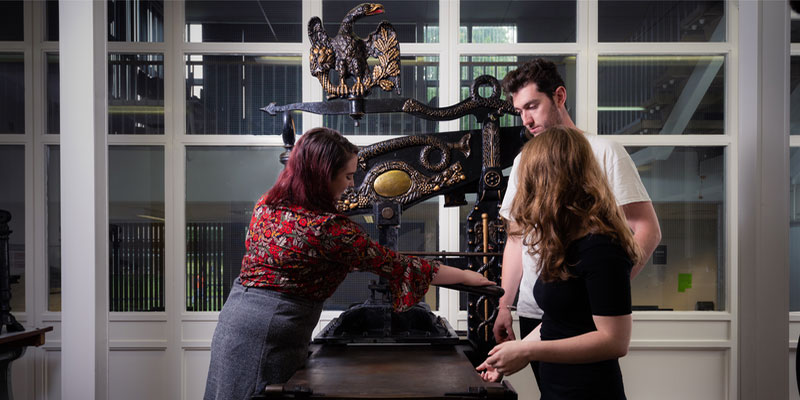
Students have the opportunity to explore both the city's literary heritage, on a range of walking tours and workshops, and its rich scholarly resources, which include the Borthwick Institute for Archives, the beautiful and stimulating Minster Library, and lots of good bookshops.