Solar farms can provide haven for British wildlife
Posted on Tuesday 25 June 2019
The report, from Solar Trade Association, underpinned by research from the Universities of York and Lancaster, sets out a growing body of evidence that well-designed and managed solar farms could provide a haven for British wildlife, including declining species such as foraging bats, yellowhammers and grey-legged partridges.
Funded by the Natural Environment Council, researchers from the Universities of York and Lancaster have created a new tool - The Solar Park Impacts on Ecosystem Services (SPIES) tool - to help create and manage solar farms that maximise benefits to nature.
Conservation initiatives
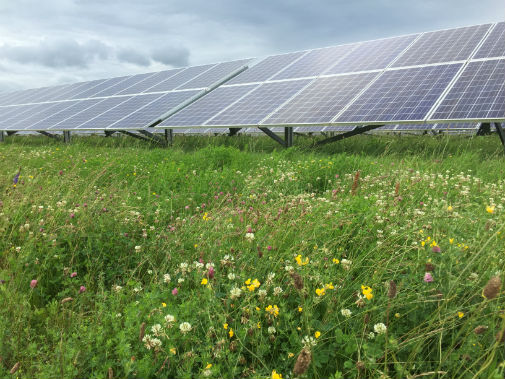
Because solar farms can be in place for 30-40 years and require minimal human disturbance to maintain, there is potential for a range of conservation initiatives to be implemented.
Schemes such as planting hedgerows and creating wildflower meadows, as well as wetland development, have far-reaching benefits including biodiversity and habitat provision, flood mitigation, carbon storage, soil erosion mitigation and pollination for food provision.
Professor Piran White, from the Department of Environment and Geography at the University of York, said: "In the light of ongoing declines of bees, butterflies and farmland birds across the UK, it is vital that we take every opportunity to encourage more environmentally-sensitive land management.
“By demonstrating how solar parks can be managed to enhance natural capital and ecosystem services, the SPIES tool shows that producing clean energy from solar parks can also deliver important co-benefits for nature conservation".
Rare species
The potential environmental benefits of solar farms highlighted by the report include:
- A boost for rare species including moths, foraging bats, yellowhammers and grey-legged partridges when developers cultivate tree-rich hedgerows.
- Increased fruit crop pollination for orchards close to wildflower meadows.
- Significantly higher plant and invertebrate diversity on sites with open drainage.
- Positive impacts on wetland bird breeding when artificial wetland features are introduced, as well as reduced nitrogen loads and enhanced pesticide filtration.
Dr Alona Armstrong of Lancaster University said: "Short of returning land to nature, land use change for solar parks arguably offers more potential than any other land use change to deliver much needed natural capital and ecosystem service benefits."
Tremendous benefits
The editor of the report, Nicholas Gall from the STA, said: "Wildlife and plant species face profound threats today which are compounded by climate change. The Solar Trade Association is determined to promote best practice in the development and management of solar parks so that our industry helps to turn around prospects for nature while slashing millions of tonnes of carbon emissions.
“This report shows that, when real care is taken, solar farms can deliver tremendous benefits for wildlife, pollinators and even sustainable food production."
The Solar Park Impacts on Ecosystem Services (SPIES) tool which is summarised in the report and freely available, draws on over 700 pieces of evidence from over 450 peer-reviewed scientific publications on management actions in support of ecosystem services and was co-developed with people involved in solar park development, operation and maintenance, nature conservation bodies, land owners, the farming community and ecological consultancies.
The Natural Capital Value of Solar report is launched at the House of Commons on Tuesday, 25 June. The report is endorsed by the Centre for Alternative Technology and Ashden.